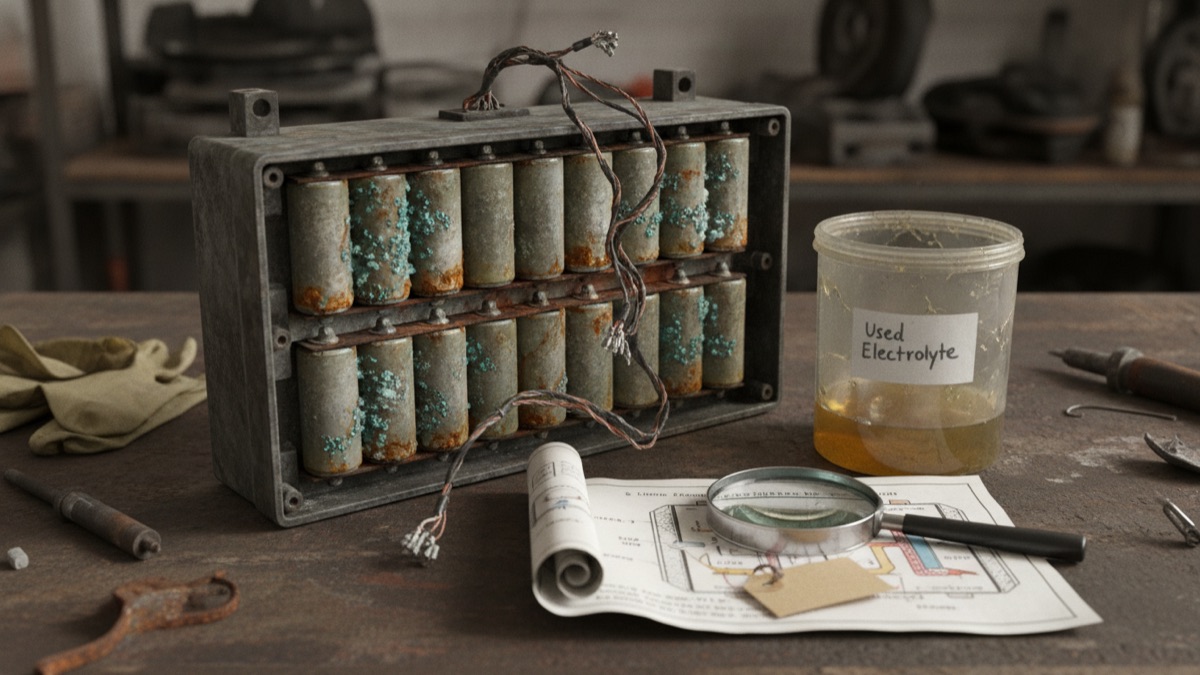
Every electric vehicle battery loses some capacity the moment it leaves the factory, a fact automakers rarely advertise but engineers have understood since long before EVs became mainstream. The battery that once delivered 400 kilometers of range on a full charge will, after enough years and enough charge cycles, deliver noticeably less, and the chemistry behind that decline is neither a manufacturing defect nor a mystery, but a well-studied set of chemical and thermal processes that behave predictably once you understand what is actually happening inside the cells.
What Is Actually Inside an EV Battery
Most modern electric vehicles use lithium-ion battery packs, composed of thousands of individual cells wired together, each cell storing energy through the movement of lithium ions between a positive electrode and a negative electrode through a liquid or gel electrolyte.
During charging, lithium ions move from the positive electrode to the negative electrode and embed themselves within its structure, and during discharge, as the car drives, those ions move back, releasing electrical energy that powers the motor along the way.
This ion movement is fundamentally a physical and chemical process, not a purely electrical one, and like most chemical processes, it produces small, mostly irreversible side effects every time it happens, which is the root cause of the capacity loss discussed throughout this article.
The Chemistry Behind Capacity Loss
The dominant mechanism behind long-term EV battery degradation is the growth of a layer called the solid electrolyte interphase, a microscopically thin film that forms on the negative electrode surface as a natural side effect of the electrolyte reacting with the electrode material.
This layer is actually necessary in a thin, stable form, since it protects the electrode from further unwanted reactions, but over many charge cycles it slowly thickens, consuming usable lithium ions in the process and permanently reducing the amount of charge the battery can store.
A second contributing mechanism, particularly at high states of charge or high temperature, is the gradual breakdown of the electrolyte itself and the loss of active material within the electrodes, both of which further reduce the battery's usable capacity independently of the interphase layer's growth.
Calendar Aging vs. Cycle Aging
Battery engineers distinguish between two overlapping degradation processes: calendar aging, which happens simply from the passage of time regardless of use, and cycle aging, which happens specifically from the repeated charging and discharging that comes with actually driving the car.
Calendar aging occurs because the chemical side reactions described above continue at a slow background rate even when a vehicle sits unused, meaning a battery left fully charged in a hot garage for months will still lose some capacity even without a single kilometer driven.
Cycle aging adds to this baseline loss through the physical stress of ion movement itself, meaning a vehicle driven frequently and charged often will generally experience somewhat faster overall degradation than an identical vehicle driven rarely, though the difference is smaller than most owners assume.
Why Heat Is the Single Biggest Enemy of Battery Life
Elevated temperature accelerates nearly every chemical side reaction responsible for long-term capacity loss, following a general chemical principle where reaction rates roughly double for every ten degrees Celsius of sustained temperature increase.
This is why EV owners in hot climates, including much of the Gulf region, generally see faster long-term degradation than owners in temperate climates, all else being equal, and it is a major reason automakers invest heavily in active thermal management systems for their battery packs.
Parking in direct sun for extended periods, frequent fast charging in high ambient heat, and leaving a battery at a high state of charge in hot weather all compound this heat-driven degradation, which is why manufacturer guidance for hot-climate markets often specifically recommends shaded parking and moderated charge levels.
How the Battery Management System Fights Degradation
Every modern EV includes a battery management system, a dedicated computer that continuously monitors the voltage, temperature, and charge level of every cell or group of cells in the pack, actively working to keep the battery operating within the safest and slowest-degrading conditions possible.
The battery management system actively regulates charging speed, particularly slowing down the final portion of a charge as the battery approaches full capacity, and it can restrict access to the very top and bottom of the battery's actual physical capacity, presenting the driver with a usable range that is intentionally narrower than the cell's true limits.
This buffering strategy, sometimes called capacity headroom, is a deliberate engineering tradeoff: sacrificing a small amount of immediately usable range in exchange for meaningfully slower long-term degradation, since operating a lithium-ion cell at its absolute extremes accelerates the chemical stress described earlier.
Why Fast Charging Accelerates Wear
DC fast charging pushes a much higher electrical current into the battery than typical home AC charging, and that higher current generates significantly more internal heat and places more physical stress on the electrode structure during each charging session.
Research from battery manufacturers and independent labs has generally found that occasional fast charging has a modest, often barely measurable effect on long-term degradation, but relying on fast charging as a vehicle's primary or exclusive charging method can meaningfully accelerate capacity loss compared to predominantly slower overnight AC charging.
This is part of why most manufacturers and EV charging guidance recommend using DC fast charging for road trips and occasional top-ups, while treating slower overnight AC charging at home as the default method for day-to-day use, precisely to minimize the cumulative thermal and electrochemical stress on the cells.
The Real Effect of Charging to 100% Every Time
Lithium-ion cells experience more chemical stress, and correspondingly faster side-reaction rates, when held at a very high state of charge for extended periods, which is a direct consequence of the electrode chemistry being in a more reactive state near full capacity.
This is precisely why most EV manufacturers, through their in-car software, recommend setting a daily charge limit around eighty percent for routine use, reserving a full charge to one hundred percent specifically for days when the vehicle's maximum range is actually needed, such as a long trip.
The effect of occasionally charging to 100% for a single trip is minor and reversible in practice, since the meaningful long-term degradation risk comes specifically from routinely leaving a battery sitting at a high state of charge for many hours or days at a time, not from a single full charge used promptly.
How Depth of Discharge Affects Long-Term Health
Depth of discharge refers to how much of a battery's capacity is used before recharging, and consistently discharging a battery very deeply, close to its lower functional limit, before recharging generally causes somewhat more cumulative stress than performing frequent, smaller partial charges.
This is part of why battery researchers and EV manufacturers generally recommend against habitually running a battery down close to zero percent before charging, favoring more frequent partial top-ups instead, a pattern of use that is also simply more convenient for most daily driving.
The effect of depth of discharge on long-term degradation is real but comparatively modest next to the effect of temperature and sustained high state of charge, meaning drivers should not feel unduly anxious about occasionally running a battery low when circumstances require it.
Why Extreme Cold Also Hurts Batteries, Differently
Cold temperatures do not accelerate the same long-term chemical degradation that heat does, but they do temporarily reduce a lithium-ion battery's usable capacity and power output, since the chemical reactions that release energy simply proceed more slowly at low temperatures.
Charging a lithium-ion battery in very cold conditions carries a distinct risk called lithium plating, where lithium ions, unable to embed into the electrode structure quickly enough in the cold, instead deposit as metallic lithium on the electrode surface, a process that is genuinely and permanently damaging to long-term capacity.
This is precisely why modern EV battery management systems actively warm the battery pack before allowing fast charging in cold weather, sometimes called battery preconditioning, a feature designed specifically to prevent this cold-charging damage rather than simply tolerating slower charging speeds.
What State of Health Actually Measures
State of health is the standard metric battery engineers and EV software use to express how much usable capacity a battery retains compared to when it was new, typically expressed as a percentage, where 100% represents the battery's original factory capacity.
A battery reporting 90% state of health after several years of use is not malfunctioning; it is behaving exactly as chemistry and engineering predict, simply storing and delivering roughly ten percent less energy per full charge than it did when new, which translates into a proportional reduction in real-world driving range.
Most EV manufacturers now expose a state of health estimate directly in the vehicle's software or a companion app, giving owners a concrete, trackable number rather than having to infer degradation indirectly from subjectively noticing shorter range over time.
How Battery Warranties Are Actually Structured
Nearly all EV manufacturers offer a dedicated battery warranty separate from the vehicle's general warranty, typically guaranteeing that the battery will retain at least a specified percentage of its original capacity, commonly around seventy percent, for a defined period, often eight years or a set kilometer threshold, whichever comes first.
If a battery's measured state of health falls below the warrantied threshold within that period, the manufacturer is generally obligated to repair or replace the battery pack, though the exact process, whether a full pack replacement or a partial module repair, varies meaningfully between manufacturers and regions.
Understanding the specific percentage and duration of a battery warranty is genuinely useful for prospective EV buyers, since it represents the manufacturer's own engineering-backed estimate of expected degradation, effectively a guarantee against the battery degrading faster than the normal, expected chemical process described throughout this article.
Real-World Degradation Data From Millions of EVs
Large-scale studies aggregating real-world data from hundreds of thousands of electric vehicles, rather than laboratory testing alone, have generally found that average annual capacity loss is smaller than early skeptics predicted, often in the range of one to two percent of original capacity per year for modern battery chemistries under typical use.
These same studies have consistently found that degradation is not linear; it tends to be somewhat faster in a battery's first year or two, then slows into a more gradual, steady decline for many subsequent years, a pattern broadly consistent with the underlying chemistry described earlier in this article.
Fleet and taxi vehicles, which accumulate far higher mileage and far more charge cycles than typical personal vehicles, have provided some of the most valuable real-world degradation data, generally showing that even after several hundred thousand kilometers, many EV batteries retain a majority of their original usable capacity.
Why Some Chemistries Degrade Slower Than Others
Not all lithium-ion batteries are chemically identical; lithium iron phosphate, increasingly common in newer and more affordable EVs, generally tolerates high states of charge and frequent full charging with less long-term stress than nickel-based chemistries like nickel manganese cobalt, which remains common in longer-range vehicles.
This chemical difference is part of why manufacturers using lithium iron phosphate batteries often actually recommend routinely charging to 100%, a notably different guideline from the eighty percent recommendation common for nickel-based chemistries, illustrating that optimal charging habits genuinely depend on which specific battery chemistry a vehicle uses.
The tradeoff is that lithium iron phosphate batteries typically store somewhat less energy per unit of weight and volume than nickel-based chemistries, meaning the slower-degrading chemistry generally comes with either a shorter range or a heavier, larger battery pack for equivalent range.
What Happens to a Battery After It Leaves a Car
A battery that has degraded to roughly seventy or eighty percent of its original capacity is no longer ideal for a vehicle, where drivers expect maximum range, but it retains substantial energy storage capability that remains genuinely useful in less demanding applications.
Many manufacturers and specialized companies now repurpose retired EV batteries for stationary energy storage, such as buffering solar power for homes or businesses or stabilizing electrical grids, applications where the slower charge and discharge rates and static installation location make the remaining degradation far less consequential.
After this second-life use phase, the valuable metals within the battery, including lithium, cobalt, and nickel, can be recovered through recycling processes, an increasingly mature industry that reduces the environmental footprint of battery production and addresses long-term concerns about raw material supply.
Common Misconceptions About EV Battery Degradation
A common misconception is that EV batteries fail suddenly and completely, similar to how a phone battery might seem to die abruptly; in reality, degradation is a gradual, predictable, and slow process, and total sudden failure is a rare fault condition rather than the normal aging pattern.
Another misconception assumes that all fast charging is significantly harmful; occasional fast charging, particularly on modern battery chemistries and well-engineered thermal management systems, has a genuinely modest long-term effect, and the real risk comes specifically from using it as a near-exclusive charging method.
A third misconception treats all EV batteries as chemically identical, assuming charging advice for one vehicle applies universally; in reality, optimal charging habits depend meaningfully on the specific battery chemistry, and manufacturer-specific guidance, rather than generic advice, is the most reliable source for any particular vehicle.
EV battery degradation is not a hidden flaw or a marketing gap between promise and reality; it is a well-understood, gradually occurring chemical process shaped by a small number of controllable factors, heat exposure, charging speed, state of charge habits, and depth of discharge, each behaving according to established electrochemical principles. Understanding these mechanisms explains why a battery's range shrinks slowly over years rather than failing suddenly, and it points directly toward the habits, moderate daily charge limits, shaded parking in hot climates, and reserving fast charging for road trips, that meaningfully extend a battery's useful life.
Sources
- U.S. Department of Energy — Research and data on lithium-ion battery chemistry and electric vehicle technology.
- National Renewable Energy Laboratory — Studies on real-world EV battery degradation and thermal management.
- International Energy Agency — Global data and analysis on electric vehicle adoption and battery technology trends.
- SAE International — Technical standards for electric vehicle battery systems and testing.
FAQ
How much range do EV batteries typically lose per year?
Most modern EV batteries lose roughly one to two percent of their original capacity per year on average, though the rate varies significantly based on climate, charging habits, and battery chemistry.
Does fast charging damage an EV battery faster than regular charging?
Yes, frequent DC fast charging generates more heat and stress inside battery cells than slower AC charging, and studies have found it can accelerate capacity loss somewhat over the vehicle's lifetime if used as the primary charging method.
Is it bad to charge an EV battery to 100% every time?
Regularly charging to 100% and leaving a battery at a high state of charge for extended periods accelerates chemical degradation, which is why most manufacturers recommend daily charging to around 80% and reserving 100% for long trips.
What does an EV battery warranty actually guarantee?
Most EV battery warranties guarantee the battery will retain a specified minimum percentage of its original capacity, commonly around 70%, for a set number of years or kilometers, replacing or repairing it if capacity falls below that threshold.
Does extreme heat affect EV battery degradation more than cold?
Yes, sustained high temperatures generally accelerate the chemical side reactions that cause long-term capacity loss more than cold does, which is why hot climates place extra importance on a vehicle's active thermal management system.
About the Author
We reference the U.S. Department of Energy, the National Renewable Energy Laboratory, the International Energy Agency, and SAE International to explain the background and current understanding of this topic.
Loved This Article?
Share it on WhatsApp → Share it on WhatsApp
Get more guides in your inbox — Subscribe to our newsletter for weekly surprising stories from Egypt, Saudi Arabia, Dubai, and beyond.