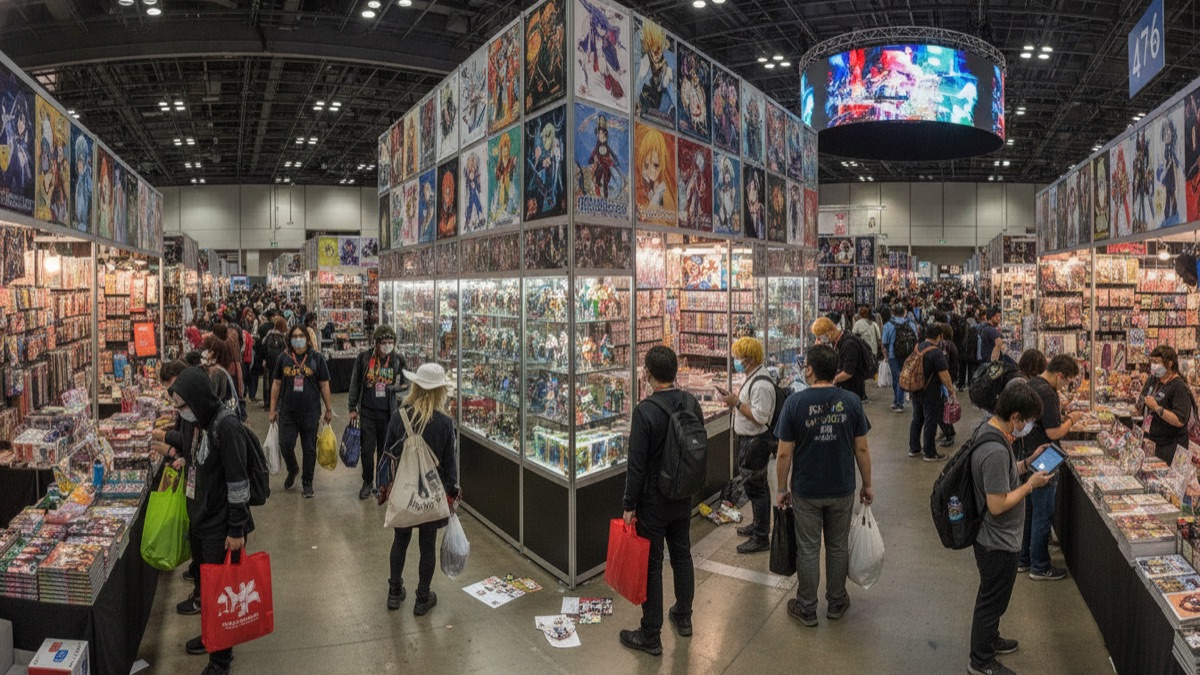
Anime went from a niche import hobby, traded on late-night television blocks and dubbed VHS tapes, into one of the most commercially significant entertainment categories in the world, and the shift happened largely within the space of a decade. Understanding how that happened requires looking past the shows themselves and into the distribution technology, licensing economics, and fan-driven convention culture that turned a subculture into an industry worth tens of billions of dollars annually, with a rapidly growing footprint across the Middle East and North Africa.
From Bootleg Tapes to a Legitimate Global Market
Anime fandom outside Japan spent decades as an underground pursuit, sustained by fan clubs that traded VHS tapes recorded off Japanese television, then translated and subtitled by volunteers working entirely outside any licensing agreement, long before streaming existed as a concept.
This underground distribution model was not really a business at all; it was a gift economy built on enthusiasm and technical patience, since acquiring a single episode could involve importing a broadcast recording, translating dialogue by ear, and physically duplicating tapes to mail to other fans across different countries.
The industry that exists today, with legal same-day streaming, official merchandise partnerships, and ticketed convention circuits spanning multiple continents, is a direct descendant of that fan infrastructure, and much of its current scale can be traced to how deliberately it absorbed and replaced the underground system rather than simply competing against it.
What Fansubbing Actually Was and Why Fans Relied on It
Fansubbing refers to the practice of fans acquiring raw, untranslated anime episodes, translating the dialogue, and adding subtitles before distributing the finished file, typically for free and typically without any authorization from the Japanese rights holder.
For much of the 1990s and 2000s, fansubbing was effectively the only way most international viewers could watch new anime close to its Japanese broadcast date, since official licensing and localized release schedules often lagged the original air date by months or years, if a title was licensed for a given market at all.
A loosely enforced norm developed within fansub communities: groups would typically stop distributing a title once it received an official license in a given territory, a self-regulating convention that reflected genuine fan investment in the industry's health even while operating entirely outside copyright law, though this norm was inconsistently honored and gradually eroded as the community grew larger and less centralized.
How Simulcasting Changed the Economics of Watching
Simulcasting, short for simultaneous broadcasting, means a show streams with officially licensed subtitles within hours of its original Japanese television broadcast, collapsing what was once a wait of months or years down to a same-day release window.
This single shift fundamentally undercut the core value proposition of fansubbing, since the primary reason fans historically turned to unauthorized fan translations was speed and availability, not price; once a legal option became faster and just as accessible as the illegal one, a meaningful share of the audience had no remaining practical reason to seek out unofficial sources.
Crunchyroll pioneered simulcasting at meaningful scale starting in the early 2010s, initially controversial among purist fans skeptical of a platform that had itself begun as an unlicensed video-sharing site before pivoting to legitimate licensing deals with Japanese studios and production committees.
Crunchyroll and the Rise of the Dedicated Anime Platform
Crunchyroll's transformation from a site hosting unlicensed fan uploads into the dominant legal anime streaming platform is one of the more unusual redemption arcs in modern media, and it illustrates how the anime industry chose absorption over pure legal confrontation with its fan-piracy ecosystem.
Rather than treating former pirate audiences purely as an enforcement problem, rights holders increasingly worked with platforms like Crunchyroll to offer that same audience a legal, similarly fast alternative, a strategy that proved considerably more effective at reducing piracy than takedown notices and legal threats alone had been.
Sony's acquisition of Crunchyroll and its subsequent merger with the competing platform Funimation consolidated a large share of English-language anime licensing under a single company, a level of market concentration that has drawn scrutiny from fans and some industry observers concerned about pricing power and reduced platform competition.
How Licensing Money Actually Flows Back to Japan
When a streaming platform pays to license an anime series for international distribution, that money generally does not flow to a single animation studio directly; instead, it flows to whichever entity holds the international distribution rights, most often a production committee rather than the studio that physically animated the show.
This distinction matters considerably for understanding why individual animation studios in Japan have historically captured a relatively small share of a hit show's total international earnings, since studios are frequently contracted as production-for-hire labor rather than equity stakeholders in the underlying intellectual property.
Licensing negotiations for international streaming rights, merchandise categories, and dubbing rights are typically handled separately and sold to different regional partners, which is part of why a single popular series can appear on different streaming platforms in different countries, or be entirely unavailable in some territories despite strong regional fan demand.
The Production Committee System Explained
A production committee, known in Japanese as seisaku iinkai, is a consortium of companies, often including a publisher, a toy or merchandise manufacturer, an advertising agency, and a television network, that jointly fund an anime's production in exchange for a share of the resulting revenue and rights.
This financing structure was originally developed specifically to spread financial risk across multiple companies with different, complementary commercial interests in a title's success, rather than requiring a single studio or network to bear the full production cost and full downside risk alone.
Because each committee member has different priorities, a toy manufacturer wants merchandise sales, a publisher wants manga sales, a network wants broadcast ratings, the resulting show is frequently designed from the outset with multiple monetization channels in mind rather than television broadcast being the primary intended revenue source.
Why Merchandise Often Outearns the Shows Themselves
It's a common misconception that a hit anime primarily makes its money from streaming licensing fees or advertising; in reality, merchandise, including figures, apparel, trading cards, and video game tie-ins, frequently generates substantially more total revenue than the broadcast or streaming rights themselves.
This pattern traces directly back to the production committee model, since the system was historically structured around treating the television or streaming broadcast partly as an advertisement for tie-in products, an arrangement quite different from how Western television or film financing traditionally worked before the streaming era.
Collectible figures in particular have become a substantial category on their own, with specialized manufacturers producing highly detailed, often expensive scale figures of popular characters, a market segment that has grown into a multi-billion-dollar business largely independent of how well a given show performs on streaming viewership metrics.
How a Single Series Becomes a Merchandising Ecosystem
A successful anime franchise today is typically designed to expand well beyond the original television series into manga, light novels, mobile games, trading card games, theatrical films, and branded collaborations with unrelated consumer product categories, each representing a distinct licensing revenue stream.
This kind of cross-media expansion is generally planned deliberately rather than emerging organically after a show becomes popular, since the underlying intellectual property is frequently developed with merchandising and multi-format expansion built into the original commercial plan from very early on.
Brand collaborations, where anime characters appear on unrelated products ranging from fashion apparel to fast food promotions to consumer electronics, have become an increasingly visible revenue channel, reflecting how mainstream anime intellectual property has become as a licensing asset well outside its original entertainment category.
The Convention Circuit as an Economic Engine
Anime conventions, ticketed multi-day events combining screenings, guest panels, vendor halls, and fan gatherings, have grown from small, volunteer-run fan meetups into major commercial events, some drawing well over one hundred thousand attendees and generating meaningful direct economic activity for their host cities.
Convention revenue comes from several distinct streams operating simultaneously: ticket sales, vendor hall booth rental fees paid by official merchandise companies, sponsorship deals, and increasingly, appearance fees paid to voice actors, illustrators, and other industry guests who draw attendees specifically to meet them.
For host cities and venues, large anime conventions represent significant hospitality and tourism revenue, comparable in scale to other major fan convention categories, which is part of why convention organizers increasingly compete to secure exclusive premiere screenings and high-profile guest appearances that draw larger attendance.
Cosplay's Evolution From Hobby to Profession
Cosplay, the practice of constructing and wearing costumes based on fictional characters, began as a niche convention activity but has developed into a genuinely professional field, with some cosplayers earning substantial income through sponsorships, commissioned costume work, and paid convention guest appearances.
Professional cosplayers frequently function similarly to influencers in other industries, building audiences on social media platforms around their costume craftsmanship and character portrayals, then monetizing that audience through brand partnerships, print sales, and tutorial content teaching costume-making techniques.
Convention organizers have increasingly recognized professional and highly skilled amateur cosplayers as a genuine draw for attendance in their own right, offering appearance fees, guest badges, and dedicated photo session slots in ways that mirror how conventions treat voice actors and other industry professionals.
Artist Alleys and the Fan-Made Economy
Artist alleys, dedicated convention sections where independent illustrators and craftspeople rent table space to sell original fan art, prints, stickers, and handmade merchandise directly to attendees, represent a distinct economic layer separate from official licensed vendor booths.
This fan-made economy exists in something of a legal gray area, since most artist alley merchandise technically uses copyrighted characters without formal licensing, an arrangement most rights holders have historically tolerated as long as sales remain small-scale and clearly fan-made rather than mass-produced counterfeit goods competing directly with official merchandise.
For many independent illustrators, artist alley sales have become a genuine, sustainable income source, and successful artist alley tables at major conventions can generate revenue comparable to, or exceeding, a full-time salary for the several days of a given convention weekend.
Anime's Growth Across Saudi Arabia, the UAE, and Egypt
Anime fandom across Saudi Arabia, the United Arab Emirates, and Egypt has expanded substantially over the past decade, moving from small, informal community meetups organized through online forums and social media groups into large, professionally organized convention events.
Saudi Arabia's broader entertainment sector expansion, including major event programming under initiatives like Riyadh Season, has created space for large-scale pop culture and gaming conventions that include significant anime and cosplay programming, drawing both regional attendees and international guests from the anime industry.
The UAE, particularly Dubai, has similarly hosted growing anime and comic conventions that combine anime-specific programming with broader pop culture content, reflecting the country's position as a regional hub that attracts fans and industry guests from across the Gulf, while Egypt's convention scene has grown from grassroots fan gatherings into larger organized events with a substantial, highly engaged local fanbase built up over many years of online fan community activity.
Arabic Dubbing and Subtitling as a Growth Engine
Official Arabic dubbing and subtitling availability has expanded considerably as global and regional streaming platforms have recognized MENA audiences as a commercially significant and rapidly growing market rather than a secondary afterthought to English-language releases.
Arabic-language anime dubbing actually has a longer regional history than many fans realize, with certain classic series dubbed for broadcast television decades ago becoming genuinely formative childhood viewing for a generation of Arab viewers, a cultural memory that has fed directly into the current wave of adult fandom and convention attendance.
Modern streaming-era Arabic localization, spanning both dubbing and subtitling, has generally expanded access far beyond what broadcast television previously offered, since streaming platforms can license and localize a much larger catalog of titles than any single broadcaster's programming schedule could accommodate, meaningfully lowering the language barrier that once limited the audience for newer titles.
Streaming Competition and Regional Licensing Complexity
The anime streaming market has grown more fragmented as multiple platforms, including Crunchyroll, Netflix, and regional players, compete for exclusive or semi-exclusive licensing rights to popular titles, a shift that has occasionally frustrated fans accustomed to a single dominant platform holding most available content.
Regional licensing agreements can vary considerably by territory, meaning a title's availability, dubbing options, and even release timing in Gulf and North African markets can differ meaningfully from availability in Europe or North America, a fragmentation that mirrors licensing complexity seen across other streaming media categories.
This fragmentation has created renewed piracy pressure in some markets, since fans facing incomplete regional catalogs or missing localization options sometimes revert to unauthorized sources, illustrating that convenience and completeness, not just legality, remain central to keeping audiences on official platforms.
What Piracy Still Costs the Industry Today
Despite the dramatic shift toward legal streaming, unauthorized distribution has not disappeared entirely, and industry trade groups continue to estimate meaningful annual revenue losses attributable to piracy sites, unauthorized aggregators, and unlicensed merchandise sales.
Piracy today looks structurally different from the fansub era, shifting toward large-scale aggregator sites that repost licensed streaming content without authorization or translation labor of their own, rather than the earlier model built around volunteer translation communities working from raw, unlicensed footage.
Industry responses have increasingly combined legal enforcement against major piracy sites with continued investment in making legal access faster, cheaper, and more complete across more regions, reflecting a broader recognition that competing on convenience has generally proven more durable than relying on enforcement alone.
Anime's transformation from a scattered, fan-sustained subculture into a global commercial industry did not happen through any single breakthrough, but through the layered combination of legal streaming closing the speed gap that piracy once filled, a merchandising and licensing system built to monetize far beyond the screen, and a convention culture that turned fandom itself into a recurring, ticketed economic event. The continued growth of dubbing, subtitling, and convention culture across Saudi Arabia, the UAE, and Egypt shows this is not a static, already-finished story, but one still actively expanding into new regional markets with genuinely engaged, fast-growing fan communities.
Sources
- Association of Japanese Animations — Annual industry market data on anime production and international revenue.
- Crunchyroll — Platform information on simulcasting and licensed anime distribution.
- Variety — Trade coverage of anime streaming licensing deals and industry consolidation.
- Anime News Network — Long-running trade publication covering anime industry business and convention news.
- Motion Picture Association — Research on media piracy trends and enforcement efforts.
FAQ
What is simulcasting and why did it matter for anime piracy?
Simulcasting means a show streams with official subtitles within hours of its Japanese broadcast, which removed the multi-week wait that fansub piracy previously filled, making legal streaming faster and more convenient than illegal downloads.
Does Crunchyroll pay Japanese anime studios directly?
Streaming platforms license anime through agreements with Japanese production committees, which pool investment from multiple companies, so subscription and advertising revenue flows back through those committees rather than to a single studio.
Why is merchandise more profitable than the anime shows themselves?
Japan's production committee system was originally built to fund shows as advertising for merchandise, games, and other licensed goods, so figures, apparel, and collectibles frequently generate more total revenue than streaming or broadcast rights.
Is anime fandom growing in Saudi Arabia, the UAE, and Egypt?
Yes, anime conventions and community meetups have expanded significantly across the Gulf and Egypt over the past decade, supported by growing official Arabic dubbing and subtitling availability on regional and global streaming platforms.
What is an artist alley at an anime convention?
An artist alley is a dedicated section of a convention where independent illustrators and craftspeople rent table space to sell original fan art, prints, and handmade merchandise directly to attendees, separate from official licensed vendor booths.
About the Author
We reference the Association of Japanese Animations, Crunchyroll, Variety, Anime News Network, and the Motion Picture Association to explain the background and current understanding of this topic.
Loved This Article?
Share it on WhatsApp → Share it on WhatsApp
Get more guides in your inbox — Subscribe to our newsletter for weekly surprising stories from Egypt, Saudi Arabia, Dubai, and beyond.