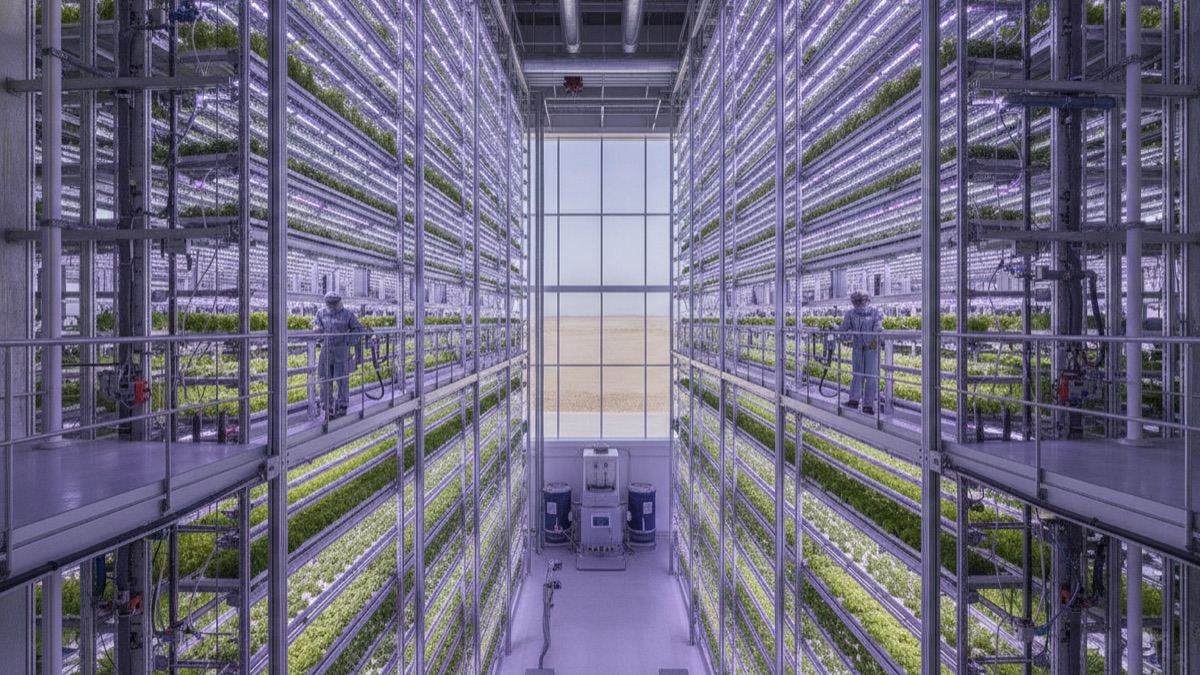
Dubai sits in one of the most water-scarce, least arable environments on the planet, yet inside a handful of sealed, climate-controlled buildings around the city, rows of leafy greens are growing stacked ten and twelve layers high, harvested every single day of the year regardless of the desert heat outside. This is not a marketing gimmick or a boutique experiment; it is a genuine, commercial-scale response to a hard geographic constraint, since the UAE imports the overwhelming majority of what it eats and has almost no naturally arable land or fresh water to rely on for traditional field agriculture. Understanding how these vertical farms actually work, from the root systems up to the economics that make or break them, explains both why Dubai bet heavily on this technology and where its real limits still lie.
Why Dubai Needed a Different Way to Grow Food
The UAE's natural growing conditions are about as unfavorable as commercial agriculture gets: annual rainfall across most of the country measures in the low single digits of inches, daytime summer temperatures regularly exceed 45 degrees Celsius, and the sandy desert soil that does exist lacks the organic structure and water retention that open-field crops generally need.
Because of these constraints, the UAE has historically imported somewhere in the range of 80 to 90 percent of its food, a dependence that became strikingly visible during global supply chain disruptions, when shipping delays and export restrictions in other countries directly affected what was available on Emirati supermarket shelves.
Vertical, climate-controlled farming emerged as one of the few technically credible ways to grow meaningful volumes of fresh produce inside the country itself, since it sidesteps the desert's heat, poor soil, and water scarcity entirely by growing plants in a fully enclosed, engineered environment rather than in open desert conditions.
Hydroponics: Growing Plants Without Soil
Hydroponic systems, used widely across Dubai's commercial vertical farms, grow plants with their roots suspended directly in a water-based solution that has been precisely enriched with the nitrogen, potassium, phosphorus, and micronutrients plants would otherwise draw from soil.
Because the nutrient solution is delivered directly to the root zone in exactly the concentration each crop needs, hydroponic systems generally allow for faster growth cycles than soil-based farming, since plants expend less energy searching for nutrients and instead put that energy into leaf and stem growth.
Water in a hydroponic system is continuously recirculated through a closed-loop system rather than being applied once and lost to gravity and evaporation, which is the single biggest reason hydroponic and related soil-free methods use dramatically less water than open-field agriculture growing the same crop.
Aeroponics: Misting Roots Instead of Submerging Them
Aeroponics takes the soil-free principle a step further: rather than suspending roots in a standing nutrient solution, plants are held in place with their root systems hanging in open air, which is then misted at frequent intervals with a fine nutrient-rich spray.
Because roots in an aeroponic system are directly exposed to oxygen between misting cycles rather than sitting continuously in liquid, many growers report even faster growth rates and higher nutrient uptake efficiency compared to standard hydroponics, though aeroponic systems are mechanically more complex and demand more precise control over misting timing and droplet size.
Aeroponic systems also tend to use even less water than hydroponics, since only a fine mist rather than a standing reservoir of nutrient solution is required at any given moment, making it an increasingly attractive choice for operators specifically optimizing for water efficiency in a desert climate.
Inside Bustanica, One of the World's Largest Indoor Farms
Bustanica, a large-scale vertical farming facility operated as a joint venture between Emirates Flight Catering and California-based agricultural technology company Crop One, opened in Dubai as one of the largest indoor vertical farms in the world by growing area under a single roof.
The facility uses hydroponic growing towers stacked across multiple levels inside a fully sealed building, producing thousands of kilograms of leafy greens daily, much of which is supplied directly to Emirates' in-flight catering operation as well as UAE retail grocery chains.
Bustanica's scale matters because it demonstrates that vertical farming in the Gulf has moved past small pilot projects into genuine industrial-scale food production, with a supply chain, retail distribution relationships, and daily output volumes that function as a real, if still niche, part of the UAE's fresh produce market.
How Vertical Stacking Multiplies Usable Growing Area
The core efficiency argument behind vertical farming is straightforward: stacking growing trays ten, twelve, or more layers high inside a single building multiplies the usable growing area achievable within a given physical footprint many times over compared to a single-layer greenhouse or open field covering the same ground area.
This means a vertical farm can produce a volume of leafy greens comparable to many hectares of conventional open-field farmland while occupying a building footprint measured in a small number of city blocks, a meaningful advantage in a dense urban environment like Dubai where large tracts of arable land simply do not exist.
The tradeoff is that this vertical density requires artificial lighting and precisely engineered climate control for every single layer, since only the top layer of any stacked system could realistically receive natural sunlight, making the entire growing system dependent on engineered inputs rather than free ambient conditions.
Climate Control: Replacing Weather With Software
Inside a sealed vertical farm, temperature, humidity, and carbon dioxide concentration are continuously monitored and adjusted by automated systems, effectively replacing the role that outdoor weather and atmosphere would normally play for a field crop.
This level of control allows operators to maintain the specific temperature and humidity range each crop grows best in year-round, regardless of whether it is 20 degrees Celsius or 48 degrees Celsius outside the building, which is precisely the variable that makes traditional outdoor farming in the UAE so difficult for most of the year.
Carbon dioxide levels inside the growing environment are often deliberately elevated above normal outdoor atmospheric concentration, since many common crops photosynthesize measurably faster under moderately enriched CO2 conditions, another lever available to indoor growers that is simply not accessible to open-field farmers.
The LED Lighting That Replaces the Sun
Because sunlight cannot reach every stacked growing layer inside a sealed vertical farm, LED lighting systems tuned to the specific wavelengths plants use most efficiently for photosynthesis, typically concentrated in red and blue light bands, provide the light energy each layer needs.
Modern horticultural LED systems are considerably more energy-efficient than older lighting technology and can be precisely dimmed, timed, and color-tuned to each crop's specific growth stage, giving growers a level of control over the light input that natural sunlight simply cannot offer.
Even with efficiency gains, LED lighting remains one of the largest ongoing operating costs for a vertical farm, since unlike a conventional greenhouse that uses free sunlight for most of its light needs, an indoor vertical farm must generate essentially all of its light input from purchased electricity around the clock.
Why Water Use Drops So Dramatically
Operators of large UAE vertical farms commonly report water use reductions in the range of 90 to 95 percent compared to open-field cultivation of the same crops, a figure driven primarily by the closed-loop recirculation systems used in both hydroponic and aeroponic growing methods.
In open-field desert agriculture, a substantial share of applied irrigation water is lost to evaporation in the intense heat, runoff, and absorption into sandy soil that does not hold moisture near plant roots effectively, none of which occurs inside a sealed, climate-controlled vertical farm.
This water efficiency is arguably the single most important reason vertical farming has attracted serious government and private investment in the UAE specifically, since fresh water is a genuinely scarce and expensive resource in the Gulf, produced substantially through energy-intensive desalination rather than natural rainfall or river systems.
What Crops Actually Make Financial Sense to Grow This Way
Commercial vertical farms in the UAE focus overwhelmingly on leafy greens, culinary herbs, and salad crops such as lettuce, arugula, spinach, and basil, which share fast growth cycles, relatively low biomass per plant, and high retail value per kilogram compared to staple grains.
Staple crops like wheat, rice, and corn remain economically impractical to grow in vertical farms at any meaningful scale, since their low per-kilogram retail price cannot realistically cover the energy-intensive lighting and climate control costs that leafy greens' higher price point can absorb.
This crop selection pattern is consistent across nearly every commercial vertical farming operation globally, not unique to Dubai, reflecting a genuine economic constraint of the technology rather than a deliberate strategic choice specific to the UAE market.
The Energy Cost Nobody Likes to Mention
Vertical farming's water savings come with a real tradeoff: replacing free sunlight and natural climate with LED lighting and mechanical climate control requires a continuous, substantial electricity input that a conventional open-field farm or even a standard greenhouse simply does not need.
Industry analysts and agricultural economists have noted that vertical farming's total resource footprint should be evaluated honestly across both water and energy use, since a technology that dramatically reduces water consumption while significantly increasing electricity demand is not an unambiguous environmental win in every context, particularly where that electricity comes from fossil fuel generation.
The UAE's growing investment in solar power generation, discussed elsewhere on this site, is relevant here specifically because it offers a pathway to make vertical farming's electricity-heavy footprint considerably less carbon-intensive over time, an argument UAE officials and vertical farming operators have both made publicly.
How Vertical Farming Fits the UAE's Food Security Strategy
The UAE's National Food Security Strategy, launched with an explicit goal of improving the country's global food security ranking, identifies domestic high-tech agriculture, including vertical and controlled-environment farming, as one of several pillars intended to reduce the country's heavy reliance on food imports.
Government-linked entities and sovereign investment vehicles have directly backed vertical farming ventures in the UAE, reflecting a policy view that food security is a genuine strategic priority rather than purely a private commercial opportunity, particularly following the supply chain volatility experienced during recent global disruptions.
Vertical farming alone cannot realistically close the UAE's broader food import gap, since it currently addresses only a narrow slice of the overall food basket, mainly leafy greens and herbs, but it functions as a meaningful, growing contributor within a wider diversification strategy that also includes greenhouse agriculture, aquaculture, and continued international trade partnerships.
Comparing Vertical Farming to Traditional Desert Agriculture
Traditional open-field farming in the UAE, where it exists at all, has historically relied heavily on groundwater extraction, drawing from fossil aquifers that recharge extremely slowly if at all in the region's arid climate, a practice widely recognized as unsustainable over the long term.
Vertical farming avoids this groundwater depletion problem entirely, since its water needs are dramatically lower and typically sourced from desalinated municipal water supplies rather than direct aquifer extraction, removing one of traditional desert agriculture's most serious long-term sustainability concerns.
That said, traditional greenhouse agriculture, which uses natural sunlight but still benefits from some climate moderation, remains more energy-efficient than fully enclosed vertical farms for certain crops, meaning vertical farming is best understood as one tool within a broader toolkit rather than a wholesale replacement for every form of controlled agriculture in the region.
Who Actually Buys the Produce
UAE vertical farm output is sold through a mix of channels, including direct supply agreements with major supermarket chains, hotel and restaurant procurement, and, in Bustanica's specific case, a direct supply relationship with an airline catering operation serving international flights.
Marketing for vertical farm produce in the UAE frequently emphasizes freshness and a dramatically shortened supply chain, since greens can move from harvest to shelf within hours rather than the days or weeks typical of imported produce shipped by sea or air from other countries.
Consumer price points for vertically farmed produce in UAE retail have generally sat at or above imported organic produce pricing, reflecting the technology's current cost structure, though prices have shown a gradual downward trend as facilities scale and operational efficiency improves.
The Limits: What Vertical Farming Cannot Yet Do
Vertical farming technology, as currently deployed commercially in the UAE and globally, remains fundamentally limited to a narrow range of crop types, meaning it cannot realistically replace imports of grains, most fruits, and many vegetables that require either far more growing space per calorie or pollination and growing conditions vertical systems don't yet replicate economically.
The capital cost of building a large-scale vertical farming facility, including specialized racking, LED systems, climate control infrastructure, and automation, is substantially higher per unit of growing area than a conventional greenhouse, creating a real barrier to rapid, large-scale expansion of the model.
Profitability across the vertical farming industry globally, not just in the UAE, has proven genuinely difficult to achieve consistently, with several prominent vertical farming ventures in other countries having scaled back operations or shut down entirely, a sobering reminder that the technology's promise has not yet fully translated into reliable commercial economics everywhere it has been tried.
Where Vertical Farming in the UAE Goes Next
Continued investment in UAE solar capacity, alongside ongoing efficiency improvements in LED horticultural lighting, is likely to gradually improve vertical farming's energy economics over the coming years, potentially expanding the range of crops that make commercial sense to grow this way.
Government-backed agricultural technology research initiatives in the UAE continue to explore whether vertical farming techniques can be adapted to a wider crop range, including certain fruiting vegetables, though staple grains remain outside what most industry experts consider realistically achievable at scale in the near term.
The most likely trajectory is incremental rather than transformative: vertical farming will probably keep growing its share of the UAE's leafy green and herb supply steadily, while remaining one meaningful piece within a broader food security strategy rather than becoming the primary source of the country's food.
Vertical farming in Dubai is best understood as a genuinely engineered solution to a genuinely hard geographic problem, not a novelty. By replacing soil, sunlight, and open-air climate with precisely controlled nutrient delivery, LED lighting, and closed-loop water systems, facilities like Bustanica can grow meaningful volumes of fresh produce inside a city that has almost no natural capacity for traditional agriculture. The tradeoff is a heavy, ongoing electricity demand and a crop range still limited mostly to leafy greens and herbs, meaning vertical farming remains one important tool within the UAE's food security strategy rather than a complete answer to feeding a desert nation.
Sources
- UAE Ministry of Climate Change and Environment — National Food Security Strategy and domestic agriculture policy.
- Emirates Group — Official information on the Bustanica vertical farming joint venture.
- Food and Agriculture Organization of the United Nations — Global data and analysis on controlled-environment and vertical agriculture.
- The Official Portal of the UAE Government — Government policy on food security and agricultural technology investment.
FAQ
How much water do Dubai's vertical farms actually save compared to traditional farming?
Operators of Dubai's largest vertical farms report using roughly 95 percent less water than open-field farming of the same crops, mainly because water is recirculated in a closed loop rather than lost to evaporation, runoff, and desert soil absorption.
Do vertical farms in Dubai use soil at all?
No. Dubai's major vertical farms use soil-free hydroponic or aeroponic systems, where plant roots are suspended in a nutrient-rich water solution or misted directly with a nutrient solution rather than grown in soil.
What crops are actually grown in Dubai's vertical farms today?
Current commercial-scale vertical farms in the UAE focus overwhelmingly on leafy greens, herbs, and salad crops like lettuce, arugula, and basil, which grow quickly and have a favorable yield-to-energy-cost ratio compared to staple grains.
Is vertical farming actually cheaper than importing food into the UAE?
Not yet on a pure cost-per-kilogram basis for most crops, since energy for lighting and climate control is expensive, but the model is increasingly competitive for premium, fast-perishing produce where freshness and reduced import logistics add real value.
Why is vertical farming considered part of UAE food security strategy?
The UAE imports the large majority of its food, and vertical farms reduce dependence on volatile international supply chains for at least some fresh produce categories, aligning with the National Food Security Strategy's stated diversification goals.
About the Author
We reference the UAE Ministry of Climate Change and Environment, the Emirates Group, the Food and Agriculture Organization of the United Nations, and the official UAE government portal to explain the background and current understanding of this topic.
Loved This Article?
Share it on WhatsApp → Share it on WhatsApp
Get more guides in your inbox — Subscribe to our newsletter for weekly surprising stories from Egypt, Saudi Arabia, Dubai, and beyond.