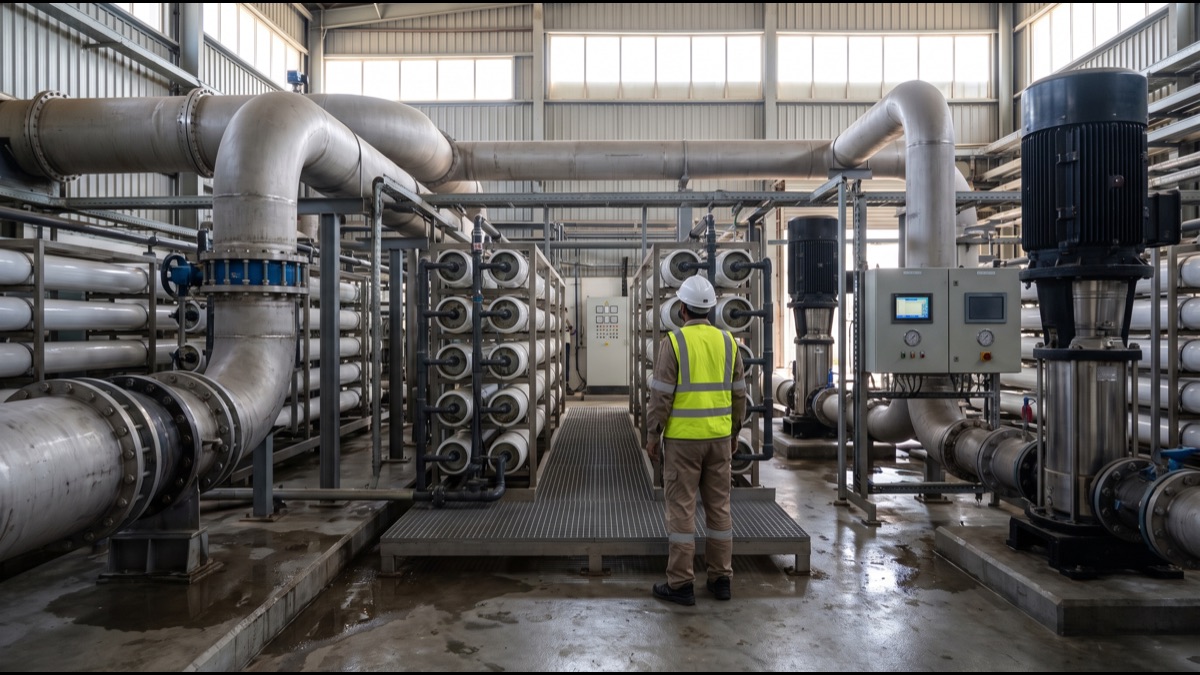
Turn on a tap almost anywhere in Dubai and the water that comes out began, only hours or days earlier, as seawater from the Arabian Gulf. Dubai has essentially no rivers, no significant natural lakes, and a groundwater supply far too limited and saline to support a modern city of more than three million residents plus tens of millions of annual visitors. Nearly the entire municipal water supply is instead manufactured, stripped of salt through industrial desalination plants running around the clock along the coastline. Understanding how that system actually works, and what it costs in energy and infrastructure to keep it running, explains one of the more remarkable and least visible engineering feats behind daily life in the city.
A City That Makes Its Own Rain
Dubai's water utility, the Dubai Electricity and Water Authority, commonly known as DEWA, effectively functions as an artificial water cycle for the entire emirate, drawing in seawater, removing the salt and impurities at industrial scale, and distributing the resulting freshwater through the same pipe network any conventional city relies on.
Unlike cities that draw from rivers, reservoirs, or aquifers and can therefore experience supply shocks from drought, Dubai's water supply is functionally decoupled from rainfall entirely, since the Arabian Gulf provides a functionally unlimited feedstock; the constraint is not the availability of seawater but the energy, infrastructure, and cost required to convert it into drinkable water at the scale a growing city demands.
Why Dubai Has Almost No Natural Freshwater
The United Arab Emirates sits within one of the most water-scarce regions on Earth, receiving on average only a small amount of rainfall annually, concentrated in a handful of days, with the rest of the year characterized by intense heat and evaporation rates that would rapidly deplete any surface water that did accumulate.
Groundwater does exist beneath the emirate, but much of it is either too saline for direct use without treatment or has been drawn down over decades faster than natural recharge can replace it, a pattern common across the wider Gulf region and one that made desalination not simply a convenient option but effectively the only viable path to reliably supplying a large modern population.
Multi-Stage Flash Distillation: The Original Technology
For decades, the dominant desalination technology across the Gulf, including in Dubai, was multi-stage flash distillation, a thermal process that mimics, at industrial scale and speed, the natural process of evaporation and condensation that separates salt from water.
Multi-stage flash plants were particularly well suited to the Gulf specifically because they could be built alongside power plants and use the substantial waste heat those plants generate, turning what would otherwise be an energy cost into a partially recycled input, a pairing that shaped how Dubai's earliest large-scale desalination infrastructure was designed and sited.
How Multi-Stage Flash Actually Works
The process works by heating seawater under pressure and then passing it through a series of chambers, each held at successively lower pressure, causing a portion of the water to instantly vaporize, or flash, into steam at each stage, which is then condensed back into pure, salt-free water using cooler incoming seawater running through condenser tubes.
Because each stage recovers a portion of the heat used in the previous one, a well-designed multi-stage flash plant can pass seawater through dozens of stages, extracting freshwater at each step while making the overall thermal process considerably more energy efficient than a single simple boil-and-condense cycle would be.
The remaining concentrated seawater, now significantly saltier than what entered the system, known as brine, exits the process and must be managed separately, a byproduct that becomes an important environmental consideration addressed later in this article.
The Shift Toward Reverse Osmosis
Over the past two decades, Dubai and much of the wider desalination industry have shifted a growing share of new capacity toward reverse osmosis, a membrane-based technology that separates salt from water using pressure rather than heat, generally consuming meaningfully less energy per unit of water produced than older thermal methods.
This shift reflects significant improvements in membrane technology, energy recovery devices, and pretreatment processes over the past twenty years, which have collectively narrowed reverse osmosis's historical weaknesses, such as membrane fouling from marine organisms and sediment in warm Gulf seawater, making it increasingly competitive even in the challenging water conditions of the Arabian Gulf.
How Reverse Osmosis Differs
Reverse osmosis works by forcing seawater under high pressure through a semi-permeable membrane with pores small enough to block salt ions and other dissolved impurities while allowing water molecules to pass through, essentially reversing the natural osmotic flow that would otherwise pull fresh water toward saltwater.
Because the process relies on mechanical pressure rather than heat and phase change, reverse osmosis plants generally have a smaller physical footprint relative to their output than thermal plants of comparable capacity, and modern reverse osmosis facilities incorporate energy recovery devices that capture pressure energy from the outgoing concentrated brine stream and reuse it to pressurize incoming seawater, substantially reducing net energy consumption.
Gulf seawater's relatively high salinity and warm temperature compared to open ocean water historically made reverse osmosis technically more difficult to apply reliably in this specific region than in cooler, less saline waters elsewhere, which is part of why thermal desalination dominated the region for so long before membrane technology matured enough to compete effectively.
Cogeneration: Pairing Desalination With Power Plants
Much of Dubai's desalination capacity has historically been built as cogeneration facilities, combined plants that simultaneously generate electricity and produce desalinated water, a design that allows the waste heat from power generation to directly supply the thermal energy multi-stage flash distillation requires.
This integrated design creates genuine efficiency gains compared to running separate, unconnected power and water plants, but it also creates a structural link between electricity demand and water production capacity, meaning water supply planning in Dubai has historically had to account for how electricity demand patterns, which peak sharply during the hottest summer months due to air conditioning load, interact with water production needs.
The Jebel Ali Complex
The Jebel Ali power and desalination complex is among the largest facilities of its kind in the world, combining substantial electricity generation capacity with a very large share of Dubai's total desalinated water output, and it has been expanded and upgraded repeatedly since its earliest phases to keep pace with the emirate's growth.
DEWA has progressively added reverse osmosis capacity alongside the site's original thermal units, reflecting the broader industry shift described earlier, and the complex now represents a hybrid model combining both major desalination technologies within a single integrated site rather than relying on one technology exclusively.
Energy Cost and the Carbon Question
Desalination is inherently energy-intensive regardless of which technology is used, since separating salt from water, whether through heat or pressure, requires meaningfully more energy input than simply treating and distributing naturally occurring freshwater, which is one reason desalinated water has historically carried a materially higher production cost.
Because a large share of the region's electricity generation has historically relied on natural gas, desalination's energy intensity has translated directly into a notable carbon footprint, a tension that has become increasingly prominent as the UAE has publicly committed to broader decarbonization targets alongside continued population and tourism growth that keeps pushing water demand upward.
Brine Discharge and Environmental Concerns
Every desalination process produces a concentrated brine byproduct that must be returned to the sea, and researchers studying Gulf marine ecosystems have raised concerns about the cumulative effect of brine discharge on local salinity levels and marine life, particularly given how many desalination plants operate along the relatively enclosed and shallow waters of the Gulf compared to open ocean coastlines.
Engineers have developed various brine management approaches, including diffusers designed to disperse the concentrated discharge more widely and rapidly dilute it, and some newer projects have explored using brine as a feedstock for extracting valuable minerals, though large-scale mineral recovery from brine remains more experimental than commercially standard across the industry today.
Solar Power and DEWA's Shift in Strategy
DEWA has publicly stated an intention to shift a growing share of Dubai's desalination capacity toward reverse osmosis powered increasingly by solar and other clean energy sources, part of a broader strategy to reduce the historical link between water production and fossil-fuel-based electricity generation described earlier.
The Mohammed bin Rashid Al Maktoum Solar Park, one of the largest single-site solar installations in the world, forms a central piece of this broader energy strategy, and DEWA has indicated plans to pair an increasing share of future desalination capacity with renewable generation as both solar capacity and battery storage technology continue to mature and scale within the emirate.
Storage: The Strategic Water Reserve
Because desalinated water is produced continuously rather than stored naturally the way a river or aquifer accumulates water over time, Dubai and the wider UAE have invested in engineered storage systems specifically designed to provide a buffer against any disruption to desalination output, whether from plant maintenance, unexpected outages, or extreme events.
The UAE has developed strategic groundwater storage capacity by injecting treated desalinated water into underground aquifers during periods of surplus production, effectively using natural geological formations as a large-scale reserve that can be drawn down during emergencies, a strategy explicitly designed to provide weeks of backup supply rather than relying purely on continuous real-time desalination output.
Desalination Across the Gulf Region
Dubai's reliance on desalination is not unique; the wider Gulf region collectively accounts for a very large share of global desalination capacity, with Saudi Arabia in particular operating some of the largest desalination programs in the world alongside the UAE, Qatar, Kuwait, and Bahrain, all of which face broadly similar natural water scarcity constraints.
This regional concentration has made the Gulf a global center for desalination engineering expertise and innovation, with technologies and efficiency improvements developed and tested in Gulf facilities frequently informing desalination projects elsewhere in the world facing similar water scarcity or salinity challenges.
Water Security and Long-Term Planning
Water security planning in Dubai extends well beyond simply building enough desalination capacity to meet current demand, incorporating demand-management measures such as tiered water pricing intended to discourage excessive consumption, public awareness campaigns, and building codes that increasingly require water-efficient fixtures in new construction.
Government planning documents and utility strategy statements generally frame desalination capacity, storage reserves, and demand management as three complementary pillars of water security rather than treating desalination capacity alone as a sufficient solution, reflecting an awareness that a system entirely dependent on continuous industrial production carries inherent vulnerabilities that pure supply expansion cannot fully address.
Tourism, Population Growth, and Capacity Planning
Dubai's water demand planning has to account for a population and visitor base that has grown rapidly for decades, with the emirate regularly welcoming tens of millions of overnight hotel stays annually on top of its resident population, a combination that pushes peak water demand meaningfully higher than resident numbers alone would suggest.
Utility planners generally build desalination and storage capacity with a margin well above current average demand specifically to absorb these seasonal and event-driven spikes, such as major conferences, sporting events, and the winter tourist season, rather than sizing the system to match only typical daily consumption, a buffer that has repeatedly proven necessary as the city's tourism sector has continued expanding faster than many earlier infrastructure forecasts anticipated.
This forward-leaning capacity planning mirrors the same build-ahead-of-demand philosophy visible in Dubai's transport and power infrastructure more broadly, reflecting a consistent government approach to major utilities: treating anticipated future growth as a planning input from the outset rather than waiting for demand to visibly strain existing capacity before expanding it.
What Comes Next for Dubai's Water Supply
The clearest trend shaping Dubai's water future is the continued shift from thermal desalination toward reverse osmosis paired with renewable energy, a combination that engineers and utility planners generally expect will substantially lower both the cost and the carbon intensity of Dubai's water supply over the coming years compared to the historical gas-powered thermal model.
Even as that technology transition continues, the fundamental engineering reality is unlikely to change: Dubai will remain a city that manufactures nearly all of its own drinking water from the sea rather than relying on rainfall or rivers, meaning the desalination infrastructure examined here, its technology, its energy sourcing, and its storage reserves, will remain one of the most consequential and least visible systems underpinning daily life in the emirate.
Engineers and regional water researchers also generally point out that the lessons learned from decades of large-scale Gulf desalination, including cost reductions in reverse osmosis membranes, improved brine management techniques, and growing experience pairing desalination directly with solar generation, are increasingly being exported to other water-scarce regions around the world facing similar constraints, meaning Dubai's own water infrastructure has become something of a proving ground for solutions well beyond the emirate's own borders.
For residents and visitors alike, the practical result of all this engineering complexity is a tap that simply works, delivering water that meets recognized international drinking water quality standards on demand, a level of reliability that obscures just how much continuous industrial effort, energy input, and forward planning is required to keep a desert city of this size supplied with fresh water every single day.
Sources
- Dubai Electricity and Water Authority (DEWA) — Government utility responsible for Dubai's water and electricity production and distribution.
- International Desalination Association — Global industry body publishing research and data on desalination technology and capacity.
- International Renewable Energy Agency (IRENA) — Research on renewable-powered desalination and regional clean energy transitions.
- World Bank — Research on global water scarcity, desalination economics, and water security planning.
FAQ
Where does Dubai actually get its drinking water?
Nearly all of Dubai's municipal water supply comes from desalinating seawater drawn from the Arabian Gulf, since the emirate has essentially no rivers, significant lakes, or sufficient natural groundwater to supply its population.
What is the difference between multi-stage flash distillation and reverse osmosis?
Multi-stage flash distillation uses heat to evaporate and then condense seawater into freshwater, while reverse osmosis uses high pressure to force seawater through a membrane that blocks salt, generally consuming less energy per unit of water produced.
Why were Dubai's desalination plants historically built alongside power stations?
Cogeneration plants allow waste heat from electricity generation to directly supply the thermal energy needed for multi-stage flash distillation, creating efficiency gains compared to running separate, unconnected power and desalination facilities.
Is desalinated water bad for the environment?
Desalination produces a concentrated brine byproduct that must be managed carefully to avoid raising local seawater salinity, and it is energy-intensive, though the shift toward reverse osmosis and renewable-powered facilities is reducing its environmental footprint over time.
What happens if a desalination plant goes offline?
The UAE maintains strategic underground water storage reserves, created by injecting treated desalinated water into aquifers during surplus periods, specifically to provide weeks of backup supply in the event of plant outages or disruptions.
About the Author
We reference the Dubai Electricity and Water Authority, the International Desalination Association, IRENA, and peer-reviewed water engineering research to explain the background and current understanding of this topic.
Loved This Article?
Share it on WhatsApp → Share it on WhatsApp
Get more guides in your inbox — Subscribe to our newsletter for weekly surprising stories from Egypt, Saudi Arabia, Dubai, and beyond.