Video Assistant Referee technology has been part of top-level football for less than a decade, yet it has already changed how goals are celebrated, how fouls are argued, and how fans experience the seconds after a big moment on the pitch. A goal is no longer final the instant the ball crosses the line — it is provisionally true until a video official somewhere off the pitch has had a chance to check it. Understanding how VAR actually works, what it can and cannot review, and why it still produces controversy even when it functions exactly as designed, explains a lot about the tension between technological precision and the emotional, fast-moving nature of the sport it was built to serve.
What VAR Actually Is and What Problem It Solves
VAR stands for Video Assistant Referee, and at its core it is a support system, not a replacement for the on-field referee. The referee remains the sole decision-maker on the pitch; VAR exists to flag "clear and obvious errors" or serious missed incidents in a small number of high-impact situations.
The system was developed by the International Football Association Board, known as IFAB, the body that sets the laws of the game, working with FIFA on trials that began in the mid-2010s before wider adoption. The stated problem it was built to solve is simple: a single referee and a small team of on-field assistants, watching a match live at full speed, will occasionally miss or misjudge a small number of decisive moments that broadcast replays make obvious to millions of viewers within seconds.
Researchers who study officiating error rates generally note that human referees are already highly accurate on the vast majority of decisions, so VAR was designed to target a narrow category of high-stakes mistakes — goals, penalties, red cards, and mistaken identity — rather than to review every decision made during a match.
The Camera and Broadcast Infrastructure Behind VAR
A VAR operation for a top-tier match typically draws on dozens of broadcast camera angles already being used for television coverage, supplemented in some competitions by additional dedicated tracking cameras mounted specifically for officiating purposes rather than broadcast aesthetics.
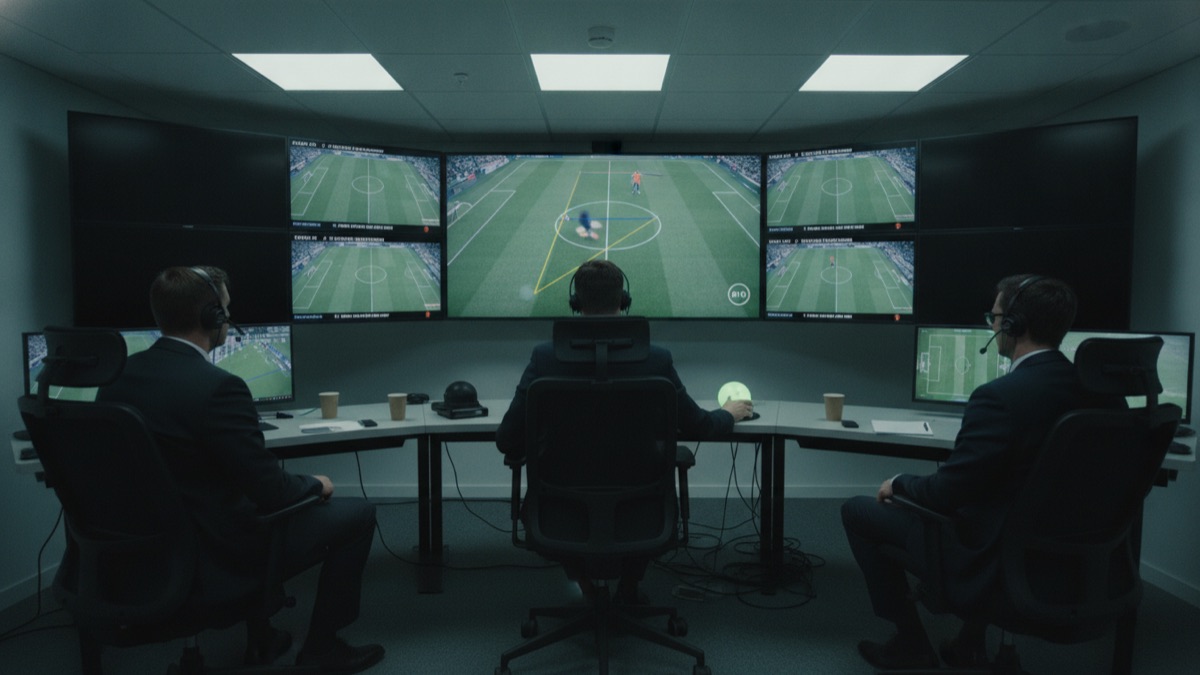
These feeds are routed to a centralized video operation room, which for many major competitions is located away from the stadium entirely, sometimes in a different city, and connected to every match in a tournament simultaneously through dedicated broadcast infrastructure.
This centralization is deliberate: it lets a competition standardize the technology, camera setup, and review protocol across every venue, rather than relying on whatever camera coverage happens to exist at each individual stadium, which was a real limitation in early domestic-league VAR trials.
Who Sits in the VAR Room and What They Do
A VAR team generally includes a lead video assistant referee, who is a qualified match referee, along with several assistant VARs who each monitor specific camera angles or specific types of incidents, such as offside, simultaneously with the live action.
An offside official, working with either manual frame-by-line analysis or semi-automated tracking software depending on the competition, focuses specifically on marginal offside calls, which are among the most frequent VAR interventions in professional football.
Because VAR officials are themselves trained match referees rather than a separate technical role, the system is designed around the idea that the person reviewing a decision understands the laws of the game with the same depth as the referee on the pitch, not merely how to operate the technology.
The Four Categories of Reviewable Decisions
IFAB's protocol limits VAR review to four categories of decisions: goals and whether any offense occurred in the buildup, penalty decisions, direct red card incidents, and cases of mistaken identity where a card is shown to the wrong player.
This narrow scope is a deliberate design choice, not a technical limitation — IFAB has repeatedly stated that expanding VAR to cover more decision types, such as every foul or every yellow card, would slow the game down considerably and undermine the flow that makes football distinct from more stop-start sports.
Critics of the current scope argue that some of the most consequential fouls of a match, particularly ones that don't result in a card, still go unreviewed under these rules, which is a genuine and ongoing debate within football's governing bodies rather than a settled matter.
How a VAR Review Actually Unfolds During a Match
During normal play, the VAR team continuously monitors the match on video feeds even when nothing appears to be wrong, silently checking each goal, penalty claim, and potential red card incident in the background without interrupting play unless something meets the review threshold.
Most VAR checks are invisible to fans watching the match live, since the large majority resolve within seconds without any stoppage — the review only becomes visible when the VAR team flags a possible clear and obvious error and communicates that to the on-field referee via a dedicated radio link.
Once flagged, play is stopped if the ball is not in a promising attacking position for the team that would benefit from the review, and the referee is informed that a check is underway, at which point the process moves either to a quick recommendation from the VAR team or a full on-field review.
The Referee Review Area and On-Field Review
For more complex or subjective incidents, the referee can walk to a pitch-side monitor, known as the referee review area, to watch the replay personally and make the final call — this on-field review is used specifically for judgment-heavy decisions like the force or intent behind a challenge.
For more factual matters, such as whether the ball crossed the touchline before a cross or whether contact occurred at all, the VAR team can issue what's called a VAR-only review, delivering a recommendation directly to the referee's earpiece without requiring a walk to the monitor.
IFAB has generally pushed competitions to use the on-field review more often rather than less, on the theory that fans and players find outcomes more legitimate when they can see the referee personally examine the replay rather than simply following an instruction relayed from off-pitch.
Semi-Automated Offside Technology Explained
Semi-automated offside technology, first used at a FIFA World Cup in Qatar in 2022 and refined since, combines a network of tracking cameras mounted around the stadium roof with a sensor inside the match ball that transmits its position many times per second.
The tracking cameras follow up to 29 data points on each player's body in real time, which the system uses to construct a three-dimensional skeletal position for every player on the pitch at the exact moment the ball is played, rather than relying on a single frozen video frame as earlier manual offside checks did.
FIFA and IFAB have presented this as a meaningful accuracy and speed improvement over manual line-drawing, since it removes some of the human judgment involved in selecting the exact video frame and the exact point on a player's body used to judge an offside position.
How the Offside Line Is Actually Calculated
Under the laws of the game, a player is offside if any part of their body that can legally play the ball is closer to the opponent's goal line than both the ball and the second-last opponent at the moment the ball is played by a teammate.
The semi-automated system calculates this by combining the exact moment the ball is played, drawn from the ball's sensor data, with the tracked position of the attacking player's relevant body parts and the defending team's second-last player, generating an offside line automatically rather than requiring an operator to manually draw it.
The system still requires human confirmation before a decision is finalized and broadcast — an official reviews the automatically generated calculation before the offside line graphic is shown to the referee and, in many competitions, to the stadium screen and television audience.
Goal-Line Technology and How It Differs from VAR
Goal-line technology is a separate system from VAR, designed to answer one narrow factual question: did the whole of the ball cross the whole of the goal line? It uses either multiple high-speed cameras or a magnetic field system around the goal frame, depending on the vendor a competition selects.
Unlike VAR, which involves a video team reviewing footage and communicating a recommendation, goal-line technology sends an automatic signal directly to the match officials' smartwatches within roughly one second of the ball fully crossing the line, without any human review step at all.
Because goal-line technology answers a strictly factual, binary question rather than a judgment call, it has generated dramatically less controversy than VAR since its introduction, and is generally regarded within football as one of the sport's clearest technology success stories.
The Communication Protocol Between VAR and the Referee
Communication between the VAR room and the on-field referee runs over a dedicated radio channel, and in many top competitions this audio is recorded and, in some cases, later released publicly to explain contentious decisions after a match has finished.
Some competitions, including recent World Cups, have experimented with broadcasting parts of this VAR communication live or near-live to stadium screens and television audiences, an effort aimed at making the review process feel more transparent to fans watching a lengthy stoppage unfold.
Broadcasting VAR audio remains inconsistent across leagues and tournaments, and referees' associations have expressed mixed views about wider rollout, balancing transparency against concerns that officials could face harsher personal scrutiny for split-second, defensible judgment calls.
Why VAR Hasn't Eliminated Controversy
VAR was never designed to eliminate controversy entirely, because a meaningful share of the decisions it reviews — was a challenge reckless enough for a red card, was there enough contact for a penalty — remain matters of interpretation rather than simple fact, even once officials have a clear replay.
Sports governance researchers who study officiating technology generally point out that video review reduces one category of error, clearly missed incidents, while leaving a separate category, genuinely marginal judgment calls, largely unresolved, since better footage doesn't necessarily produce a more obvious answer.
This distinction is often lost in public debate, where any contested VAR decision tends to get labeled a "VAR failure," even when the system worked exactly as intended by giving officials the clearest possible view of an inherently debatable moment.
The 'Clear and Obvious Error' Threshold
The "clear and obvious error" standard is the central threshold that determines whether the VAR team intervenes at all, and it is intentionally a high bar — the protocol does not ask whether an alternative decision was reasonable, only whether the on-field decision was clearly wrong.
This means a VAR official can personally disagree with a decision and still not intervene, if the original call falls within the range of what a competent referee could reasonably decide in real time, a distinction that frequently confuses fans expecting VAR to simply produce the "correct" outcome.
IFAB has defended this high threshold as necessary to preserve the referee's authority on the pitch and to prevent VAR from becoming a second full review of every marginal decision, which would fundamentally change the pace and character of the sport.
Notable VAR Controversies That Shaped the Rules
Several high-profile incidents have directly shaped VAR's protocol since its introduction, including lengthy stoppages for marginal offside calls that led competitions to standardize maximum review times and improve how offside lines are communicated to broadcast audiences.
A widely discussed handball-related controversy in a major European competition prompted IFAB to clarify and narrow the handball law itself, since the original wording left too much room for inconsistent interpretation even with clear video evidence available.
These episodes illustrate a broader pattern: VAR controversies have often driven changes to the underlying laws of the game, not just to the review technology, because clearer video exposed ambiguities in rules that had existed, largely unnoticed, for decades before cameras could scrutinize them this closely.
How VAR Will Be Used at the 2026 World Cup
FIFA has confirmed that the 2026 World Cup, hosted across the United States, Canada, and Mexico, will use both VAR and an updated version of semi-automated offside technology across all venues, continuing the rollout that began at the 2022 tournament in Qatar.
Because the 2026 tournament spans three countries and a large number of stadiums, FIFA has emphasized standardizing camera installation and video infrastructure across every venue well ahead of the competition, learning from earlier tournaments where inconsistent camera coverage occasionally slowed reviews.
FIFA officials have also indicated an intention to continue broadcasting selected VAR explanations to stadium screens during the tournament, building on the transparency measures first tested at the 2022 World Cup, though the exact scope of what gets shown live has not been finalized for every match type.
Criticism From Players, Coaches and Fans
Player and coach criticism of VAR has remained consistent since its introduction, focused less on the technology's accuracy and more on stoppage length, inconsistent application of the clear-and-obvious threshold across different matches, and the disruption long reviews cause to a sport built around continuous flow.
Fan surveys conducted by football supporter organizations across multiple leagues have generally found mixed sentiment: many fans support VAR's stated goal of catching major errors while simultaneously reporting frustration with how it is applied in practice, particularly the loss of instant, uncomplicated goal celebrations.
Some critics argue the deeper issue isn't the technology itself but the subjective legal language it's asked to adjudicate — until laws around handball, contact, and reckless challenges become less ambiguous, no review system, however precise the cameras, can fully remove debate from decisions that are ultimately judgment calls.
What's Next for Football Officiating Technology
IFAB continues to trial refinements to VAR protocol, including faster offside processing, clearer stadium-screen graphics, and, in some competitions, limited coach challenge systems modeled loosely on systems used in other sports like tennis and American football.
Full automation of more decision types remains technically distant, since most of the decisions fans find most contentious involve intent, force, and contact judgments that current tracking and sensor technology cannot yet reliably classify without human interpretation.
The broader trajectory football's governing bodies have signaled is incremental rather than revolutionary: expect faster processing and clearer communication of existing VAR functions in the coming years, rather than a sudden expansion of what the system is allowed to review.
Sources
- FIFA — Official information on VAR and semi-automated offside technology at FIFA competitions.
- IFAB — The International Football Association Board, which sets the Laws of the Game and the VAR protocol.
- Reuters — Independent reporting on VAR controversies and rule changes.
- BBC Sport — Coverage of officiating technology and fan and player reaction.
FAQ
What does VAR actually do during a match?
VAR is a video review system that checks a narrow set of decisions — goals, penalties, red cards, and mistaken identity — for clear and obvious errors, without replacing the on-field referee's authority.
Can VAR overturn any refereeing decision?
No. VAR's protocol under IFAB limits review to four categories of decisions, and it only intervenes when an error is clear and obvious, not simply debatable.
How does semi-automated offside technology work?
It combines tracking cameras that follow up to 29 points on each player's body with a sensor inside the ball, generating an offside line automatically that an official then confirms before it's shown.
Why do VAR reviews sometimes take so long?
Complex or subjective incidents may require the referee to personally review footage at the pitch-side monitor, and inconsistent camera coverage or communication protocols can add further delay.
Will VAR be used at the 2026 World Cup?
Yes, FIFA has confirmed VAR and an updated semi-automated offside system will be used across all venues at the 2026 World Cup in the United States, Canada, and Mexico.
About the Author
We reference FIFA, IFAB, Reuters, and BBC Sport to explain the background and current understanding of this topic.
Loved This Article?
Share it on WhatsApp → Share it on WhatsApp
Get more guides in your inbox — Subscribe to our newsletter for weekly surprising stories from Egypt, Saudi Arabia, Dubai, and beyond.