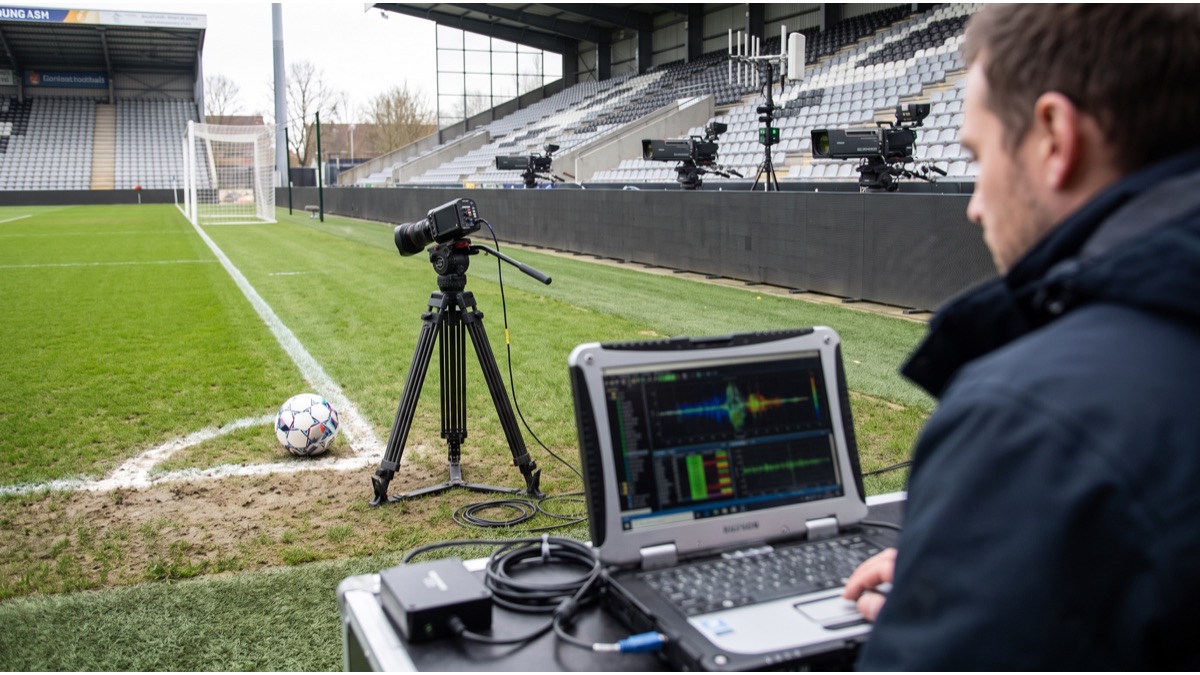
A ball crossing a goal line is one of the simplest facts in football and, for more than a century, one of the hardest for a human being to confirm reliably at full speed from thirty metres away. At the World Cup today, that question is answered by a purpose-built sensor network before the goalkeeper has finished picking the ball out of the net, and a second, entirely separate system now settles marginal offside calls by tracking every player's limbs fifty times every second. Neither of these technologies is VAR itself, even though both feed into the review process VAR relies on, and understanding exactly how the hardware works — the cameras, the chip stitched into the match ball, the skeletal player models — explains both why these calls have become dramatically more precise and why arguments about football technology have not gone away.
Two Different Systems Wearing One Nickname
Fans often use "VAR" as a catch-all term for every piece of officiating technology at a modern tournament, but goal-line technology, semi-automated offside technology, and VAR itself are three distinct systems that happen to work together during a World Cup broadcast. Goal-line technology is a fully automated sensor system with one narrow job: deciding whether the ball has wholly crossed the goal line. It does not involve a human review room at all in the moment of the call.
Semi-automated offside technology, often abbreviated SAOT, is a camera and sensor system that calculates player and ball positions to draw an offside line, but it still requires a human video official to check and confirm the automatically generated line before informing the referee, which is why FIFA insists on the word "semi" in its official name.
VAR, by contrast, is the broader review process and the team of match officials who use replay footage, including goal-line and offside data when relevant, to check a small set of reviewable decisions: goals, penalties, direct red cards, and cases of mistaken identity. A separate article on this site, how VAR technology actually works in football, walks through that broader review process, the video operation room, and the on-field review protocol in detail; this article focuses specifically on the two automated tracking systems that sit underneath it at the World Cup — the goal-line sensors and the semi-automated offside cameras — rather than repeating that ground.
The Physics Problem Goal-Line Technology Had to Solve
A football travels toward goal at speeds that can exceed 100 kilometres per hour during a powerful strike, meaning the ball can cross the goal line and rebound off a post, a goalkeeper, or a defender within a fraction of a second, sometimes leaving no clear photographic moment where the whole ball is visibly behind the line to the human eye from any single fixed angle.
Historically, assistant referees stationed near the goal line, and in some competitions additional goal-line officials positioned specifically to watch for these incidents, made this call using nothing but eyesight and positioning, a method that worked most of the time but produced high-profile, verifiably wrong decisions in matches watched by hundreds of millions of people.
The engineering challenge was therefore not simply "watch the goal line," it was building a system precise enough to determine, in three dimensions, whether the entire spherical surface of the ball — not just its shadow or a flat two-dimensional projection — had passed completely over a line that itself has width, all while the ball is frequently obscured by players' bodies at the exact moment it matters most.
Camera-Based Goal-Line Systems: Hawk-Eye and Its Rivals
The most widely used goal-line technology at major tournaments, including recent World Cups, is Hawk-Eye, a system originally developed for cricket and later adapted for tennis line-calling before being engineered for football. A Hawk-Eye goal-line installation uses at least seven high-speed cameras trained on each goalmouth from different angles, positioned around the stadium roof and stands specifically to maintain a clear view of the goal area regardless of where players are standing.
Each camera captures the position of the ball dozens of times per second, and specialised software triangulates those multiple two-dimensional camera images into a single three-dimensional model of the ball's location relative to the goal line, updated continuously rather than relying on any single frozen frame.
A rival system called GoalControl, built by a German engineering firm, uses a comparable multi-camera triangulation approach and was the technology FIFA selected for the 2014 World Cup in Brazil, the first World Cup to use goal-line technology at all, while Hawk-Eye has been FIFA's chosen provider for several tournaments since. Both approaches solve the same triangulation problem using broadly similar principles, differing mainly in camera count, placement, and proprietary tracking software.
The Ball's Own Sensor: Connected Ball Technology
Camera-based triangulation alone can still struggle when the ball is heavily obscured by a crowd of players in the six-yard box, which is part of why FIFA has increasingly paired goal-line camera systems with connected ball technology, a sensor suspended in the exact centre of the match ball itself.
The Adidas match balls used at recent World Cups, developed with chip manufacturer KINEXON, contain a 500-hertz motion sensor, meaning it records the ball's position 500 times per second, considerably faster than the camera systems alone, and transmits that data wirelessly to the stadium's tracking system in real time.
This ball sensor was originally introduced primarily to support semi-automated offside decisions by pinpointing the exact moment the ball is kicked, discussed further below, but it also provides an independent, camera-independent data source that can corroborate or supplement optical goal-line tracking, giving officials two separate technical readings of the same physical event rather than relying on a single method.
From Triangulated Data to the Referee's Watch in Under a Second
Once the camera array or ball sensor determines that the ball's full circumference has passed completely over the goal line, the system does not wait for a human to review footage; it sends an encrypted signal automatically and near-instantly to a receiver worn on the match referee's wrist, which vibrates and displays the word "GOAL" within roughly one second of the line being crossed.
This near-instant confirmation is precisely what distinguishes goal-line technology from VAR's broader review process: there is no separate video assistant referee checking multiple camera angles, no delay for a review room discussion, and no on-field review at the pitch-side monitor, because the goal-line system's only function is producing this single binary answer as fast as physically possible.
Broadcasters typically pair this instant confirmation with their own simplified 3D graphic showing the ball's path relative to the goal line for the television audience, but that graphic is a presentation layer built from the same underlying tracking data, not a separate decision-making step; the referee has already been informed before the graphic even airs.
Why FIFA Needed a New System for Offside
Traditional offside decisions, even after VAR was introduced, still relied on an assistant referee's initial flag combined with a video official manually drawing straight lines across a paused broadcast frame using whatever camera angle happened to be available, a process that could take well over a minute for close calls and depended heavily on finding a truly perpendicular camera angle to the pitch.
Manually drawn offside lines also introduced a genuine, well-documented source of human error: a broadcast camera positioned even slightly off the correct angle, combined with a video official manually placing a line based on a still image of a player's body part, could produce a technically incorrect offside call despite everyone involved acting in good faith and using the best information visibly available.
These manual review delays became a significant point of fan frustration during VAR's early years specifically because offside is judged by fractions of a metre, and a process built around human eyes and a mouse cursor simply could not deliver both the speed and the millimetre-level precision that a bright line rule like offside actually demands.
Inside Semi-Automated Offside Technology
Semi-automated offside technology, first used at a FIFA World Cup in Qatar in 2022 and refined for subsequent tournaments, replaces the manual line-drawing process with a dedicated tracking system built specifically to solve the offside problem rather than adapting football's existing broadcast cameras after the fact.
The system relies on up to twelve dedicated tracking cameras mounted beneath the stadium roof, positioned specifically to maintain a clear, consistent, high overhead view of the entire pitch at all times, combined with the same connected-ball sensor used for goal-line purposes to determine precisely when the ball is played.
Unlike the broadcast cameras used for general match coverage, these tracking cameras are dedicated solely to the offside system, are calibrated specifically to the pitch's exact dimensions before each match, and run continuously throughout the game rather than being manually selected and reviewed only when a close offside incident occurs, which is what makes real-time automatic line generation possible in the first place.
The 29 Data Points and the Skeletal Model
Rather than tracking a player as a single dot or a flat silhouette, the tracking cameras feed limb-tracking software that generates a detailed skeletal model of every player on the pitch, capturing up to 29 distinct data points on each individual — including limbs, torso position, and extremities — 50 times every second.
These 29 points specifically include the body parts that are legally relevant to an offside decision under the Laws of the Game, since a player can be offside based on the position of their head, body, or feet, but not their arms or hands, meaning the system needs enough anatomical detail to isolate exactly which body parts count and which do not for each individual player at each fraction of a second.
This skeletal approach solves a problem that plagued earlier optical tracking systems: a stretched-out leg, an extended arm, or an awkward jumping posture could previously distort where a flat two-dimensional camera angle appeared to place a player's outermost offside-relevant body part, whereas a full skeletal model lets the software isolate the correct point regardless of a player's exact posture at that instant.
How the Offside Line Is Actually Drawn
Using the skeletal data from every player combined with the exact moment the ball was played, determined from the connected ball sensor's 500-hertz motion data, the system automatically calculates the precise offside line and checks whether any attacking player's offside-relevant body part was positioned beyond the second-to-last defender at that exact instant.
This calculation happens continuously throughout the match rather than only when triggered by an official's suspicion, meaning the underlying positional data effectively already exists the moment a goal is scored or a marginal attacking play develops, dramatically cutting the time needed to reach a decision once a review is actually required.
The system then automatically generates a three-dimensional offside line rendered directly onto the video feed, distinguishing this from earlier manual systems that could only draw straight lines across a single flat broadcast frame; the automated version accounts for the pitch's real dimensions and camera perspective rather than approximating them.
The Kick-Point Problem and Why Timing Still Matters
Determining the exact fraction of a second the ball was played is arguably as important as tracking player positions, since an offside line drawn even a tenth of a second too early or too late can place a player on the wrong side of a genuinely close call, which is precisely why the connected ball sensor's high sampling rate matters so much to the overall system's accuracy.
Before connected ball technology, officials estimated the kick point visually from broadcast footage, a method vulnerable to motion blur and frame-rate limitations, especially on powerful strikes or first-time passes where the exact contact moment happens faster than standard broadcast cameras can cleanly resolve.
With the ball's own sensor reporting motion data 500 times per second, the system can identify the precise moment of a sudden change in the ball's acceleration consistent with being kicked, giving the offside calculation a far more reliable time stamp than any camera-only method could realistically provide.
Human Confirmation: The 'Semi' in Semi-Automated
Despite the heavy automation involved, FIFA has been explicit that the system is not fully automatic: a human video match official in the video operation room reviews the automatically generated offside line and the calculated kick point before any information is passed on to the on-field referee, and can override or query the automated output if something looks technically wrong.
This human checkpoint exists partly for technical reliability reasons — cameras can occasionally be obstructed, calibration can occasionally drift, and edge cases exist that engineers did not fully anticipate — and partly because certain offside judgments genuinely require human interpretation that pure positional data cannot resolve on its own, such as whether a player in an offside position was actively interfering with play or an opponent.
Once the video official confirms the automated line is technically sound, that confirmation, not the raw computer output alone, is what gets relayed to the referee, and only then does the referee make the final on-field decision, preserving the same basic principle that runs through VAR as a whole: technology surfaces information, but a qualified match official remains the decision-maker of record.
From Detection to Broadcast: the 3D Animation Fans See
The now-familiar broadcast graphic showing a player's skeletal outline alongside a coloured offside line is generated from the same tracking data used for the decision itself, rendered as a polished animation for television and stadium screens only after the on-field decision has already been communicated to the referee and players.
This sequencing matters for managing fan expectations: the striking 3D graphic that appears on screen is a visualisation built after the fact for clarity and entertainment value, not a live tool officials are watching in real time to make the call, even though it draws on identical underlying positional data.
FIFA and its broadcast technology partners have refined this animation specifically to make an inherently technical, camera-angle-dependent decision look intuitive and self-evidently fair to a television audience, which has measurably reduced (though not eliminated) public argument over offside calls compared with the era of manually drawn lines on a single flat replay frame.
Accuracy Record and Known Failure Points
Goal-line technology has an extremely strong accuracy record since its introduction at the 2014 World Cup, with FIFA-approved systems required to pass rigorous pre-tournament testing standards, and no major publicly disputed goal-line error has occurred at a World Cup using the technology since its adoption.
Semi-automated offside technology has likewise improved measured decision speed dramatically, with FIFA reporting that average offside review time dropped from roughly 70 seconds under the manual review process to well under half that at the tournament where the system debuted, though the technology is not entirely without controversy.
Known failure points cluster around camera calibration errors before a match, unusual player postures the skeletal model was not trained to handle cleanly, and — perhaps most persistently — disputes over subjective judgment calls like active involvement in play that sit downstream of the automated positional data and remain, deliberately, a human referee's decision rather than the system's.
World Cup History: From Frank Lampard to Full Automation
The push for goal-line technology gained enormous public momentum after England's Frank Lampard had a shot at the 2010 World Cup that clearly crossed the goal line against Germany waved away by officials who simply could not see it from their positions, a moment replayed globally within minutes on broadcast technology far more precise than what officials had access to on the pitch.
That single high-profile miss, alongside a similar disputed non-goal for Ukraine against England at Euro 2012, is widely credited with accelerating IFAB's approval of goal-line technology trials, which culminated in its first World Cup use in Brazil in 2014, followed by semi-automated offside technology's World Cup debut in Qatar in 2022.
Each tournament since has generally added camera precision, faster processing, and refined skeletal tracking rather than changing the fundamental approach, reflecting a technology that reached a broadly workable architecture relatively quickly and has since been an engineering refinement project rather than a series of redesigns.
How This Differs from the Broader VAR Review Process
It is worth restating plainly how these systems relate to the wider VAR apparatus described in our companion piece on how VAR technology actually works in football: goal-line technology operates entirely outside the VAR review room and requires no request from the referee, while semi-automated offside technology feeds directly into VAR's existing review workflow as one specific tool among the several camera angles and replay methods VAR officials can draw on.
A penalty decision, a red-card incident, or a case of mistaken identity still goes through the full VAR review process, including the on-field review at the pitch-side monitor when relevant, none of which applies to a straightforward goal-line or offside determination, which is why fans sometimes see an instant goal-line confirmation on one play and a multi-minute VAR review on another within the same match.
The distinction matters because it explains why some World Cup decisions feel instantaneous while others still take time: the tournament has automated the two categories of decision — line-crossing and player position — that are genuinely reducible to precise measurement, while deliberately leaving categories that require contextual judgment inside the slower, human-led VAR process.
What Changes for the 2026 World Cup Specifically
The 2026 World Cup, hosted across the United States, Canada, and Mexico, is the first edition of the tournament to be played across three countries and dozens of stadiums with varying roof structures and camera-mounting configurations, which has required FIFA's technology partners to individually calibrate the tracking camera arrays for each specific venue rather than deploying a single uniform setup.
FIFA has also indicated continued refinement of the connected ball sensor and skeletal tracking software heading into the 48-team format, since the expanded tournament structure means more matches, more venues, and more simultaneous fixtures placing higher overall demand on the technology and the officiating teams operating it across a compressed group-stage schedule.
For Arab football fans following national teams at the tournament, the practical takeaway is straightforward: a marginal offside call against or in favour of an Arab side at the 2026 World Cup will be settled by the same skeletal-tracking, ball-sensor-based system used throughout the tournament, reviewed by a human video official before the referee is informed, rather than by a single fallible human eye trying to judge a fraction of a second from thirty metres away.
Goal-line sensors and semi-automated offside cameras have not removed football officiating from the realm of controversy entirely, but they have narrowed that controversy to a much smaller set of genuinely contestable questions — subjective interference judgments, rare calibration failures, and disputes over how much automation the sport should embrace — rather than the basic, verifiable facts of where the ball and a player's feet actually were at a given instant. Understanding the hardware behind these calls, the triangulated cameras, the ball's own 500-hertz sensor, and the skeletal models built from 29 tracked points, makes it much easier to separate a legitimate grievance about football officiating from simple disbelief that a decision could possibly be that precise.
Sources
- FIFA — Official statements and technical background on goal-line technology and semi-automated offside technology at FIFA tournaments.
- The International Football Association Board (IFAB) — Laws of the Game and approval standards for match officiating technology.
- Hawk-Eye Innovations — Technical background on multi-camera ball-tracking systems used for goal-line decisions.
- KINEXON Sports — Background on connected ball sensor technology used in FIFA match balls.
FAQ
How fast does goal-line technology confirm a goal?
Goal-line technology systems used at the World Cup send a signal to the referee's watch within about one second of the ball fully crossing the line, based on triangulated data from at least seven high-speed cameras trained on each goalmouth.
Is goal-line technology the same thing as VAR?
No. Goal-line technology is a separate, fully automated system dedicated only to determining whether the ball crossed the goal line, while VAR is a broader video review process covering goals, penalties, red cards, and mistaken identity that still relies on human judgment.
How does semi-automated offside technology work?
Semi-automated offside technology uses up to 12 tracking cameras under stadium roofs plus a sensor inside the match ball to capture 29 data points on every player 50 times per second, generating a 3D offside line automatically the instant the ball is played, which a human operator then confirms before the referee is informed.
Does semi-automated offside technology remove human judgment entirely?
No. The system automates the measurement of player and ball positions, but a video match official still validates the calculated offside line and kick point before any decision is relayed to the on-field referee, and subjective judgments like active involvement in play remain human calls.
Has goal-line and offside technology eliminated controversy at major tournaments?
Largely for physical goal-line and offside-line measurement, yes, but controversy persists around camera calibration errors, broadcast visualisation delays, and decisions that hinge on subjective interpretation rather than pure positional data.
About the Author
We reference FIFA, the International Football Association Board, Hawk-Eye Innovations, and KINEXON Sports to explain the background and current understanding of this topic.
Loved This Article?
Share it on WhatsApp → Share it on WhatsApp
Get more guides in your inbox — Subscribe to our newsletter for weekly surprising stories from Egypt, Saudi Arabia, Dubai, and beyond.