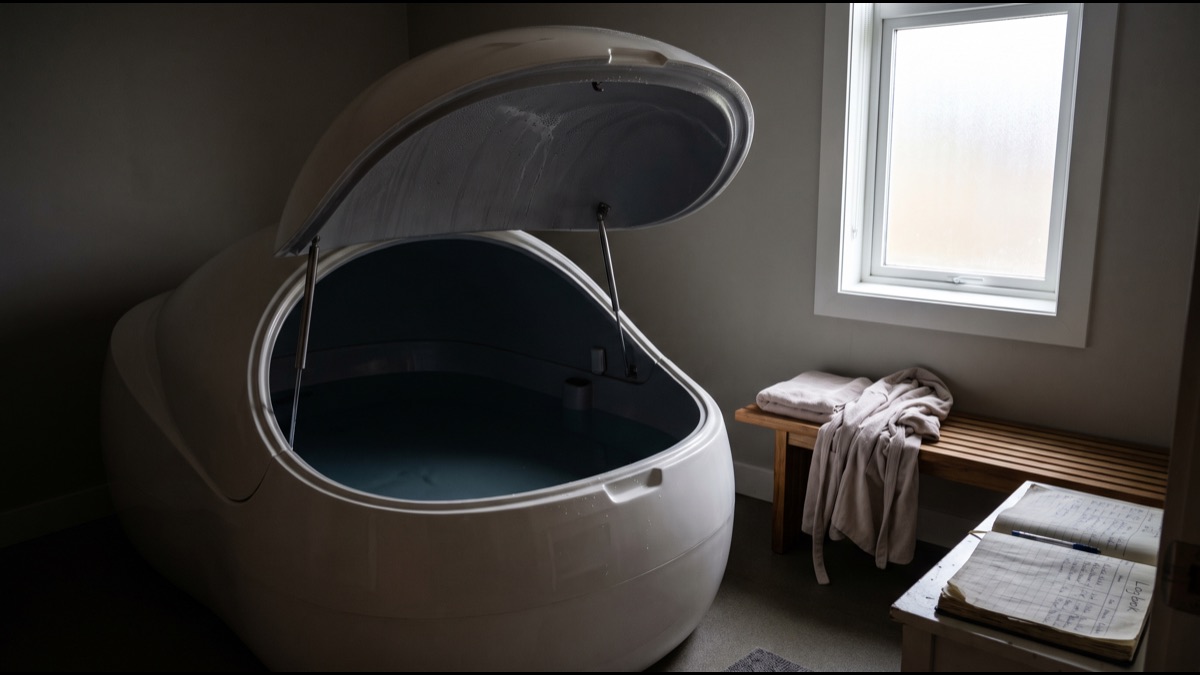
Step into roughly a foot of water saturated with over a thousand pounds of dissolved Epsom salt, close a lid that blocks essentially all light and most sound, and the body becomes almost weightless, floating on the surface without any conscious effort to stay afloat. Float tanks, also called isolation or sensory-deprivation tanks, have moved from a fringe 1950s research device into a mainstream spa and wellness offering, and understanding what genuinely happens physiologically requires separating the well-documented physics and neuroscience from the more speculative claims layered on top.
What Actually Happens Inside a Float Tank
A float tank is a lightproof, largely soundproof pod or small room containing roughly 25 to 30 centimetres of water heated to approximately skin temperature, around 35 degrees Celsius, so that the boundary between water and skin becomes difficult to perceive after the first few minutes.
Sessions typically last 60 to 90 minutes, during which the participant lies on their back, lid closed, in essentially total darkness and near-total silence, with the option to leave the lid ajar or use a small interior light for those uncomfortable with full enclosure.
Modern commercial tanks filter and disinfect the water between sessions to a very high standard given the extremely high salt concentration, which is itself strongly inhospitable to most bacteria, making float tanks considerably easier to keep hygienic than an ordinary swimming pool.
Why the Water Makes You Weightless
The buoyancy in a float tank comes from dissolving an enormous quantity of magnesium sulfate, commonly known as Epsom salt, into a relatively shallow pool of water, raising its density well beyond that of the Dead Sea or ordinary seawater.
At this density, a human body floats on the surface with almost no muscular effort required to stay afloat, distributing weight so evenly that most people stop being able to clearly feel where their body ends and the water begins after a period of adjustment.
This effortless buoyancy is the mechanism most directly responsible for the deep muscular relaxation many floaters report, since the postural and stabilising muscles that work continuously throughout ordinary waking life have essentially nothing left to do.
Where the Idea Originated
The float tank traces to research conducted by neuroscientist John C. Lilly beginning in the 1950s, who was investigating what happens to consciousness and brain activity when external sensory input is minimised as completely as practically possible.
Lilly's early tanks required the subject to wear a breathing mask and float fully submerged in a saline solution, a considerably more extreme and technically demanding setup than the modern shallow, heavily salted design that emerged later specifically to make the experience commercially viable and comfortable for a general audience.
The commercial float industry that exists today descends from this research lineage but has moved decisively toward relaxation and wellness framing rather than the more clinical, exploratory sensory-deprivation research that originally motivated the technology's development.
What Sensory Reduction Actually Does to the Brain
Removing visual, auditory, tactile, and even much of the gravitational input the brain normally processes continuously produces a genuinely unusual state, since the brain ordinarily spends considerable resources integrating a constant stream of sensory data most people never consciously notice.
EEG studies of floating have found shifts toward theta-wave brain activity, a pattern also associated with the transition into sleep and with certain meditative states, though the presence of a genuine and reliable shift does not by itself establish exactly what subjective or therapeutic significance that shift carries.
Several researchers describe the float state as functionally similar to a deep meditative or hypnagogic state achieved with far less active mental effort than traditional meditation typically requires, since the removal of external stimuli does much of the attentional work a meditator would otherwise need to do deliberately.
The Evidence on Stress and Anxiety
Floating has one of the stronger evidence bases among alternative wellness practices for short-term anxiety and stress reduction, with several controlled studies, including work specifically on generalised anxiety disorder, finding statistically significant reductions in self-reported anxiety following float sessions.
Some of this research has come from academic medical centres rather than the wellness industry itself, lending it somewhat more credibility than practices whose research literature is produced primarily by practitioners and equipment manufacturers with a direct commercial interest in positive findings.
Reductions in cortisol and other physiological stress markers have also been documented in some studies, broadly consistent with the subjective reports, though sample sizes remain modest by the standards of mainstream clinical research and replication across independent labs is still limited.
One plausible mechanism researchers point to is the reduction of what is sometimes called allostatic load, the cumulative physiological cost of constantly processing background stressors that most people never consciously register, from ambient noise to minor postural adjustments to low-level social vigilance. Removing nearly all of that input at once, even temporarily, appears to give the autonomic nervous system a rare and unusually complete opportunity to shift out of a sympathetic, alert-oriented state, which several researchers argue may explain why the anxiety-reduction effect shows up so consistently even in studies with fairly small sample sizes.
What Float Tanks Do for Muscle Tension and Pain
The combination of buoyancy, warmth, and magnesium-rich water is frequently credited with easing muscle tension and joint pain, and floaters commonly report feeling physically lighter and less sore immediately after a session, consistent with what would be expected from prolonged, effortless weight-bearing relief.
Whether meaningful magnesium actually absorbs through the skin during a float session in quantities sufficient to produce a systemic effect remains genuinely debated among researchers, since skin absorption of dissolved minerals is generally limited, and much of the pain relief effect may instead be attributable to buoyancy and warmth rather than mineral uptake specifically.
Chronic pain patients in a small number of studies have reported meaningful short-term relief after float sessions, though as with the anxiety research, sample sizes are modest and the duration of any pain-relief benefit beyond the immediate post-float period is not well established.
Why Some People Report Mild Hallucinations
Extended sensory reduction is a documented trigger for mild perceptual phenomena in some individuals, including faint visual patterns, a sense of the body's boundaries dissolving, or brief auditory effects, generally understood as the brain's perceptual systems generating activity in the relative absence of the external input they normally calibrate against.
These effects are typically mild in a standard 60 to 90 minute commercial float session and are not universal; many floaters report nothing beyond deep relaxation, with more pronounced perceptual effects more commonly associated with the longer, more extreme sensory-deprivation protocols used in some research contexts rather than typical spa sessions.
None of this represents a clinically concerning experience for the great majority of healthy floaters, though anyone with a history of psychosis or severe dissociative symptoms should discuss floating with a mental health professional before trying it.
Where the Evidence Is Weaker
Claims that floating improves immune function, accelerates detoxification, or produces lasting changes to chronic conditions beyond the studied short-term stress and anxiety effects are not well supported by the current research literature, which remains considerably smaller and less rigorous than research into more established interventions like exercise or cognitive behavioural therapy.
As with many wellness interventions built around a genuinely pleasant, novel experience, expectation and placebo effects are difficult to fully separate from any float-specific mechanism, particularly given how memorable and distinctive the sensory experience itself is compared with a more neutral control condition.
Consumers are generally well served by treating the well-supported short-term relaxation and anxiety-reduction findings as the core, reliable benefit, while remaining sceptical of more sweeping health claims that go considerably beyond what controlled research has actually established.
How Athletes and Performers Use Floating
Professional and elite amateur athletes have increasingly incorporated float sessions into recovery routines, citing both the physical unloading benefit for joints and muscles after intense training and the mental rehearsal opportunities the quiet, distraction-free environment provides for visualisation and pre-competition focus.
Some sports psychologists use float sessions specifically as a setting for guided visualisation work, reasoning that the absence of competing sensory input makes mental rehearsal of technique or competition scenarios considerably more vivid and immersive than attempting the same exercise in an ordinary room.
As with the general wellness claims, rigorous controlled evidence that floating produces measurably better athletic recovery or performance outcomes compared with equivalent rest time in a quiet, comfortable setting without the sensory-deprivation element specifically remains limited.
Several professional sports organisations have nonetheless installed float pods directly within their training facilities rather than sending athletes to outside commercial centres, treating the practice as similar in principle to cryotherapy chambers or compression recovery boots — a recovery tool worth having in-house even where the underlying research is still developing, because the downside risk is low and the anecdotal buy-in from athletes themselves tends to be strong. Coaches in sports with dense competition schedules, where genuine rest days are scarce, have been particularly receptive to any intervention plausibly reducing perceived fatigue between fixtures.
Who Should Be Cautious About Floating
People with open wounds, certain skin conditions, epilepsy, or a history of psychosis should discuss floating with a healthcare provider beforehand, and anyone who has consumed alcohol or sedatives should avoid floating given the increased and unpredictable risk profile even though genuine drowning risk during a normal float is low.
Individuals prone to claustrophobia can generally still float comfortably, since the option to leave the lid open, use interior lighting, or choose an open-pool-style float room rather than an enclosed pod addresses most of the discomfort claustrophobic people anticipate.
Anyone with broken skin or a recent tattoo should generally postpone floating, since the extremely high salt concentration is genuinely uncomfortable and potentially irritating on open or healing skin.
What a First Float Actually Feels Like
Most first-time floaters describe an initial period of mild restlessness or difficulty relaxing fully as the body and mind adjust to the unfamiliar absence of stimulation, with the sense of deep relaxation often building gradually over the first 20 to 30 minutes rather than arriving immediately.
A shower before and after the session is standard practice to remove body oils beforehand and rinse off the concentrated salt water afterward, and most float centres provide earplugs, since water can otherwise enter the ear canal and the extreme salinity is uncomfortable if it does.
It is common to feel unusually calm, mildly disoriented, or notably tired for a short period after leaving the tank, generally regarded as a normal part of the transition back to an ordinary sensory environment rather than any cause for concern.
Most centres recommend against driving immediately after an unusually deep first float for exactly this reason, and many build a short lounge period with tea or water into the standard session so that clients have somewhere quiet to reorient before stepping back into traffic, phone notifications, and everyday noise. Repeat floaters often report that this disorientation fades with subsequent sessions as the body becomes more accustomed to how quickly it settles into and then exits the relaxed state, with the transition afterward becoming noticeably smoother by the third or fourth visit.
How the Float Industry Has Grown
Commercial float centres have expanded substantially over the past decade across North America, Europe, and increasingly the Gulf, often positioned alongside cryotherapy, infrared saunas, and other recovery-focused wellness offerings in dedicated recovery studios rather than traditional day spas.
Equipment costs and the specialised filtration and heating systems required make float centres a comparatively capital-intensive wellness business relative to something like a yoga studio, which has generally kept the sector smaller and more concentrated among specialised operators than more accessible practices.
As access has grown, so has the range of claims made by individual centres, reinforcing the same general pattern seen across the wellness industry where a genuinely useful core practice attracts marketing claims that outpace what the underlying research can currently support.
Regional demand has grown alongside the broader recovery-and-wellness boom across the Gulf, where standalone float studios have opened in several major cities as part of a wider wave of dedicated recovery spaces sitting alongside gyms, cryotherapy centres, and infrared sauna studios. The appeal in a hot, high-stimulation urban environment is fairly intuitive — a genuinely dark, silent, climate-controlled hour is a scarcer commodity in a dense modern city than it might first appear, which helps explain why float centres have found a steady, if still niche, customer base even in markets with no prior cultural association with the practice.
Sources
- Wikipedia — history and background of isolation and float tanks
- National Center for Complementary and Integrative Health (NCCIH) — evidence reviews of complementary wellness practices
- PubMed Central — peer-reviewed research on flotation-REST and anxiety outcomes
- American Psychological Association — research on stress physiology and sensory-reduction interventions
- World Health Organization — general guidance on stress management and wellbeing
FAQ
What is the water in a float tank actually made of?
It is ordinary water saturated with roughly 500 to 1000 pounds of dissolved magnesium sulfate, commonly known as Epsom salt, which raises the water's density well above that of seawater and produces effortless buoyancy.
Is there real scientific evidence float tanks reduce anxiety?
Several controlled studies have found meaningful short-term reductions in self-reported anxiety and stress after floating, among the more rigorously studied outcomes in this area, though the evidence base for other claimed benefits is considerably thinner.
Can you drown in a float tank?
Genuine drowning risk is extremely low because the high salt concentration keeps the body floating face-up on the surface without effort, though people should still avoid floating shortly after drinking alcohol or taking sedatives.
Do people hallucinate in a float tank?
Mild sensory phenomena such as light visual or auditory effects are reported by some users during longer sessions, a documented but not universal effect of extended sensory reduction rather than a sign anything has gone wrong.
How long does a typical float session last?
Most commercial float sessions run 60 to 90 minutes, long enough for the body to fully relax but generally short of the durations used in more extreme sensory-deprivation research protocols.
About the Author
We reference Wikipedia, the National Center for Complementary and Integrative Health, PubMed Central, the American Psychological Association, and the World Health Organization to explain the background and current understanding of this topic.
Loved This Article?
Share it on WhatsApp → Share it on WhatsApp
Get more guides in your inbox — Subscribe to our newsletter for weekly surprising stories from Egypt, Saudi Arabia, Dubai, and beyond.