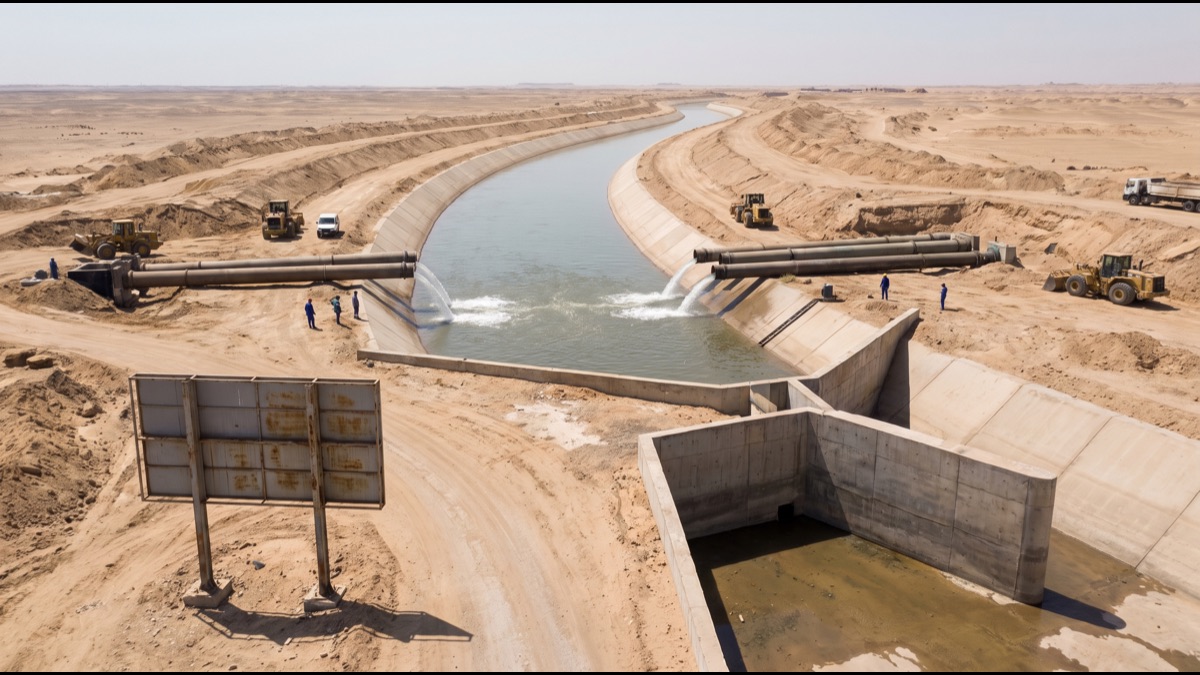
Roughly ninety-five percent of Egypt's population lives on about five percent of its land, crowded along the narrow ribbon of the Nile Valley and Delta while the vast majority of the country remains open desert. The Toshka project, launched in the late 1990s, set out to change that ratio directly by pumping Nile water far into the Western Desert to create an entirely new agricultural region roughly the size of the existing Nile Valley itself.
More than two decades later, Toshka remains one of the most ambitious and most frequently criticized infrastructure projects in modern Egyptian history, achieving only a fraction of its original targets while continuing to receive fresh investment and periodic relaunches. Understanding how the project actually works, and why its results diverged so sharply from the initial plan, explains a great deal about the genuine difficulty of engineering new farmland out of open desert.
Why Egypt Looked Beyond the Nile Valley for New Farmland
Egypt's population has grown dramatically over the past half-century while its cultivable land has expanded only modestly, producing a persistent structural mismatch between people and arable soil that successive governments have treated as a genuine long-term security concern rather than merely an economic inconvenience.
Because nearly all of that cultivable land sits within the narrow Nile Valley and Delta, the country has effectively been squeezing an expanding population into a fixed and shrinking share of usable territory, a pattern that planners have periodically tried to interrupt by proposing large new settlement and agricultural zones carved out of the surrounding desert.
Toshka was conceived as the largest and most ambitious of these attempts, aiming not merely to add a modest amount of new farmland but to create what officials at the time described as a second Nile Valley, intended to eventually support millions of new residents drawn away from the overcrowded existing valley.
What the Toshka Project Actually Set Out to Build
The core engineering concept was to draw water from Lake Nasser, the vast reservoir created by the Aswan High Dam, and pump it westward through a purpose-built canal system into the Toshka depression, a low-lying area of the Western Desert capable of holding and distributing that water across a wide new agricultural zone.
The plan envisioned reclaiming several hundred thousand feddans of new farmland, supporting new towns and agricultural communities, and eventually connecting the region to Egypt's existing infrastructure network, with officials at various points projecting that the broader New Valley region could eventually house a substantial share of Egypt's future population growth.
This was explicitly framed as a national strategic project rather than a purely agricultural one, tied to Egypt's long-standing concern about overcrowding along the Nile and to a broader ambition to demonstrate that large-scale desert reclamation, powered by Nile water and modern pumping technology, could genuinely expand the country's habitable footprint.
How Water Gets Pumped From Lake Nasser Into the Canal
The physical heart of the project is the Mubarak Pumping Station, a large facility built on the shore of Lake Nasser capable of lifting enormous volumes of water out of the reservoir and pushing it into the head of the main canal system that carries it toward the Toshka depression.
This pumping capacity was, at the time of construction, described as among the largest of its kind in the world, reflecting the sheer scale of lift and flow required to move water from a fixed reservoir elevation into a canal network stretching many kilometers across largely flat desert terrain toward the reclamation zone.
The station's design allows water to be drawn in a controlled, adjustable volume depending on the level of Lake Nasser itself, which matters because the reservoir's level fluctuates with the annual flow of the Nile and with Egypt's overall water balance, meaning the pumping station cannot simply run at a fixed maximum rate indefinitely.
Why the Canal Was Routed and Built the Way It Was
The main conveyance canal, commonly known as the Sheikh Zayed Canal, was engineered to run roughly parallel to the existing Nile corridor but well to its west, deliberately routed to reach the Toshka depression's naturally low terrain where gravity could then help distribute water further into secondary channels without requiring continuous additional pumping.
Building a canal of this length across open desert required substantial earthmoving and lining work to limit water loss through the porous desert subsoil, since an unlined channel crossing that much sandy terrain would lose a significant share of its carried volume to seepage before ever reaching the intended farmland.
The canal's construction was funded and named in recognition of significant financial support from the United Arab Emirates, reflecting the project's early framing as a joint regional undertaking rather than a purely domestic Egyptian infrastructure program, with several Gulf states expressing interest in the reclaimed land for agricultural investment.
What New Farmland the Project Has Actually Produced
Independent assessments and Egyptian government figures have generally agreed that the actual area of land reclaimed and brought into productive cultivation has fallen substantially short of the original targets set out when the project was launched, with estimates of realized cultivated land representing a small fraction of the several hundred thousand feddans originally envisioned.
The land that has been developed has produced genuine agricultural output, including various field crops and, in some areas, higher-value produce grown under private agricultural investment, demonstrating that the underlying concept of desert reclamation using pumped Nile water is technically workable rather than fundamentally flawed.
The gap between what was reclaimed and what was originally planned reflects a combination of factors rather than a single point of failure, spanning financing shortfalls, the underlying difficulty of desert soil development, and shifting government priorities across the more than two decades since the project's initial launch.
How the Project's Scale Compares to Its Original Ambitions
When Toshka was first announced, officials described a project intended to eventually rival the Nile Valley itself in habitable area, a framing that generated enormous domestic and international attention and set an extremely high bar against which the project's later, more modest results would inevitably be measured.
That initial framing has been widely acknowledged, including within Egyptian planning and academic circles, as having significantly overstated what could realistically be achieved within the original projected timeline, given the genuine technical and financial difficulty of developing desert land at that scale.
Later official communications about the project have generally adopted more measured language, describing incremental progress and specific completed phases rather than repeating the original scale of ambition, a shift that itself reflects an implicit acknowledgment of how far actual outcomes diverged from initial projections.
Why Evaporation and Seepage Became a Persistent Problem
Open canals and reservoirs in a hot desert environment lose a meaningful share of their water to evaporation, a physical reality that reduces the effective volume of water actually reaching farmland even when the pumping station itself is operating at full planned capacity from Lake Nasser.
Seepage into the surrounding sandy subsoil compounds this loss, particularly in sections of the canal network that were not fully lined during initial construction, meaning a portion of every cubic meter pumped from Lake Nasser never reaches its intended agricultural destination regardless of how efficiently the pumping infrastructure itself performs.
These losses were a known engineering consideration from the outset, but the actual scale of water lost to evaporation and seepage across the full canal network has been cited by independent water engineers as larger in practice than the more optimistic early planning assumptions had allowed for.
How Soil Quality in the New Valley Differs From the Nile Delta
The Nile Delta and Valley benefit from millennia of natural silt deposition, producing deep, naturally fertile soil that requires comparatively little amendment to support intensive agriculture, a condition that does not automatically exist in the Toshka depression's underlying desert terrain.
Desert soils reclaimed for agriculture generally require substantial upfront investment in soil improvement, including the addition of organic material, careful management of salinity, and gradual conditioning over multiple growing seasons before they can support the same intensity of cultivation as naturally silt-rich Nile land.
This soil-conditioning requirement adds real time and cost to bringing reclaimed Toshka land into full production that a simple land-area comparison with the Nile Valley does not capture, and it is one of the technical reasons agricultural yields on newly reclaimed desert plots often lag behind established Nile Valley farmland for years after initial planting.
Why Private Investment Was Brought Into the Project
Given the scale of capital required and the limits of what state financing alone could sustain over a project of this size, Egyptian authorities have periodically opened sections of the reclaimed Toshka land to private and foreign agricultural investors, offering land allocations intended to accelerate development beyond what government-led cultivation alone had achieved.
Some of this private investment has come from Gulf-based agricultural companies interested in securing long-term food production capacity outside their own more water-constrained territories, treating Toshka's reclaimed land as a strategic asset for growing crops that would otherwise be difficult to produce domestically at scale.
This shift toward private participation has produced some of the project's more visible agricultural successes, though it has also drawn criticism from commentators who argue that land intended to relieve Egyptian overcrowding has in some cases been allocated to export-oriented commercial farming rather than domestic resettlement.
How Toshka Connects to Egypt's Broader Population Strategy
Toshka has never been purely an agricultural initiative; it has consistently been framed within Egypt's broader, decades-long strategy of encouraging population movement away from the crowded Nile corridor into new desert cities and reclamation zones, a strategy that spans multiple large projects beyond Toshka alone.
This connects the project to Egypt's newer new administrative capital and other planned desert cities, all part of the same underlying policy logic that treats desert reclamation and new urban development as complementary tools for redistributing population growth away from an already saturated Nile Valley and Delta.
Whether Toshka specifically has meaningfully advanced this broader resettlement goal remains contested, since the population actually residing in the New Valley region attributable to Toshka development is generally acknowledged to represent a small fraction of the millions originally envisioned when the project was launched.
What Went Wrong With the Original Timeline
The original project timeline anticipated substantial land reclamation and settlement within roughly a decade of the canal and pumping station's completion, a schedule that proved unrealistic once the combined effects of financing gaps, soil development requirements, and infrastructure maintenance costs became clear during actual implementation.
Egypt's broader economic conditions during parts of the project's history, including periods of currency pressure and shifting national investment priorities, also affected how consistently funding was directed toward Toshka relative to other competing national infrastructure and development priorities across different government administrations.
Some phases of planned canal extension and additional pumping capacity were delayed or scaled back as a direct result of these financing constraints, meaning the physical infrastructure itself, not merely the pace of agricultural settlement, ended up smaller in several respects than the original engineering plans had specified.
How the Project Has Been Revived and Rebranded Over Time
Successive Egyptian governments have periodically relaunched Toshka under updated names and revised targets, generally accompanied by renewed public commitments to accelerate land reclamation, attract fresh investment, and integrate the project more closely with newer national development initiatives launched in subsequent decades.
These relaunches have sometimes involved genuine additional investment and completed infrastructure work, including further canal extensions and new agricultural development contracts, rather than being purely rhetorical restatements of the original 1990s vision without corresponding action on the ground.
The recurring pattern of relaunch and rebranding has itself become a point of public commentary within Egypt, with critics noting that a project repeatedly described as newly revitalized after more than two decades illustrates how difficult it has proven to translate the original ambition into a single sustained, uninterrupted development program.
Why Water Allocation From the Nile Remains Politically Sensitive
Any large-scale diversion of Nile water for a new agricultural zone occurs against the backdrop of Egypt's broader dependence on the river for the overwhelming majority of its freshwater supply, a dependence that makes water allocation decisions genuinely consequential rather than a routine administrative matter.
This sensitivity has grown more acute in recent years alongside Egypt's separate, high-profile dispute with Ethiopia over the Grand Ethiopian Renaissance Dam upstream on the Blue Nile, a dispute that has heightened domestic attention on how every cubic meter of Nile water is allocated and used within Egypt itself.
Toshka's water draw from Lake Nasser is therefore evaluated not purely as an agricultural or economic question but within this wider context of national water security, with some domestic critics specifically questioning whether directing substantial water volumes toward a still-underdeveloped desert reclamation zone represents the most defensible use of an increasingly scrutinized national resource.
What Toshka's Critics Argue About Its Cost-Effectiveness
Critics of the project, including some Egyptian economists and independent water policy analysts, have argued that the capital invested in Toshka's pumping infrastructure and canal network could plausibly have produced a larger net increase in agricultural output if directed instead toward improving efficiency and productivity on Egypt's existing, already-irrigated Nile Valley farmland.
This argument rests on the observation that reclaiming and conditioning entirely new desert land is inherently more capital- and water-intensive per unit of eventual agricultural output than incremental improvement of land that already benefits from established irrigation infrastructure and naturally fertile Nile silt.
Defenders of the project have generally responded that a purely output-per-dollar comparison undervalues Toshka's strategic objective of physically expanding Egypt's habitable and cultivable footprint, an objective they argue cannot be achieved at all through efficiency gains on existing Nile Valley land regardless of how well-executed those efficiency improvements might be.
What the Project's Future Actually Looks Like
Toshka today operates as a considerably scaled-down version of its original 1990s conception, with an established core of reclaimed and cultivated land, a functioning pumping and canal infrastructure, and an ongoing pattern of incremental expansion rather than the rapid, transformative development originally promised.
Egyptian officials continue to describe further expansion plans, generally framed in more conservative and specific terms than the project's original announcements, alongside continued efforts to attract private and foreign agricultural investment into additional reclaimed sections as capital becomes available.
Whether Toshka ultimately comes to be judged primarily as a technically successful, if slower and smaller than promised, expansion of Egypt's cultivable land, or as a cautionary case study in the gap between desert reclamation ambition and achievable reality, remains an open question that later decades of continued development will help settle.
What is not contested is that the underlying engineering challenge, moving Nile water far beyond its natural valley to create productive new farmland in open desert, has proven achievable in a technical sense while remaining vastly more difficult, slow, and capital-intensive than the project's founding announcements suggested it would be.
That gap between technical feasibility and practical, affordable execution at the originally promised scale is, more than any single design flaw, the central lesson later Egyptian and regional desert-reclamation planners have drawn from Toshka's first two and a half decades.
Sources
- Wikipedia — overview of the Toshka depression and the New Valley reclamation project
- Food and Agriculture Organization of the United Nations — agricultural and land-use data for Egypt
- Egyptian Ministry of Water Resources and Irrigation — official information on Egypt's water infrastructure and irrigation policy
- World Bank — economic and development data on Egypt's agricultural and infrastructure sectors
FAQ
What is the Toshka project in simple terms?
It is a large Egyptian project that pumps water from Lake Nasser through a canal system into the Toshka depression in the Western Desert, aiming to reclaim new farmland and eventually support new communities away from the crowded Nile Valley.
How much farmland has Toshka actually created?
Independent assessments and government figures generally agree the reclaimed and cultivated area has fallen well short of the several hundred thousand feddans originally targeted when the project launched in the late 1990s.
Why did the project fall short of its original goals?
A combination of financing gaps, the high cost and time required to condition desert soil for farming, evaporation and seepage losses in the canal system, and shifting national investment priorities over more than two decades.
Is Toshka connected to Egypt's dispute with Ethiopia over the Nile?
Not directly, but both issues heighten domestic attention on how Nile water is allocated and used within Egypt, since Toshka's Lake Nasser water draw is evaluated within the same broader national water-security context.
Is the Toshka project still active today?
Yes — it operates at a smaller scale than originally envisioned, with periodic relaunches, private agricultural investment in reclaimed sections, and continued incremental expansion rather than the rapid transformation first promised.
About the Author
We reference Wikipedia, the Food and Agriculture Organization, Egypt's Ministry of Water Resources and Irrigation, and the World Bank to explain the background and current understanding of this topic.
Loved This Article?
Share it on WhatsApp → Share it on WhatsApp
Get more guides in your inbox — Subscribe to our newsletter for weekly surprising stories from Egypt, Saudi Arabia, Dubai, and beyond.