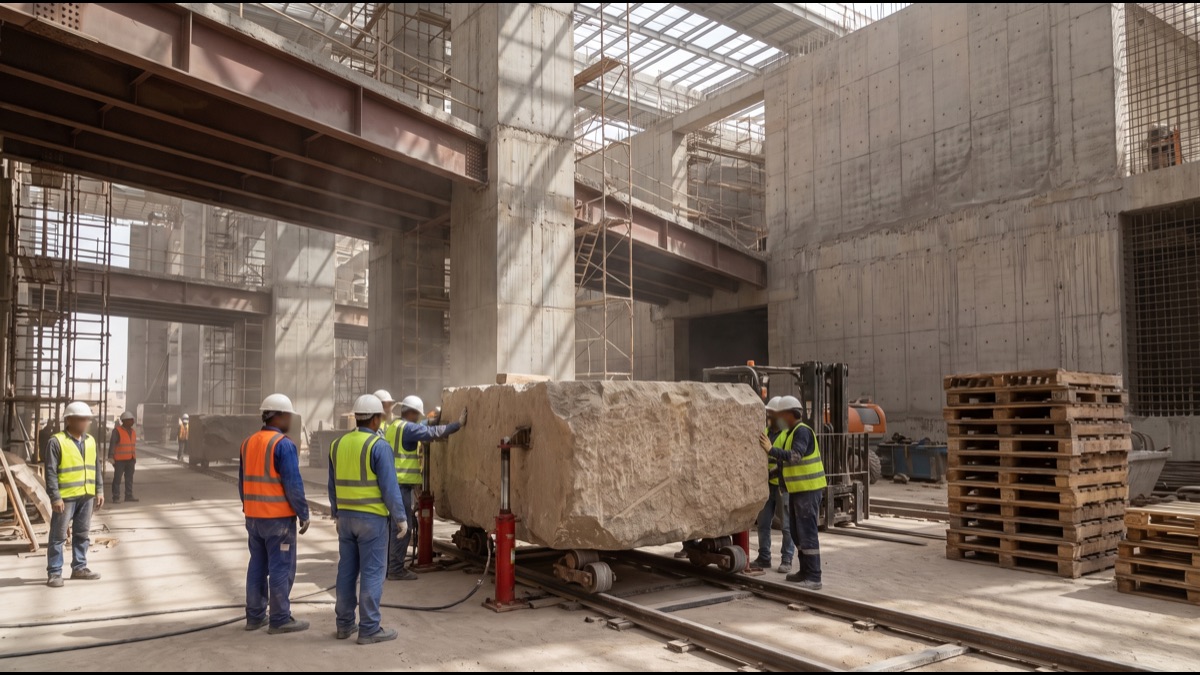
For nearly two decades, a triangular limestone-clad building rose slowly on the Giza plateau, visible from the pyramids it was deliberately built to face, while inside Cairo an entire generation of conservators quietly prepared the largest and most delicate relocation of ancient artifacts Egypt had ever attempted. The Grand Egyptian Museum, commonly shortened to GEM, is now the largest archaeological museum devoted to a single civilization anywhere in the world, but getting it from an announcement on paper to a functioning building involved an international design competition, a Japanese-financed construction program, a full-scale conservation laboratory built specifically for the project, and years of delay driven by revolution, security concerns, and a global pandemic. Understanding how it actually got built explains both why the museum looks the way it does and why "opening" turned out to be a multi-year process rather than a single ribbon-cutting.
Why Egypt Decided to Build an Entirely New Museum
The original Egyptian Museum in Tahrir Square, opened in 1902, was designed to hold a fraction of the artifacts eventually excavated across the twentieth century, and by the 1990s it was widely acknowledged within Egypt's antiquities sector to be dangerously overcrowded, with tens of thousands of objects in storage rather than on display and inadequate climate control for many fragile pieces.
Egyptian officials began discussing a new, purpose-built museum capable of properly displaying and conserving the full breadth of the country's pharaonic collection, rather than continuing to squeeze an ever-growing inventory into a colonial-era building never designed for modern conservation standards or the tourist volumes Egypt hoped to attract.
The project was formally announced in 2002, framed from the outset as a flagship cultural and tourism investment intended to give Egypt a world-class showcase for its ancient heritage on a scale that matched, and was meant to exceed, major museums elsewhere in the world.
Choosing the Giza Site and Launching a Global Design Competition
Rather than expanding in central Cairo, planners selected a roughly 50-hectare site near the Giza plateau, close enough to the pyramids that visitors could plausibly combine both in a single day, and large enough to accommodate a building program far bigger than anything possible downtown.
In 2002 and 2003, Egypt's Ministry of Culture and UNESCO jointly organized an international architectural competition, drawing more than 1,550 entries from firms and design teams in over 80 countries, reportedly one of the largest architectural competitions ever held for a single building.
The scale of the competition itself became part of the project's early publicity, signaling that Egypt intended the museum to be judged against the best contemporary museum architecture worldwide rather than treated as a conventional government building project.
The Winning Design and Its Deliberate Alignment With the Pyramids
The Dublin-based firm Heneghan Peng Architects won the competition in 2003 with a design organized around a translucent stone facade patterned with a triangular motif echoing the pyramids, and a site plan aligned on a direct visual axis toward the Giza plateau itself.
The winning concept treated the desert landscape as part of the architecture rather than something to be built over, with the building positioned so that a visitor walking through its main galleries would eventually arrive at a floor-to-ceiling window framing an unobstructed view of the pyramids, intended as the emotional and spatial climax of the visit.
Judges reportedly favored the design's restraint, choosing a building that deferred visually to the ancient monuments nearby rather than competing with them, a decision that shaped nearly every subsequent engineering and construction choice on the project.
Building on a Desert Plateau: Foundations and Structural Engineering
Constructing a building of this scale on desert terrain near a UNESCO World Heritage site required extensive geotechnical study before any foundation work began, since engineers needed both a structure capable of supporting a massive stone facade and museum floor loads, and a construction process that would not disturb archaeological remains or groundwater conditions near the pyramids.
The building's stone cladding system, using locally sourced Egyptian alabaster-toned limestone for parts of the facade, required custom fabrication and assembly techniques since the triangular geometric pattern needed extremely precise, large-format panel placement across a facade spanning hundreds of meters.
Construction proceeded in phases rather than as a single continuous build, with the main museum structure, the separate conservation center, and later external landscaping and entrance plaza work scheduled around financing availability and shifting completion targets over more than fifteen years of active construction.
Financing the Project and Japan's Central Role
The Grand Egyptian Museum's budget, ultimately estimated at well over one billion dollars across the full build-out, combined Egyptian government funding with a series of concessional loans from the Japan International Cooperation Agency, Japan's official development assistance arm, which became the project's single largest external financing partner.
JICA's involvement went beyond financing loans, extending into technical cooperation on conservation science, exhibition design training for Egyptian museum staff, and support for the specialized laboratory equipment installed in the museum's conservation center, reflecting a broader bilateral cultural cooperation relationship between Egypt and Japan.
Additional funding gaps during the project's slower years were covered through Egyptian state budget allocations and periodic reprioritization, with officials repeatedly emphasizing the museum's expected long-term tourism revenue as justification for continued investment even as the completion date moved repeatedly.
The Grand Staircase and the Building's Signature Architecture
The museum's most photographed interior space is its Grand Staircase, a soaring six-story public atrium lined with dozens of large-scale statues and monumental pieces arranged as visitors ascend, functioning simultaneously as a circulation route, an exhibition space, and the building's architectural centerpiece.
Placing structurally significant, multi-ton statues along a staircase required close coordination between structural engineers and conservators, since object mounts had to be engineered for both seismic safety and long-term stability, an unusual requirement for a space that also functions as the museum's primary vertical circulation core for tens of thousands of daily visitors.
Natural light plays a deliberate role throughout the building's public spaces, with the design using the facade's stone patterning and glazing to filter Egypt's intense desert sunlight rather than blocking it out entirely, a choice intended to keep the interior connected to the surrounding landscape.
How Tutankhamun's Full Collection Was Actually Moved
Moving Tutankhamun's roughly 5,000-piece collection, which had never before been displayed in its entirety in one place, from the old Egyptian Museum to the new site was treated as its own multi-year logistics and conservation project rather than a simple transport job.
Each object, from small jewelry pieces to large gilded shrines, chariots, and the famous funerary mask, was individually assessed, documented, and in many cases stabilized or lightly conserved before being packed into custom-built, climate-controlled crates engineered to prevent vibration damage during the roughly 12-kilometer road transfer between the two museums.
Transfers were carried out in stages over several years rather than all at once, partly to allow the conservation center's laboratories to process each batch properly and partly to manage the security requirements of moving some of the most valuable archaeological objects in the world through Cairo's streets.
Inside the Grand Egyptian Museum Conservation Center
Built and opened years ahead of the main exhibition halls, the Grand Egyptian Museum Conservation Center functions as a dedicated scientific facility with specialized laboratories for organic materials, stone, metal, and textile conservation, X-ray and CT scanning equipment, and DNA analysis capability rarely available to Egyptian antiquities work previously.
The center trained a new generation of Egyptian conservators in techniques that had often previously required sending objects, or staff, abroad, part of a broader project goal of building sustainable long-term Egyptian expertise rather than relying primarily on foreign conservation teams.
Some of the most technically demanding conservation work in the project's history took place here, including full restoration of Tutankhamun's chariots and several large wooden shrines that arrived in fragile or partially deteriorated condition after nearly a century in storage.
Repeated Delays and Why the Opening Timeline Kept Slipping
Egyptian officials initially targeted a 2015 opening when major construction accelerated in the mid-2000s, a date that slipped repeatedly across the following decade as financing, security, and construction milestones each introduced fresh delays.
Museum officials and Egyptian ministers announced several subsequent target dates publicly over the years, each accompanied by genuine construction progress, but each also eventually pushed back as new obstacles emerged, a pattern that became a recurring point of both local and international media coverage of the project.
Large-scale museum construction projects worldwide frequently run years behind original schedules, but GEM's delay period was unusually long even by that standard, a reflection of just how many external shocks intersected with the build across nearly two decades.
The 2011 Revolution, Security Concerns, and Construction Setbacks
The Egyptian revolution of January 2011 and the political instability that followed had a direct effect on the project, disrupting construction schedules, government budget priorities, and tourism forecasts that underpinned the museum's economic justification during a period when the government had far more urgent concerns.
Tourism, Egypt's largest source of foreign currency revenue and a key rationale for the museum's investment case, collapsed sharply following the revolution and again after subsequent security incidents through the following years, weakening the economic argument for accelerating an expensive, discretionary capital project.
Construction continued through this period at a reduced pace rather than stopping entirely, with the conservation center and portions of the main building progressing even as the broader completion timeline stretched further into the following decade.
COVID-19 and the Final Push Toward Completion
The COVID-19 pandemic added a further, more direct disruption starting in 2020, halting international shipments of specialized exhibition equipment, delaying contractor work due to public health restrictions, and freezing global tourism entirely during a period the museum had hoped to use for final preparation and staff training.
Egyptian authorities used part of the pandemic period productively, accelerating conservation lab work on objects already relocated to the site since many of those tasks did not depend on international travel or large on-site construction crews in the same way finishing work did.
By 2022 and 2023, construction had visibly entered its final phase, with landscaping, entrance plaza work, and the last major gallery installations proceeding toward a long-anticipated opening that Egyptian officials had by then learned to announce cautiously given the project's history of shifting dates.
The Phased Trial Opening and Public Access
Rather than a single grand opening, the museum adopted a phased approach, opening select areas including the Grand Staircase, some exhibition halls, and public commercial spaces to visitors starting in 2024 under a trial operating period, while the full Tutankhamun galleries and remaining sections continued final preparation.
This phased strategy allowed Egyptian tourism authorities to begin generating visitor revenue and international attention immediately rather than waiting for every gallery to be simultaneously ready, while also giving museum staff a live operating environment to refine visitor flow, ticketing, and security procedures ahead of full capacity operation.
Officials framed the phased opening explicitly as a deliberate operational choice rather than another delay, distinguishing it from the earlier pattern of postponed full openings that had defined much of the project's public narrative in prior years.
What the Museum Holds Beyond Tutankhamun
While Tutankhamun's collection draws the most international attention, the Grand Egyptian Museum's total holdings span more than 100,000 artifacts covering the full sweep of ancient Egyptian history, from prehistoric and early dynastic material through the Old, Middle, and New Kingdoms and into the Greco-Roman period.
The museum also displays the solar boat of Khufu, a roughly 4,600-year-old full-size wooden vessel excavated near the Great Pyramid, relocated to a dedicated gallery designed specifically around its scale and structural conservation requirements.
Curatorial planning grouped many objects thematically and chronologically rather than purely by object type, an approach intended to give visitors a coherent narrative of Egyptian civilization's development rather than a purely encyclopedic room-by-room display.
Economic Goals: Tourism Revenue and Job Creation
Egyptian tourism officials have consistently framed the Grand Egyptian Museum as a centerpiece of a broader strategy to raise annual visitor numbers substantially, positioning the museum alongside the Giza pyramids as a combined must-see destination capable of extending average tourist stays in the Cairo area.
The project also generated substantial direct and indirect employment, from construction and conservation staff during the build to permanent museum operations, retail, hospitality, and tour-guiding roles expected to expand once the museum reaches full operating capacity.
Government economic planning has linked the museum's success to wider goals around foreign currency earnings from tourism, one of Egypt's most important sources of hard currency and a sector policymakers have repeatedly prioritized in national economic strategy discussions.
Common Misconceptions About the Grand Egyptian Museum
A common misconception is that the museum opened on a single date; in reality, public access rolled out in stages starting in 2024, with different galleries and facilities becoming available to visitors at different points rather than everything opening simultaneously.
Another misconception assumes the old Egyptian Museum in Tahrir Square closed once the new museum opened; Egyptian authorities have indicated the historic downtown museum continues operating with a modified collection, rather than being shut down entirely.
A third misconception treats the project's delays as evidence of mismanagement alone; while inefficiencies existed as with any megaproject of this scale, independent analysis has generally attributed the bulk of the delay to genuinely disruptive external events, including a revolution, a regional security downturn, and a global pandemic, rather than construction failures on their own.
Getting the Grand Egyptian Museum from a 2002 announcement to a functioning building on the Giza plateau took an international design competition, a conservation science program built almost from scratch, a major bilateral financing relationship with Japan, and the resilience to keep construction moving through a revolution, a tourism collapse, and a global pandemic. The result is a museum built explicitly to face the pyramids it sits beside, holding a collection whose scale and conservation quality Egypt had wanted to properly display for more than a century, and one whose long, difficult construction story is now becoming as well known internationally as the artifacts inside it.
Sources
- Grand Egyptian Museum Official Site — Official project information, gallery descriptions, and visitor updates.
- Japan International Cooperation Agency (JICA) — Financing and technical cooperation details for the museum project.
- Egyptian Ministry of Tourism and Antiquities — Government reporting on Egypt's museum and heritage sector.
- UNESCO World Heritage Centre — Memphis and its Necropolis — Heritage context for the Giza plateau site.
- Heneghan Peng Architects — Design firm background and project architecture details.
FAQ
How long did it take to build the Grand Egyptian Museum?
Construction and preparation spanned roughly two decades from the original 2002 announcement and 2005 design competition through a phased opening that began with partial public access starting in 2024, making it one of the longest-running museum builds in the world.
Who designed the Grand Egyptian Museum?
The Irish-based firm Heneghan Peng Architects won an international design competition in 2003 that drew entries from firms in dozens of countries, with a design deliberately aligned on an axis toward the Giza pyramid plateau.
How was Tutankhamun's collection moved to the new museum?
Conservators packed and transported thousands of individual objects, including large and structurally fragile pieces like gilded shrines and chariots, in specially engineered climate-controlled crates over a multi-year relocation project from the old Egyptian Museum in Tahrir Square.
Why was the Grand Egyptian Museum's opening delayed so many times?
Delays stemmed from a combination of financing gaps, the 2011 revolution and subsequent political instability, regional security concerns affecting tourism forecasts, and the COVID-19 pandemic, each of which pushed back construction, staffing, or the final opening date.
Who paid for the Grand Egyptian Museum?
The project combined the Egyptian government's own budget with major concessional loan financing from the Japan International Cooperation Agency, along with in-kind support and expertise for the conservation and exhibition planning.
About the Author
We reference the Grand Egyptian Museum's official communications, the Japan International Cooperation Agency, Egypt's Ministry of Tourism and Antiquities, UNESCO, and Heneghan Peng Architects to explain the background and current understanding of this topic.
Loved This Article?
Share it on WhatsApp → Share it on WhatsApp
Get more guides in your inbox — Subscribe to our newsletter for weekly surprising stories from Egypt, Saudi Arabia, Dubai, and beyond.