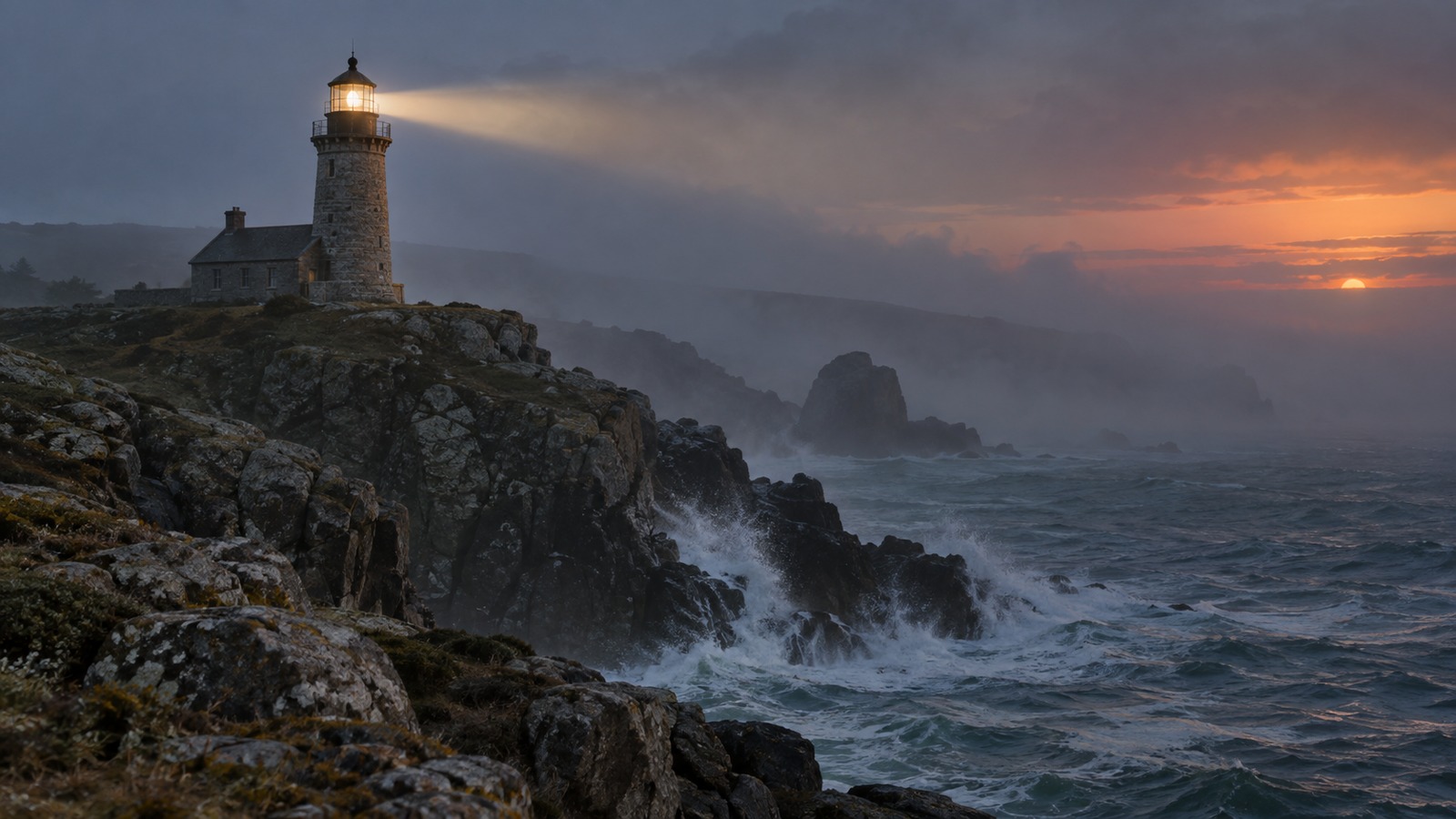
For most of maritime history, a lighthouse was simply an open fire kept burning on a headland. That crude arrangement reliably meant one thing to a sailor scanning a dark coastline: land, rocks, or a harbour entrance lay somewhere nearby. The purpose of a lighthouse has not changed since then, but almost everything about how it delivers that warning has been rebuilt from the ground up, several times over, as new technology made each previous version obsolete.
Tracing that evolution, from open flame to reflector, from whale oil to electricity, from a resident keeper to a satellite-monitored automatic beacon, explains not only how coastal navigation actually works today but also why a technology many assume GPS made irrelevant is still being maintained, restored, and in some cases built anew along coastlines around the world.
Why Lighthouses Existed Long Before Electricity
The earliest known lighthouse-like structures, including the Pharos of Alexandria in the third century BCE, worked on the simplest possible principle: build a fire high enough on a tower that it remains visible from far out at sea, well before a low-lying coastline itself becomes visible to an approaching ship.
For centuries afterward, coastal authorities and private operators built towers topped with open coal or wood fires, sometimes housed in a lantern room to shield the flame from wind and rain, but fundamentally still relying on raw combustion rather than any optical engineering to project the light further.
The practical range of an open-flame light was modest and inconsistent, heavily dependent on weather, fuel quality, and how diligently a keeper tended the fire through the night, which left considerable gaps in coverage along busy and dangerous shipping routes.
How Open Flames Gave Way to Reflectors
The eighteenth century brought the first serious optical improvement: parabolic metal reflectors, typically silvered copper, positioned behind an oil lamp to gather scattered light and redirect it into a more concentrated, forward-facing beam rather than letting it radiate uselessly in every direction.
This catoptric approach, meaning reflector-based, meaningfully extended a light's visible range for the same amount of fuel burned, and became the standard design across many national lighthouse services through the early nineteenth century, including installations along British and American coastlines.
Reflectors were still relatively inefficient, however, since a large proportion of the light produced by the lamp was absorbed or lost rather than successfully redirected, which set the stage for a considerably more effective optical solution developed in France.
Why the Fresnel Lens Changed Everything
In 1822, French physicist Augustin-Jean Fresnel introduced a stepped lens design that solved the reflector's core inefficiency. Instead of one thick, heavy piece of glass, the Fresnel lens used a series of concentric prism rings that bent light from a single lamp into a tightly focused beam, using dramatically less glass and weight than a conventional lens of equivalent power.
The practical effect was transformative: a Fresnel lens could project a visible beam dozens of kilometres out to sea from a modest oil lamp, a range previously achievable only with much larger and more expensive light sources, and it did so using an apparatus light enough to be rotated by a modest clockwork mechanism.
Fresnel lenses were manufactured in a standardised series of sizes called orders, from the enormous first-order lenses used at major coastal landfall lights to smaller sixth-order lenses suited to harbour entrances, allowing lighthouse authorities to match optical power to the specific navigational importance of each site.
How Fuel Sources Evolved From Whale Oil to Electricity
Through most of the nineteenth century, lighthouse lamps burned whale oil, prized for burning cleanly and consistently, though its cost rose considerably as whale populations declined under commercial hunting pressure, pushing lighthouse authorities toward cheaper alternatives including colza oil, kerosene, and eventually vaporised mineral oil burned under pressure.
Electric arc lighting arrived at a small number of prestige lighthouses in the late nineteenth century, offering far greater brightness than any oil flame, but the technology remained expensive, mechanically complex, and unreliable enough that oil-burning lamps continued serving the majority of lighthouses well into the twentieth century.
Widespread electrification of lighthouses only became practical once reliable incandescent and later halogen lamps existed alongside dependable power supply, whether from mains connection at accessible sites or generators and eventually solar arrays at remote ones, finally allowing oil lamps to be retired at most stations.
Why Every Lighthouse Has a Unique Light Pattern
A mariner identifying a lighthouse at night relies not on its colour alone but on its characteristic, a specific timed sequence of flashes, occultations, or steady light unique to that particular station and recorded on nautical charts, allowing a navigator to confirm exactly which light they are observing.
This characteristic is produced by rotating the lens assembly at a fixed speed, or by mechanically or electronically interrupting a fixed light, and the resulting pattern, whether a single flash every five seconds or a more complex group-flashing sequence, functions as a kind of maritime fingerprint for that coastline.
Because two lighthouses positioned close enough to be confused would defeat the purpose of unique identification, coordinating authorities carefully assign distinct characteristics to neighbouring lights, a planning requirement that has remained essentially unchanged from the Fresnel era through to today's electronic beacons.
How Keepers' Jobs Actually Disappeared
For most of lighthouse history, a resident keeper was essential: someone had to trim wicks, refill fuel reservoirs, wind the clockwork rotation mechanism, polish the lens, and above all watch through the night for any failure that would leave the light dark and ships unwarned.
Automation eliminated these tasks one by one over the twentieth century. Reliable electric lamps removed the need for constant fuel tending, automatic lamp-changers swapped in a spare bulb the instant one failed, and photoelectric sensors switched lights on and off with dusk and dawn without any human intervention required.
The final wave of automation added remote monitoring, transmitting a light's operational status back to a central control centre so that any fault triggers an alert and a maintenance visit, rather than depending on a keeper's continuous physical presence, a shift that eliminated the profession almost entirely by the late twentieth century in most developed maritime nations.
What Automation Actually Replaced
It is worth being precise about what automation removed and what it did not. The optical principles established by Fresnel remain largely intact at many historic stations; automation replaced the human labour of operating and monitoring the light, not the fundamental physics of how the light is produced and projected.
Modern automated stations still require periodic physical maintenance, including cleaning optics, replacing components, and servicing power systems, but this work is now performed by visiting technicians on a scheduled or fault-triggered basis rather than by someone living permanently at the site.
The economic case for automation was straightforward: maintaining a resident keeper, including housing, supply runs, and salary, cost considerably more over a light's operating life than the combination of automated equipment and periodic maintenance visits, particularly at remote or difficult-to-access locations.
How Radar Beacons Extended a Lighthouse's Reach
Visual range is fundamentally limited by weather and the curvature of the earth, so twentieth-century engineers added a complementary technology: the radar beacon, or racon, a transponder that receives a ship's radar pulse and transmits back an identifying signal displayed directly on the vessel's radar screen.
A racon-equipped lighthouse effectively extends its usefulness into fog, heavy rain, and darkness far beyond what a visual light alone can achieve, since a ship's radar can detect and correctly identify the station well before any lookout could see it, or in conditions where visual identification is impossible altogether.
This layering of technologies, optical light plus radar identification, reflects a broader pattern in coastal navigation aids: rather than each new system fully replacing the last, most stations accumulate complementary capabilities that together provide redundancy no single method offers alone.
Why GPS Did Not Make Lighthouses Obsolete
Satellite navigation might reasonably be expected to have made lighthouses redundant, and it has certainly reduced day-to-day reliance on visual coastal lights for routine position-fixing, but maritime authorities have deliberately kept the network operating rather than decommissioning it wholesale.
The reasoning centres on redundancy: GPS signals can be degraded, jammed, or lost entirely through equipment failure, atmospheric interference, or deliberate interference in contested waters, and a mariner who suddenly loses satellite positioning still benefits enormously from a lit, charted, unmistakably identified tower on a fixed coastal position.
Many maritime authorities explicitly frame their remaining lighthouse network as a resilience layer for exactly this scenario, a philosophy sometimes described as ensuring navigation does not depend entirely on any single technology, however reliable that technology normally is.
How Solar Power Changed Remote Lighthouse Maintenance
Solar photovoltaic panels paired with battery storage transformed the economics of maintaining lights at remote or difficult-to-access locations, since a station no longer needs mains electricity, a generator requiring regular fuel deliveries, or a keeper to maintain either.
A modern solar-powered light typically uses highly efficient LED lamps drawing far less power than older incandescent sources, allowing a comparatively small solar array and battery bank to keep a beacon running reliably through extended periods of poor weather with minimal sunlight.
This combination has made it economically practical to maintain navigation lights at genuinely isolated reefs, rocks, and minor headlands that would never have justified the cost of a resident keeper or regular fuel supply runs under the older technology.
Why Some Historic Lighthouses Are Being Decommissioned
Where a combination of satellite navigation, buoys, and other electronic aids already provides adequate coverage for a stretch of coastline, some maritime authorities have concluded that continuing to maintain an ageing structure and its optical equipment is no longer cost-justified relative to the marginal safety benefit it provides.
Decommissioning does not always mean demolition. Many retired lighthouses are transferred to heritage trusts, local governments, or private buyers, who preserve the structure as a historic landmark, museum, or even boutique accommodation, while navigation authorities remove or replace only the operational optical equipment.
This distinction between the physical tower as heritage asset and the light as an active aid to navigation has become an increasingly common way to reconcile budget pressure on maritime agencies with genuine public and historical interest in preserving these structures.
How Modern LED Optics Differ From Fresnel Lenses
Contemporary lighthouse installations increasingly use LED arrays combined with much smaller, simpler acrylic optics rather than a large classical Fresnel lens, since modern LEDs can be arranged and aimed directly to produce a controlled beam without needing a single massive lens to concentrate light from one central lamp.
LEDs also last dramatically longer than incandescent or halogen bulbs, drastically reducing how often a maintenance visit is needed purely to replace a failed lamp, and they consume far less power for equivalent visible range, which pairs naturally with the shift toward solar power at remote stations.
Where a historic Fresnel lens remains in place at a still-operating station, it is often kept for heritage and tourism value even after the original lamp behind it has been swapped for a modern LED source, preserving the visual character of the light while modernising its actual power source.
Why Fog Signals Evolved Alongside Light Design
A light, however powerful, is useless in dense fog, which is precisely when ships most need warning of a dangerous coastline, so lighthouse stations historically paired their optical signal with an audible one, evolving from hand-rung bells and cannon fire to steam-powered horns and eventually electronic foghorns.
Fog signal technology followed a broadly similar automation trajectory to the light itself, moving from manually operated equipment requiring constant attention to automated systems triggered by visibility sensors that detect fog conditions and sound the signal without any human decision required.
Many fog signals have since been decommissioned as ship-borne radar, AIS, and GPS reduced mariners' reliance on audible cues, though some remain in service, particularly in busy or hazardous waters where redundant warning systems are still considered worthwhile.
How Lighthouses Became Heritage Sites
As automation and decommissioning reduced the number of actively staffed or even actively maintained lighthouses, public interest in preserving them as historical landmarks grew correspondingly, motivated by their architectural distinctiveness, their role in local maritime history, and often their striking coastal settings.
Preservation efforts range from simple structural maintenance funded by heritage grants to full adaptive reuse as museums, visitor centres, or accommodation, with former keeper's cottages frequently repurposed since they already include living quarters built for exactly that kind of occupancy.
This heritage function now exists somewhat independently of a lighthouse's original navigational purpose, meaning a structure can continue standing, staffed by volunteers or heritage-trust employees, long after its actual aid-to-navigation function has been reduced, automated, or formally discontinued.
What the Future of Coastal Navigation Aids Looks Like
The trajectory over the past two centuries has consistently been toward less human labour, more redundancy across multiple technologies, and lower operating cost per station, and there is little reason to expect that trend to reverse; further consolidation and automation of the remaining physical light network seems likely.
At the same time, the persistence of physical lighthouses despite decades of confident predictions about GPS rendering them obsolete suggests that maritime authorities continue to value a navigation aid that does not depend on satellites, electronics susceptible to jamming, or any single point of failure.
The lighthouse's underlying purpose, a fixed, unmistakable, independently verifiable signal marking a specific point on a dangerous coastline, has proven durable across open flame, reflector, Fresnel lens, electrification, automation, and now solar-powered LED optics, even as almost every detail of how that purpose is delivered has been rebuilt multiple times over.
What began as a fire on a headland has become a largely unattended, solar-powered, remotely monitored beacon that quietly does the same essential job it always did, still standing as a deliberate hedge against the failure of every more sophisticated system built since.
Sources
- Wikipedia — overview of lighthouse history, optics, and operation
- International Association of Marine Aids to Navigation and Lighthouse Authorities (IALA) — international standards for aids to navigation
- United States Coast Guard — operational data on lighthouse automation and aids to navigation
- Trinity House — UK general lighthouse authority, historical and operational records
- International Maritime Organization — global maritime safety and navigation standards
FAQ
Why don't lighthouses need keepers anymore?
Automated lamp-changing mechanisms, solar power, and remote monitoring systems replaced the need for a resident keeper to trim wicks, wind clockwork, and watch for failures around the clock.
Are lighthouses still necessary now that ships have GPS?
Most maritime authorities keep them as a low-cost, GPS-independent backup, since satellite navigation can fail, be jammed, or lose signal, while a lit tower on a fixed, charted position cannot.
What was a Fresnel lens and why did it matter?
It was a stepped lens design that bent light from a single lamp into a powerful, far-reaching beam using a fraction of the glass and weight of a conventional lens, transforming how far a light could be seen.
How do modern lighthouses communicate with ships electronically?
Many now carry a radar beacon (racon) that returns an identifying signal on a ship's radar screen, and some broadcast their identity and position via the Automatic Identification System (AIS).
Why are some historic lighthouses being decommissioned?
Where satellite navigation, buoys, and other electronic aids provide sufficient coverage, maintaining an old structure is no longer judged cost-effective, though many are preserved as heritage sites instead of being demolished.
About the Author
We reference Wikipedia, the International Association of Marine Aids to Navigation and Lighthouse Authorities, the United States Coast Guard, Trinity House, and the International Maritime Organization to explain the background and current understanding of this topic.
Loved This Article?
Share it on WhatsApp → Share it on WhatsApp
Get more guides in your inbox — Subscribe to our newsletter for weekly surprising stories from Egypt, Saudi Arabia, Dubai, and beyond.