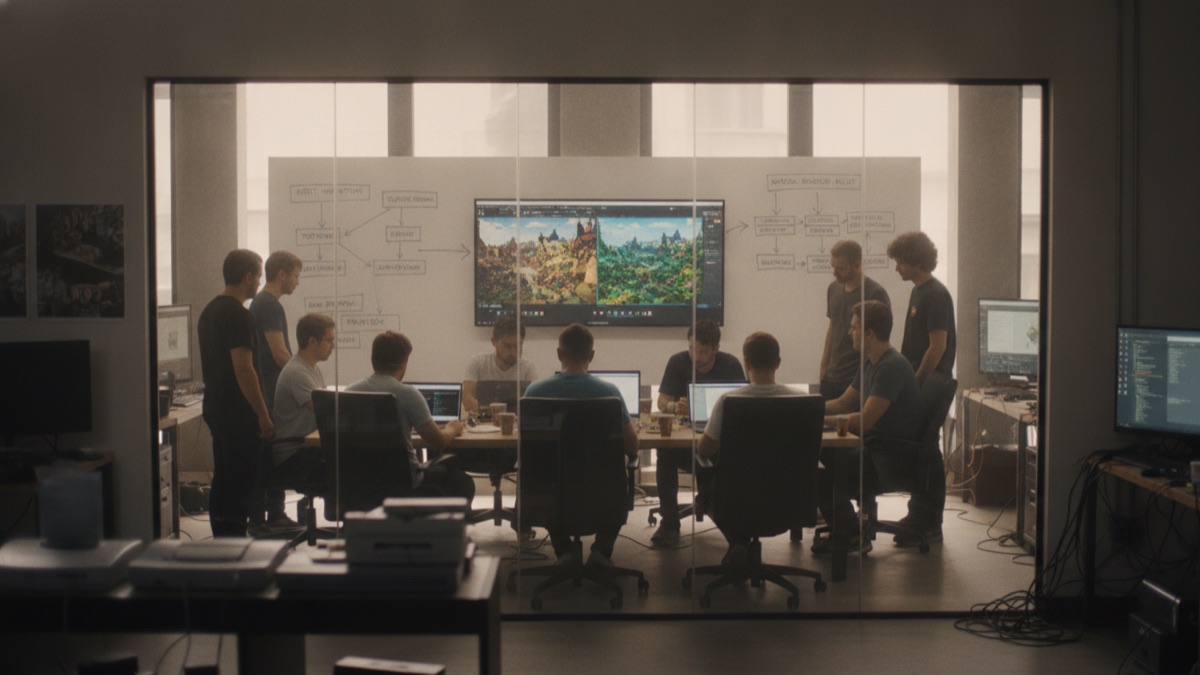
A modern remaster hitting store shelves looks like a straightforward victory lap for a beloved old game, but the reality behind that box art is generally closer to archaeology than simple graphics work. Teams routinely rebuild games from partial, damaged, or entirely missing original materials, negotiate music and voice contracts that expired decades earlier, and make hard technical tradeoffs most players never notice. Understanding what actually happens between a publisher's remaster announcement and a finished product helps explain why some remasters feel like loving restorations and others feel like a rushed cash grab.
Remaster vs. Remake vs. Re-Release: Getting the Terms Straight
The terms remaster, remake, and re-release get used almost interchangeably in marketing copy, but they generally describe fairly distinct kinds of work. A remaster typically means the original game's code and engine stay largely intact, while textures, resolution, frame rate, and sometimes lighting or audio are upgraded to look and sound better on modern hardware.
A remake, by contrast, generally means rebuilding a large portion of the game from scratch, often on a new engine, with new models, animations, and sometimes reworked mechanics or camera systems, while keeping the story, characters, and core identity recognizable.
A re-release or port sits at the opposite end from a remake: it is essentially the original game moved to new hardware, sometimes through emulation, with minimal to no visual or mechanical changes. Knowing which category a given project falls into matters, since expectations and criticism differ substantially depending on which promise was actually made.
Why a Remaster Almost Always Means Same Engine, Better Assets
Because a remaster generally keeps the original code and game logic intact, the bulk of the work concentrates on replacing or enhancing assets: higher-resolution textures, denser character and environment models where the engine can support them, sharper lighting, and modernized post-processing effects layered over unchanged gameplay systems.
This approach tends to keep budgets and timelines considerably lower than a full remake, and it preserves the exact feel that longtime fans remember, since the underlying physics, animation timing, and level layouts are untouched.
The tradeoff is that a remaster is fundamentally constrained by what the original engine can actually do. Studios can upscale a texture, but they generally cannot add dynamic lighting, physics-based destruction, or entirely new camera behavior without touching the underlying code, at which point the project starts drifting toward remake territory.
What a Full Remake Actually Involves
A remake is closer in scope to producing a new game than to polishing an old one. Environments, character models, animations, and often core gameplay systems are typically rebuilt from reference material, concept art, design documents, and the original game itself, rather than reused from existing files.
Projects widely cited as remakes, such as the 2019 Resident Evil 2 remake or the 2020 Demon's Souls remake developed by Bluepoint Games, involved production timelines and team sizes broadly comparable to an original AAA game, not a quick asset swap.
Remakes also carry more creative risk than remasters, since design teams have to decide which changes modernize the experience and which changes would alienate players who came specifically for a faithful trip back to something they loved. Studios that get this balance wrong tend to hear about it immediately from longtime fans.
Source Code and Asset Archaeology
A recurring, and often underappreciated, challenge in remaster and remake production is that the original source code, source art files, and design documents for older games are frequently incomplete, damaged, or missing entirely by the time a remaster is greenlit decades later.
The Video Game History Foundation, a nonprofit dedicated to game preservation, has documented how commonly this happens across the industry, citing poor archival practices, format obsolescence, degraded physical media, and studio closures as recurring causes of lost source material.
When originals genuinely cannot be located, teams sometimes resort to reverse engineering or decompiling the shipped, compiled version of a game, or extracting assets directly from released discs or cartridges, a slower, more technically demanding process that also raises its own legal and rights-clearance complications.
When the Original Studio No Longer Exists
Many classic games were made by studios that have since closed, merged, or been absorbed into larger companies, meaning the publisher that owns the intellectual property today may hold none of the original production files, notes, or institutional knowledge behind how the game was actually built.
A handful of studios, including Bluepoint Games, Nightdive Studios, Digital Eclipse, and Iron Galaxy, have built specific reputations around reconstructing games under exactly these conditions, reverse-engineering old systems, tracking down former developers for input, and rebuilding pipelines essentially from scratch.
These arrangements can also surface complicated rights questions, particularly for older titles where credited developers, contractors, and licensors were never clearly documented, forcing publishers into legal research nearly as involved as the technical reconstruction itself.
Texture and Model Upscaling: AI vs. Manual Re-Authoring
Two broad approaches dominate texture and model work in remasters: AI-based upscaling tools that use trained neural networks to increase the resolution and apparent detail of existing texture images, and full manual re-authoring, where artists recreate assets by hand at higher fidelity.
AI upscaling is generally faster and cheaper, making it attractive for the sheer volume of background, environment, and secondary assets a typical game contains, but it can introduce visual artifacts or invented detail that doesn't always match the original art direction faithfully.
Manual re-authoring, though considerably more labor-intensive, tends to be reserved for hero assets, main characters, key cutscene models, and anything the camera lingers on, where preserving the original artist's intent matters most, with many productions blending both approaches across a single project.
The Limits of AI Upscaling
The 2021 Grand Theft Auto: The Trilogy – The Definitive Edition drew widespread criticism, reportedly for character models and textures that appeared to lean heavily on automated upscaling tools without sufficient manual cleanup, producing a look many players and critics described as inconsistent with the original games' art style.
Beyond aesthetics, AI upscaling has real technical ceilings: it can sharpen an existing image but generally cannot infer three-dimensional geometry, fix low-polygon silhouettes, or resolve mismatches between an upscaled texture and a lighting and shading pipeline built for lower-resolution assets, which is why studios that rely on it heavily often still need a substantial manual pass afterward.
Audio Remastering and the Multi-Track Problem
Ideally, audio remastering works from original multi-track recordings, separate stems for dialogue, music, and effects, allowing engineers to rebalance and enhance each element independently without touching the others.
In practice, studios frequently only have access to the final mixed-down audio that shipped in the original game, especially for older titles where music and dialogue were heavily compressed to fit tight console memory or disc-space budgets, since intermediate production files were often discarded once the original master was finalized.
Working from a flattened mix generally limits how much can be improved without introducing new artifacts, and in some cases studios opt to re-record instrumental music or dialogue entirely rather than fight the technical limits of decades-old compressed audio.
Modernizing Controls and UX for Today's Players
Beyond visuals and audio, remasters and remakes commonly modernize control schemes, camera systems, user-interface scaling for larger and higher-resolution modern displays, and quality-of-life features like autosave, fast travel, or adjustable difficulty that were rare or absent when the original released.
This creates a real design tension: longtime fans sometimes want the exact original control feel preserved out of nostalgia or muscle memory, while new players generally expect the control conventions and accessibility options standard in modern releases.
Many recent remasters address this by offering both a classic control or camera option alongside a modern default, letting each audience choose the experience it wants rather than forcing a single compromise on everyone.
Licensing Complications: Music Rights That Expire
Licensed music tracks embedded in a game are typically negotiated under contracts with limited terms covering a specific number of years, platforms, or regions, not a permanent, unlimited grant, which becomes a serious problem when a publisher wants to re-release that same game a decade or two later.
Games historically built around large licensed soundtracks, sports titles, skateboarding and driving games, and rhythm games among them, have a long, well-documented history of losing individual tracks in re-releases when rights could not be renegotiated affordably, sometimes replacing beloved songs with substitute tracks that fans immediately notice and complain about.
Renegotiating expired music rights years later can also cost significantly more than the original licensing deal, since the commercial value of nostalgia can work against the publisher just as easily as it works in their marketing's favor.
Voice Actor Contracts and Likeness Rights
Original voice acting contracts, particularly for older games made before remaster clauses and long-term residual terms became standard industry practice, sometimes did not anticipate the game being re-released years or decades later, creating ambiguity over whether new compensation is owed or new recording sessions are even contractually possible.
An actor may also be unavailable, have moved on from the role, or in some cases have passed away, forcing a studio to either recast a beloved character's voice, a decision fans often react to strongly, or work around the limitation by reusing original recordings even where new dialogue would otherwise be desirable.
Likeness rights add another layer for remakes that rebuild character models in far greater fidelity than the original hardware allowed, since a character modeled closely on a real actor's face and performance may require a separate, updated likeness agreement beyond the original voice contract.
Notable Case Studies: Well-Received Remasters
The 2019 Resident Evil 2 remake and the 2020 Demon's Souls remake, developed by Bluepoint Games for PlayStation 5, are widely cited by outlets including IGN and Eurogamer as examples of remakes that modernized presentation and mechanics substantially while preserving what made the originals distinctive in the first place.
Shadow of the Colossus, remade for PlayStation 4, is another frequently praised example, generally credited for treating the original's deliberate pacing and atmosphere as essential rather than something to be smoothed over in pursuit of modern conventions.
A common thread across well-received projects is that the original creative direction, not just the technical fidelity, was treated as something to protect, with development teams that studied why the source material worked before deciding what to change.
Notable Case Studies: Poorly Received Remasters
Grand Theft Auto: The Trilogy – The Definitive Edition remains one of the most frequently cited cautionary examples, launching in 2021 with technical issues and art-direction criticism that outlets including Digital Foundry and Eurogamer covered extensively at the time, later prompting patches and, in some cases, partial reversals of the changes.
A recurring pattern behind poorly received remasters is a compressed production timeline, work outsourced to a studio without deep familiarity with the original material, and internal testing that did not catch problems obvious to the wider player base once the game actually shipped.
These cases tend to reinforce a broader industry lesson: treating a remaster as a low-priority side project, rather than a full production with its own dedicated budget and schedule, is one of the more reliable predictors of a poor critical and commercial reception.
Why Publishers Greenlight Remasters Over New IP
From a business standpoint, remasters carry meaningfully lower financial risk than developing new intellectual property: the audience, brand recognition, and marketing narrative already exist, and a smaller team can typically deliver a remaster on a materially shorter timeline than a full original game.
Remasters can also serve as a low-cost way to test market appetite for a franchise, or to build anticipation ahead of a genuinely new sequel, while simultaneously extending the commercial lifespan of older catalog titles on modern storefronts and subscription services.
Business press coverage of the games industry, including reporting from Reuters and other outlets on rising AAA development budgets, has noted that this risk calculus has become more pronounced as new-game production costs climb, giving publishers additional incentive to lean on proven, lower-risk catalog titles.
Preservation Concerns and the Video Game History Foundation
The Video Game History Foundation has published research indicating that a substantial majority of classic games are no longer commercially available in any legal form, making official remasters and re-releases one of the few legitimate paths back to a game that would otherwise only be accessible through unofficial emulation.
That said, the organization is careful to distinguish commercial remaster activity from genuine archival preservation, since remaster decisions are generally driven by anticipated sales rather than a comprehensive effort to keep the full historical catalog accessible, meaning many titles without obvious commercial appeal remain effectively lost to most players.
The Foundation has also advocated for legal reforms, including expanded exceptions allowing libraries and researchers to provide access to out-of-print games, arguing that relying solely on publishers' commercial incentives leaves large parts of game history permanently at risk.
Nostalgia Bias vs. Genuine Quality Assessment
Critics and players alike are subject to nostalgia bias, where fond memories of an original game can inflate expectations for a remaster or color reception of the final product in ways that have little to do with the remaster's actual technical or creative execution.
Outlets like Digital Foundry have built a reputation specifically around separating technical, measurable analysis, frame rate, resolution, load times, rendering accuracy, from more subjective, nostalgia-driven reactions, offering a useful methodological contrast to reviews built primarily around emotional response.
The most useful way to evaluate any given remaster is generally to ask what specifically changed, why the studio made that choice, and whether the change served the material, rather than treating remasters as a uniform category that is either automatically good because it revives something beloved, or automatically suspect because it deviates from memory.
Sources
- Video Game History Foundation — Nonprofit organization researching and advocating for the preservation of video game history and access to out-of-print games.
- Digital Foundry (Eurogamer) — Technical analysis outlet covering frame rate, resolution, and rendering comparisons across remasters and remakes.
- IGN — Games media outlet covering remaster and remake reviews, industry reporting, and developer interviews.
- Game Developers Conference (GDC) Vault — Recorded talks from developers on remaster production, asset reconstruction, and engine work.
FAQ
What's the difference between a remaster and a remake?
A remaster generally keeps the original game's code and engine intact while upgrading assets like textures, resolution, and audio, whereas a remake typically rebuilds much of the game from scratch, often on a new engine, while preserving the story and core identity.
Why is source code sometimes lost for classic video games?
Source code and original production files can go missing due to poor archival practices, obsolete file formats, degraded physical storage media, and studio closures, a pattern the Video Game History Foundation has documented across much of the industry.
Can AI texture upscaling fully replace manual artist work in a remaster?
Generally not on its own; AI upscaling can sharpen existing textures quickly and cheaply but cannot fix low-polygon geometry or fully match original art direction, so many studios pair it with manual re-authoring for the assets players see most closely.
Why do music licenses cause problems when older games are re-released?
Licensed music is typically negotiated for a limited term, platform, or region rather than permanently, so publishers often have to renegotiate rights years later at significant added cost, sometimes leading to tracks being replaced in a remaster.
Why do publishers favor remasters over funding brand-new games?
Remasters carry lower financial risk since the audience and brand recognition already exist, typically require smaller teams and shorter timelines than new development, and can extend the commercial life of a franchise's back catalog.
About the Author
We reference the Video Game History Foundation, Digital Foundry's technical analysis, IGN, and the GDC Vault to explain the background and current understanding of this topic.
Loved This Article?
Share it on WhatsApp → Share it on WhatsApp
Get more guides in your inbox — Subscribe to our newsletter for weekly surprising stories from Egypt, Saudi Arabia, Dubai, and beyond.