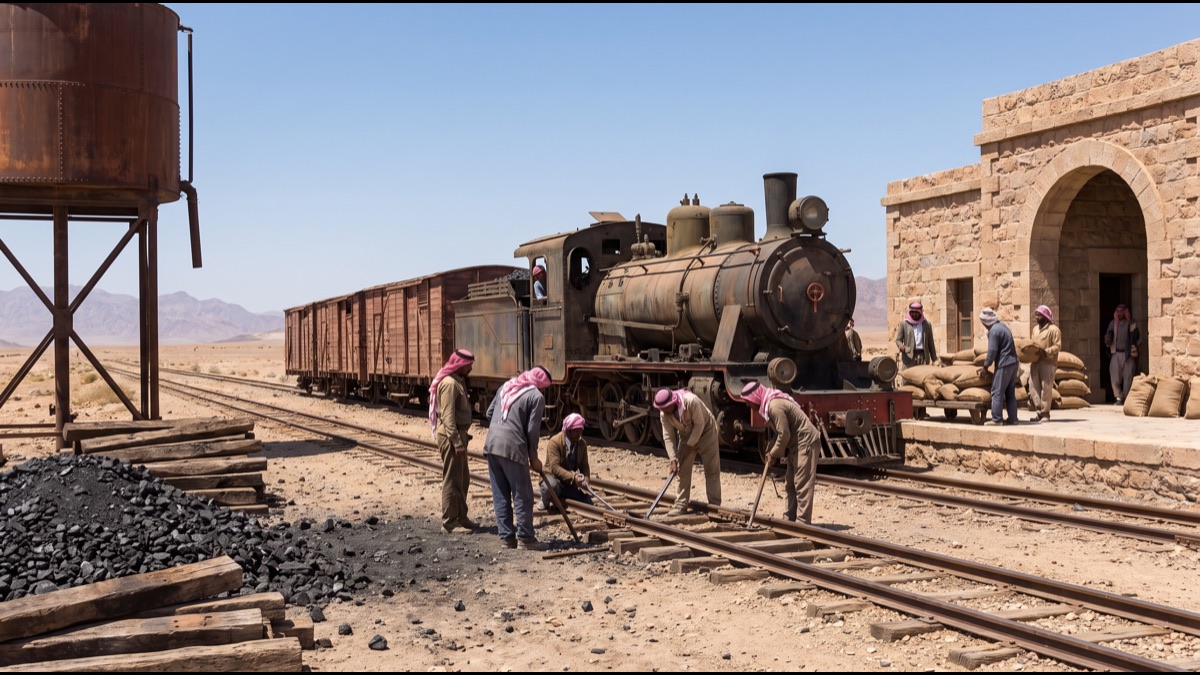
For a little over a decade, a single steel line connected Damascus to Medina, cutting a journey that once took pilgrims weeks by camel caravan down to a few days by steam train. The Hijaz Railway was one of the most ambitious engineering projects the late Ottoman Empire ever attempted, and its story runs through religious devotion, imperial politics, desert engineering, and one of the most effective sabotage campaigns in military history.
Understanding how the line was actually built, run, and eventually destroyed explains why its rusted remains still sit scattered across the Jordanian and Saudi desert more than a century later, and why the railway remains a genuinely unusual case study in what happens when infrastructure gets caught directly in the middle of a war.
Why the Ottomans Wanted a Railway Into Arabia
Sultan Abdul Hamid II announced the railway project in 1900, framing it publicly and primarily as a pious undertaking intended to make the annual pilgrimage to the holy cities of Mecca and Medina faster, safer, and more affordable for Muslims across the empire and beyond, replacing a punishing multi-week camel crossing with rail travel measured in days.
Behind that religious framing sat a considerably more practical set of imperial motives. A railway into the Hijaz region would let Constantinople move troops and administrators into Arabia far faster than camel caravans allowed, tightening central control over a peripheral region where Ottoman authority had historically been thin and difficult to project.
The project also carried symbolic weight for the sultan's broader claim to religious legitimacy as caliph, since sponsoring pilgrimage infrastructure reinforced his position as protector of the holy places at a moment when Ottoman authority was increasingly contested both within the empire and by European colonial powers circling its territories.
Financing a Line Through the Desert
Unlike many contemporary Ottoman infrastructure projects, which relied heavily on European loans and foreign concessions, the Hijaz Railway was deliberately funded through public subscription, with donations solicited from Muslims across the empire and beyond, explicitly framed as a religious contribution rather than a commercial investment.
This financing model mattered strategically as much as economically, since it kept the line free of the foreign capitulations and concession terms that gave European powers leverage over other Ottoman railways, allowing the sultan to present the project as a purely internal Islamic undertaking built without outside interference.
Fundraising campaigns reached remarkably far, with contributions arriving from Muslim communities in India, Southeast Asia, and elsewhere, turning the railway into one of relatively few Ottoman-era infrastructure projects that functioned simultaneously as engineering program and empire-wide religious mobilization effort.
The Engineering Challenge of Building Across Arabia
Constructing a railway across roughly 1,300 kilometers of largely uninhabited desert terrain, much of it without any prior surveyed routes, reliable water sources, or existing settlements to support construction crews, presented engineering and logistical problems considerably different from railway building in more developed regions.
German engineer Heinrich Meissner led much of the technical planning and construction, adapting standard railway engineering practice to conditions that included extreme heat, shifting sand, flash flooding in normally dry wadis, and long stretches where every piece of material, water, and food for workers had to be hauled in rather than sourced locally.
A narrow gauge of 1,050 millimeters was chosen specifically because it allowed tighter curves and cheaper construction than standard gauge, a practical tradeoff against a longer construction timeline given the terrain, though it also meant the line could never easily interconnect with standard-gauge networks built later in the region.
How the Route Was Actually Laid Out
The line began in Damascus and ran roughly south through Deraa, into modern Jordan through Amman and Ma'an, crossing into what is now northwestern Saudi Arabia near Tabuk before continuing on toward Medina, broadly tracing an ancient pilgrimage and trade corridor that travelers had used for centuries before the railway existed.
Surveyors deliberately routed the line near existing wells and, where possible, older caravan stopping points, both to reduce the cost of establishing new water infrastructure and to maintain some continuity with the traditional pilgrimage route that the railway was explicitly designed to modernize rather than replace with an entirely new corridor.
Construction proceeded in stages over roughly eight years, with each completed segment opened to traffic before the next stretch further south was finished, meaning the railway was already carrying substantial pilgrim and freight traffic on its northern sections years before the final push toward Medina was complete.
Water, Stations, and the Logistics of Desert Railroading
Steam locomotives require enormous quantities of water, making water supply the single hardest logistical constraint on the entire project, and engineers had to identify, drill, or transport water to a station roughly every 20 to 25 kilometers along the route to keep locomotives running reliably across the desert crossing.
Stations along the line were built as small fortified complexes rather than simple platforms, typically including a water tower, defensive walls, and housing for a garrison, reflecting the reality that isolated desert infrastructure needed to be defensible against raids from the outset, well before the Arab Revolt made that defensibility a matter of survival.
Coal and other supplies had to be shipped by sea to Red Sea ports and then hauled inland to depots along the route, adding a complex secondary logistics chain to the operation that made the railway considerably more expensive to run than its relatively modest freight and passenger revenue could fully justify on its own.
Telegraph Lines Running Alongside the Track
A telegraph line was built in parallel with the railway for its entire length, serving both as a coordination tool for train scheduling and, more importantly from Constantinople's perspective, as a direct communication link extending Ottoman administrative and military reach deep into Arabia for the first time in a genuinely reliable way.
This telegraph network later became militarily significant in its own right during the Arab Revolt, since disrupting communication between Ottoman garrisons along the route was often as strategically valuable as physically damaging the rail line itself, and the two infrastructure systems were frequently targeted together.
The combined rail-and-telegraph corridor effectively functioned as the primary nervous system connecting Ottoman authority in Damascus to its increasingly precarious position in the Hijaz, which is precisely why severing that corridor became such an effective strategy once open conflict broke out.
Why the Line Stopped Short of Mecca
Despite the railway's explicit religious mission of easing pilgrimage to both holy cities, construction stopped permanently at Medina and never extended the final roughly 400 kilometers to Mecca, leaving that stretch of the pilgrimage route dependent on traditional caravan transport for the entire life of the railway.
Funding pressure was one real constraint, since the project had already consumed enormous resources and the outbreak of the First World War soon redirected Ottoman attention and money entirely toward the war effort, but religious sensitivity around the final approach to Mecca also played a genuine role in the decision.
Extending the line to Mecca would have required non-Muslim engineers, surveyors, and likely some non-Muslim laborers to work within or very near the boundary restricting non-Muslim entry to the holy city, a complication that made the final stretch considerably more sensitive to plan and staff than the rest of the route had been.
What Riding the Hijaz Railway Was Actually Like
Passenger cars were divided by class, with more affluent pilgrims and officials traveling in relatively comfortable compartments while the majority of pilgrims, many of whom had saved for years to make the journey, traveled in considerably more basic third-class carriages that were nonetheless still a dramatic improvement over weeks on camelback.
The full Damascus-to-Medina journey took roughly four days under normal operating conditions, compared to a camel caravan crossing that commonly took a month or more and exposed travelers to genuine risks from heat, dehydration, and raids by desert tribes along the traditional route.
Contemporary accounts from pilgrims who used the line frequently describe genuine astonishment at the speed and relative safety of rail travel compared to the journey their parents and grandparents had made, framing the railway as a tangible, deeply felt improvement in religious life rather than an abstract piece of state infrastructure.
The Arab Revolt and the Railway as a Military Target
When the Arab Revolt against Ottoman rule broke out in 1916, the Hijaz Railway became an immediate and obvious strategic target, since it was the primary route by which Ottoman forces resupplied and reinforced their garrisons scattered across Arabia, including the substantial garrison holding Medina itself.
Arab irregular forces, working alongside British military advisers including the officer later known globally as Lawrence of Arabia, recognized that repeatedly cutting the line was more strategically valuable and considerably less costly than attempting direct assaults on well-defended Ottoman positions along the route.
This targeting strategy proved unusually effective specifically because the railway's own logistics vulnerabilities, the isolated stations, the dependence on a single continuous track, and the difficulty of rapid repair in remote desert terrain, made it structurally fragile in exactly the ways that favored a small, mobile raiding force over a large garrisoned army.
How Sabotage Campaigns Actually Disabled the Line
Raiding parties typically targeted bridges, culverts, and sections of track using demolition charges, deliberately choosing locations where repair required scarce materials and skilled labor that Ottoman forces struggled to bring to isolated desert locations quickly, maximizing the disruption caused by each individual attack.
Repeated attacks on the same general stretches of line forced Ottoman forces to divert increasing numbers of troops to static garrison and repair duty along the railway, troops that were consequently unavailable for other fronts, meaning the sabotage campaign drained Ottoman military capacity even when individual raids caused only localized damage.
By the later stages of the revolt, sections of the line south of Ma'an had been damaged so frequently and so extensively that regular through-service to Medina became effectively impossible, isolating the Ottoman garrison there, which held out under siege conditions considerably longer than the wider military situation would otherwise have allowed.
Why the Railway Was Never Fully Restored
After the war ended and the Ottoman Empire collapsed, the political map of the region the railway had crossed changed entirely, with the line now running through the newly created states of Syria, Transjordan, and the territory that would eventually become Saudi Arabia, each under different administrative authority and none with a strong individual incentive to fund full restoration.
Reconstructing the war-damaged sections would have required substantial capital that none of the successor states, dealing with their own post-war reconstruction and state-building challenges, were well positioned to commit to a rail line whose original strategic and religious purpose had been tied specifically to a now-defunct Ottoman administrative structure.
Automobile and later air travel also began steadily displacing rail as the practical means of making the pilgrimage over subsequent decades, reducing the economic case for the considerable expense of full restoration even as isolated short sections did periodically resume limited local service in the years following the war.
What Remains of the Line Today
Abandoned stations, water towers, bridges, and even rusted locomotives and rolling stock remain visible along stretches of the former route through Jordan and Saudi Arabia, preserved largely by the extreme aridity of the desert environment rather than through any deliberate long-term conservation effort in most locations.
Some of the most visually striking remains sit near archaeological sites the region is already known for, including areas close to Mada'in Saleh in Saudi Arabia and stretches near Wadi Rum in Jordan, placing century-old industrial ruins in direct proximity to far older archaeological landscapes that attract their own separate stream of visitors.
Researchers and railway historians have documented much of the surviving infrastructure in detail, using it as physical evidence to reconstruct construction techniques, operational practices, and the specific locations and methods of wartime sabotage attacks that textual records alone do not always describe with full precision.
Restoration and Heritage Tourism Efforts
Both Jordan and Saudi Arabia have pursued limited restoration projects on short surviving sections of the line, motivated partly by heritage preservation and partly by growing interest in developing rail-adjacent tourism attractions tied to the railway's dramatic history and its association with the well-documented Arab Revolt campaign.
Saudi Arabia's broader push to develop tourism infrastructure under its economic diversification agenda has brought renewed institutional attention to Hijaz Railway sites specifically, with restored stations in some locations now functioning as small museums presenting the line's construction and wartime history to visitors.
These restoration efforts remain modest in scale relative to the original network, focused on preserving and interpreting specific well-preserved segments rather than attempting anything resembling a full operational reconstruction of the historical Damascus-to-Medina service the line once provided.
The Railway's Place in Regional Memory
The Hijaz Railway occupies an unusual dual position in regional historical memory, remembered simultaneously as a genuine feat of engineering and religious devotion and as a symbol of the Ottoman imperial control that the Arab Revolt was fought specifically to end, meaning its legacy is read quite differently depending on which part of the story is emphasized.
For railway historians and engineers, the line remains a case study in desert infrastructure engineering under severe logistical constraints, while for military historians it functions as a frequently cited example of how targeting infrastructure and supply lines can achieve strategic effects disproportionate to the resources a raiding force actually commits to individual attacks.
The physical ruins themselves, still scattered across the desert more than a century after the line's construction, continue to draw the attention of travelers, researchers, and heritage authorities across three modern countries, ensuring that a railway that operated in regular service for barely a decade remains a subject of active study and public interest well beyond its short operational life.
Sources
- Wikipedia — history, construction, and wartime destruction of the Hijaz Railway
- Encyclopaedia Britannica — background on Ottoman administration of the Hijaz region
- Imperial War Museums — records and context on the Arab Revolt campaign
- Saudi Tourism Authority — information on heritage sites along the former railway route
FAQ
Who built the Hijaz Railway and why?
The Ottoman Empire built it under Sultan Abdul Hamid II, officially to ease the pilgrimage to Mecca and Medina, and unofficially to strengthen military and administrative control over Arabia.
How long did the Hijaz Railway operate?
Regular service ran from 1908 until 1916-1918, when Arab Revolt forces repeatedly sabotaged the line, and it was never fully restored to continuous operation afterward.
Did the railway actually reach Mecca?
No. The line stopped at Medina; the final stretch to Mecca was never completed, partly due to funding and partly due to sensitivities around non-Muslim engineers approaching the holiest city.
Why was the railway such a target in the Arab Revolt?
It was the Ottoman military's main supply and reinforcement route through Arabia, so cutting it repeatedly, most famously by forces associated with T. E. Lawrence, crippled Ottoman logistics without requiring a direct assault on garrisons.
Can you still see the Hijaz Railway today?
Yes — abandoned stations, bridges, and rusted locomotives survive along the route in Jordan and Saudi Arabia, and some short heritage sections have been restored for tourism and historical display.
About the Author
We reference Wikipedia, Encyclopaedia Britannica, Imperial War Museums, and the Saudi Tourism Authority to explain the background and current understanding of this topic.
Loved This Article?
Share it on WhatsApp → Share it on WhatsApp
Get more guides in your inbox — Subscribe to our newsletter for weekly surprising stories from Egypt, Saudi Arabia, Dubai, and beyond.