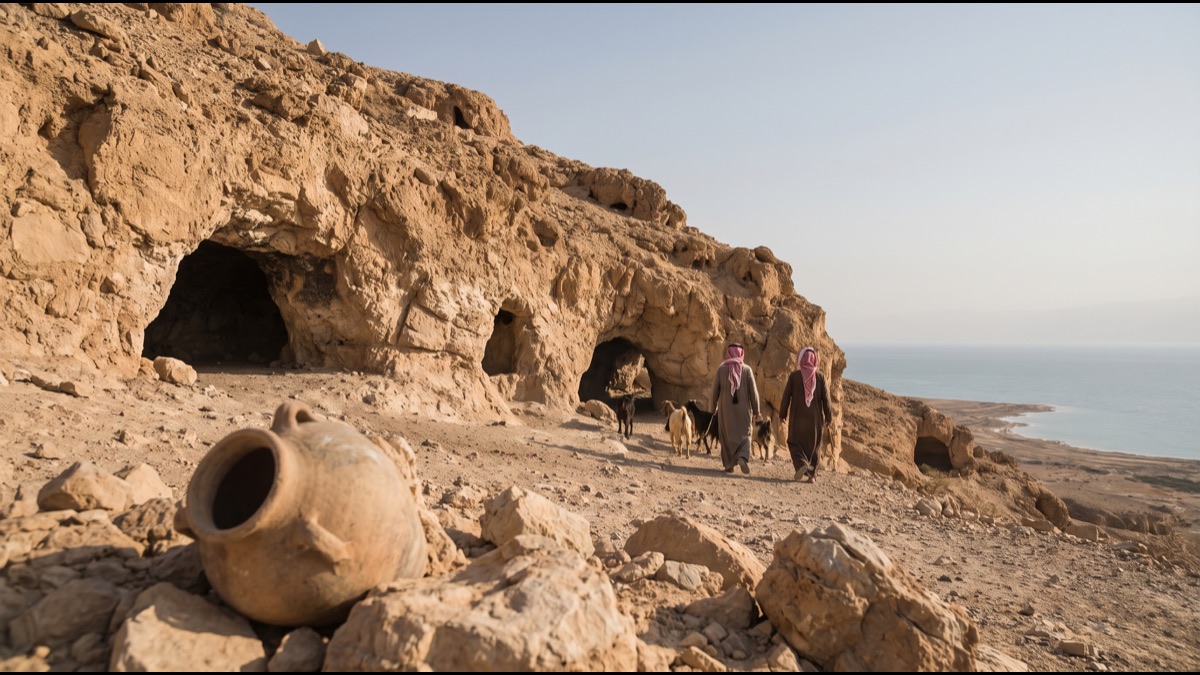
One of the most consequential archaeological discoveries of the twentieth century began with a search for a lost goat. In late 1946 or early 1947, a Bedouin shepherd tossing a stone into a cave opening near the northwest shore of the Dead Sea heard the unexpected sound of breaking pottery, and what he found inside would eventually reshape scholarly understanding of the Hebrew Bible and the world it emerged from.
The scrolls that followed from that first cave, and the roughly two decades of additional discoveries and authentication work that came after, form a genuinely tangled story involving shepherds, antiquities dealers, feuding scholars, and a slow, contested process of proving the manuscripts were exactly as old as they appeared to be.
What the Dead Sea Scrolls Actually Are
The Dead Sea Scrolls are a collection of roughly 900 manuscripts, most fragmentary, written primarily in Hebrew with some Aramaic and Greek text, recovered from eleven caves near the ruins of Qumran on the northwest shore of the Dead Sea in the modern West Bank.
They include the oldest known surviving copies of large portions of the Hebrew Bible, predating other previously known biblical manuscripts by roughly a thousand years, alongside sectarian religious texts, community rules, and other writings that were not part of any established biblical canon.
Their significance lies less in any single dramatic find and more in the sheer scale and age of the collection, which gave scholars direct manuscript evidence from a period of Jewish history that had previously been understood mostly through much later copies and secondhand accounts.
The 1947 Discovery Near Qumran
The generally accepted account holds that a young Bedouin shepherd, traditionally named Muhammed edh-Dhib, was searching for a stray animal near the cliffs above Qumran when he threw a rock into a cave opening and heard it strike pottery, prompting him to investigate.
Inside he found tall clay jars containing leather scrolls wrapped in linen, several of which he and his companions removed, an act that set in motion a chain of transactions through Bethlehem antiquities dealers that would take years to fully trace and untangle.
The exact date and precise sequence of this initial discovery remain somewhat uncertain even today, since the account rests substantially on later interviews and secondhand retellings rather than a contemporaneous written record made at the time.
Why a Bedouin Shepherd's Account Is Central to the Story
Because the discovery occurred outside any formal archaeological excavation, historians of the find have had to rely heavily on oral accounts collected after the fact, which introduces genuine uncertainty into even basic details like exactly which cave was found first and precisely when.
Scholars have generally treated the shepherd narrative as broadly reliable in its outline while remaining cautious about specific details, since it was recorded and re-recorded by different interviewers over subsequent years, with minor inconsistencies appearing between versions.
This origin story matters for more than historical color: it explains why the scrolls' early handling was so haphazard compared to a controlled excavation, and why establishing their authenticity later required scientific methods rather than simply trusting a clean documented chain of custody.
How the First Scrolls Reached Scholars and Dealers
The shepherds sold their initial finds to antiquities dealers in Bethlehem, who in turn split the scrolls between different buyers, a pattern that would repeat with later finds and that scattered related manuscripts across multiple private and institutional hands almost from the start.
Some of the earliest scrolls reached the Hebrew University in Jerusalem through the scholar Eleazar Sukenik, while others were acquired by the Syrian Orthodox Metropolitan of Jerusalem, who eventually brought a set to the United States, where they were offered for sale via a newspaper advertisement in 1954.
This fragmented, market-driven distribution meant that establishing the scrolls' authenticity and even their basic physical relationship to one another required painstaking scholarly detective work conducted well after the manuscripts had already left their original archaeological context.
The Cave-by-Cave Search That Followed
News of the discovery, and the value dealers were paying for scroll fragments, prompted both organized archaeological teams and local Bedouin searchers to comb the cliffs around Qumran through the early 1950s, eventually locating a total of eleven caves containing manuscript material.
Cave 4, excavated in 1952, proved by far the richest single site, yielding tens of thousands of fragments from several hundred separate manuscripts in a state of extreme fragmentation that would take decades of painstaking reconstruction work to sort and identify.
This competitive, partly informal search process meant that archaeological documentation varied considerably in quality between caves, with some material recovered under careful controlled conditions and other fragments purchased after already being removed by unsupervised local searchers.
What the Scrolls Actually Contain
The collection includes fragments of every book of the Hebrew Bible except the Book of Esther, alongside so-called apocryphal and pseudepigraphal texts not included in the standard biblical canon, and a substantial body of previously unknown sectarian writings.
Among these sectarian texts are community rules, biblical commentaries, calendrical documents, and other material that scholars generally associate with a distinct religious community, giving historians an unusually direct window into Jewish religious thought and practice in the Second Temple period.
The physical condition of the material varies enormously, from the nearly complete Great Isaiah Scroll to tiny fragments only a few letters wide, and reconstructing readable texts from this fragmentary material has itself been a major and ongoing scholarly undertaking.
How Radiocarbon Dating Helped Authenticate the Scrolls
Establishing that the scrolls genuinely dated from antiquity rather than being a modern forgery required scientific verification independent of the contested discovery narrative, and radiocarbon dating of the animal-skin parchment and linen wrappings provided one crucial line of evidence.
Testing conducted from the 1990s onward on small samples from multiple scrolls consistently returned date ranges spanning roughly the third century BCE to the first century CE, aligning closely with the dates scholars had already proposed based on handwriting analysis and archaeological context.
This convergence between an independent physical dating method and separate paleographic analysis is considered one of the strongest pieces of evidence supporting the scrolls' authenticity, since forging that level of agreement across unrelated verification methods would be extraordinarily difficult.
How Paleography Confirmed the Scrolls' Age
Paleography, the study of historical handwriting styles, allowed scholars to date individual manuscripts by comparing letter forms and script styles against a broader body of dated inscriptions and documents from the ancient Near East.
Because handwriting styles evolved in documentable, traceable ways across centuries, paleographers could place most scrolls within fairly narrow date ranges even before radiocarbon testing became available, and later scientific dating largely confirmed these earlier paleographic estimates.
This combination of independent methods, developed and applied by different specialists working from different kinds of evidence, is central to why the scholarly consensus treats the scrolls' ancient origin as extremely well established rather than merely assumed.
The Qumran Community Theory and Its Critics
The dominant scholarly theory connects the scrolls to a Jewish sectarian community, often identified with the Essenes described by ancient writers, who are thought to have lived at the nearby settlement of Qumran and hidden the scrolls in caves during periods of unrest.
This theory rests on the physical proximity of the caves to the Qumran settlement, apparent thematic connections between sectarian texts and archaeological features at the site, and correspondences with ancient descriptions of similar religious communities from writers like Josephus and Pliny the Elder.
A significant minority of scholars dispute parts of this picture, arguing the scrolls may represent a broader collection gathered from Jerusalem libraries rather than the output of one isolated community, a debate that remains genuinely unresolved and actively researched.
Why Publication of the Scrolls Took Decades
Full scholarly publication of the Cave 4 material in particular dragged on for decades after its 1952 discovery, a delay widely criticized within the academic community as the original small team assigned exclusive access struggled to keep pace with the sheer volume of fragmentary material.
Some scholars on the original team died before completing their assigned sections, and access restrictions meant other qualified researchers could not step in to help, producing a bottleneck that left significant portions of the collection effectively unavailable to the wider scholarly world for a generation.
This publication delay became one of the most contentious episodes in the scrolls' modern history, drawing sustained criticism from researchers who argued that restricting access to such historically significant material served no legitimate scholarly purpose.
The Controversy Over Restricted Access
Through the 1970s and 1980s, frustration over restricted access intensified as the small group controlling unpublished fragments declined to share images or transcriptions with outside researchers, effectively giving a handful of scholars exclusive control over historically vital material for decades.
The situation broke open in 1991 when the Huntington Library in California, which held a complete photographic set of the scrolls, announced it would make its images freely available to researchers, a decision that effectively ended the access monopoly regardless of the original team's objections.
This episode is now widely cited in discussions of archaeological ethics and open access to historical materials, illustrating how institutional control over an important discovery can significantly delay scholarship even when the underlying material's authenticity is not in question.
How Digital Imaging Changed Scroll Research
Modern multispectral and infrared imaging techniques, developed well after the scrolls' initial discovery, have allowed researchers to read text on fragments too faded or darkened for the naked eye to make out, recovering readable content that had effectively been illegible for decades.
The Israel Antiquities Authority's Leon Levy Dead Sea Scrolls Digital Library, launched in the 2010s, made high-resolution images of the collection freely available online, dramatically expanding the number of researchers who could study the original material directly rather than relying on published transcriptions alone.
This digitization effort also serves a conservation purpose, since the physical scrolls are extremely fragile and each handling risks further deterioration, meaning digital access increasingly substitutes for physical examination in day-to-day scholarly work.
What the Scrolls Revealed About Biblical Text Transmission
Before the scrolls' discovery, the oldest complete Hebrew Bible manuscripts available to scholars dated from around the tenth century CE, leaving a roughly thousand-year gap between the presumed composition of biblical texts and the earliest manuscripts available to verify how faithfully they had been transmitted.
Comparison between the Dead Sea Scrolls' biblical texts and these much later medieval manuscripts revealed a striking degree of consistency in most cases, providing strong evidence that scribal copying practices had preserved the core text with considerable accuracy across roughly a millennium.
At the same time, the scrolls also revealed genuine textual variation in some passages, showing that multiple versions of certain biblical books circulated simultaneously in the Second Temple period before later standardization, a nuance that reshaped scholarly understanding of how the biblical text actually developed.
Where the Scrolls Are Kept Today
Most of the scrolls are held by the Israel Antiquities Authority and displayed or stored at the Shrine of the Book, a dedicated wing of the Israel Museum in Jerusalem built specifically to house the most significant manuscripts under carefully controlled climate conditions.
Smaller portions and individual fragments are held by other institutions internationally, including museums and university collections that acquired material through the fragmented early sales process, and their exact provenance has itself sometimes required additional scholarly verification.
Ownership and repatriation questions connected to some of these dispersed fragments remain a subject of occasional legal and diplomatic discussion, reflecting the scrolls' unusual path from an informal shepherd's discovery to a globally distributed and intensely studied collection.
Why the Discovery Still Matters to Scholars
Nearly eight decades after that first cave was opened, the Dead Sea Scrolls remain one of the most actively studied bodies of ancient manuscript evidence in existence, with new imaging techniques and renewed excavation occasionally still adding fragments or reinterpreting known ones.
Their combination of biblical texts, sectarian writings, and everyday documents gives historians a genuinely rare direct window into a specific religious community's beliefs and practices, rather than relying entirely on how later outsiders chose to describe or summarize that community.
The scrolls' long, contested path from a shepherd's chance discovery through market-driven dispersal, scientific authentication, and decades of restricted access to eventual open digital availability is itself a case study in how historically significant discoveries can be shaped as much by the accidents of their handling as by their original content.
That lesson extends well beyond biblical scholarship. Archaeologists and historians studying other major manuscript finds now routinely point to the Dead Sea Scrolls' publication delays as a cautionary example, and many institutions holding comparably significant unpublished material have cited the episode directly when deciding to open their own archives sooner rather than later.
Sources
- Wikipedia — overview of the discovery, contents, and scholarly debates surrounding the scrolls
- Israel Antiquities Authority — Leon Levy Dead Sea Scrolls Digital Library — the official digitized archive of scroll images
- The Israel Museum, Jerusalem — home of the Shrine of the Book, where most scrolls are held and displayed
- Encyclopaedia Britannica — reference overview of Qumran, the scrolls, and their historical context
- Library of Congress — background on the scrolls' scholarly significance and manuscript history
FAQ
Who actually discovered the Dead Sea Scrolls?
By the traditional account, a Bedouin shepherd searching for a stray goat found the first scrolls in a cave near Qumran in late 1946 or early 1947, though exact details remain uncertain.
How do we know the scrolls are genuinely ancient?
Independent radiocarbon dating of the parchment and paleographic analysis of the handwriting both consistently place most scrolls between roughly the third century BCE and first century CE.
Why did it take so long to publish all the scrolls?
A small original team held exclusive access to the fragmentary Cave 4 material for decades, a widely criticized bottleneck that only broke open after outside institutions released their own photographic copies in 1991.
Do the scrolls contain the entire Hebrew Bible?
They include fragments from every book except Esther, but most manuscripts are partial or fragmentary rather than complete copies of entire biblical books.
Where can the public see the scrolls today?
Most are held by the Israel Antiquities Authority at the Shrine of the Book in Jerusalem, with high-resolution images of the full collection also freely viewable online.
About the Author
We reference Wikipedia, the Israel Antiquities Authority's Dead Sea Scrolls Digital Library, the Israel Museum, Encyclopaedia Britannica, and the Library of Congress to explain the background and current understanding of this topic.
Loved This Article?
Share it on WhatsApp → Share it on WhatsApp
Get more guides in your inbox — Subscribe to our newsletter for weekly surprising stories from Egypt, Saudi Arabia, Dubai, and beyond.