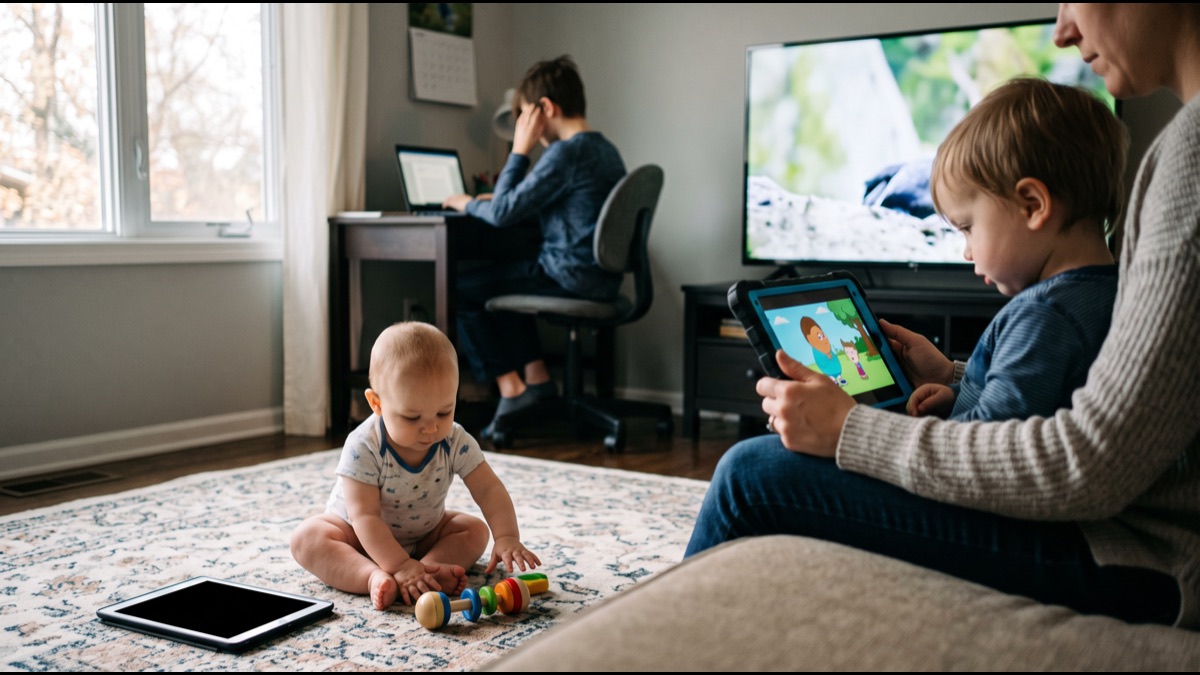
A one-year-old and a fifteen-year-old are subject to wildly different screen time recommendations, and that gap isn't arbitrary. Pediatric guidelines shift dramatically by age because the underlying developmental concerns, and the research supporting them, genuinely change as children grow — understanding why explains both the logic behind the numbers and where those numbers rest on thinner evidence than the confident guideline language suggests.
Why Screen Time Guidelines Vary by Age
Major pediatric organizations, including the American Academy of Pediatrics and the World Health Organization, structure screen time guidance around specific developmental stages rather than applying one blanket recommendation across all childhood.
This age-tiered approach reflects genuine differences in what's developmentally at stake at each stage, from early brain development and attachment formation in infancy to sleep, physical activity, and social development in later childhood and adolescence.
Understanding the specific concerns driving each age tier's recommendation helps explain why the numbers loosen considerably as children get older, rather than the guidelines simply becoming less strict for no clear reason.
What Pediatric Guidelines Actually Say for Under-2s
For children under 18 months, most major guidelines recommend avoiding screen media entirely except for video chatting, reflecting concern that passive screen exposure during this critical developmental window may interfere with the face-to-face interaction infants rely on for language and social development.
Between 18 and 24 months, guidelines generally shift to allowing limited, high-quality programming watched together with a caregiver who can help the child understand and apply what they're seeing, rather than unsupervised solo viewing.
This near-total restriction for the youngest children reflects the strongest research consensus of any age tier, since infant brain development during this period is unusually dependent on live, responsive human interaction that screens cannot replicate.
The Preschool and Early Childhood Range
For children aged 2 to 5, most guidelines recommend limiting screen use to roughly one hour per day of high-quality programming, a substantial loosening from the near-total restriction recommended for infants and toddlers.
This age range is treated as a genuine transition period in the guidelines, reflecting growing evidence that some educational content can support learning at this stage, while excessive or low-quality content still carries documented risks to attention, language development, and sleep.
The emphasis on "high-quality" programming specifically, rather than just duration, reflects a growing recognition in the research literature that content and format matter as much as, or more than, raw screen time in this age range.
School-Age Recommendations and Why They Loosen
For children roughly 6 to 12, guidelines generally shift away from strict hour-based caps toward broader recommendations emphasizing consistent limits, ensuring screens don't displace sleep, physical activity, and in-person social interaction, and prioritizing content quality.
This shift away from a hard numerical limit reflects both practical reality, since school-age children increasingly use screens for schoolwork and legitimate education, and a genuine evidentiary shift, since the strongest evidence for direct developmental harm is concentrated in earlier childhood.
Pediatric guidance for this age range increasingly focuses on the specific displacement effects of screen use — what activities screens are replacing — rather than treating screen time itself as inherently harmful above a specific numerical threshold.
Teenagers and the Shift Away From Strict Hour Limits
For teenagers, most major pediatric organizations have moved away from specific hour-based recommendations entirely, instead emphasizing balanced use, healthy sleep habits, and monitoring for signs that screen use is displacing other important activities or affecting mental health.
This shift reflects both the practical difficulty of enforcing hour limits on older, more autonomous teenagers and a genuine research gap: the evidence connecting screen time duration specifically, as opposed to content type or usage pattern, to teen mental health outcomes remains considerably weaker than popular narratives suggest.
Some researchers have specifically pushed back on treating teen screen time as a single undifferentiated category, arguing that passive social media scrolling, active content creation, gaming with friends, and homework research carry meaningfully different developmental implications despite all counting as "screen time."
Why Content and Context Matter More Than Duration
A growing body of research suggests that what a child is doing on a screen, and in what social context, predicts developmental outcomes better than raw duration alone, a finding that has meaningfully shaped how recent guidelines are worded.
Passive, low-quality content consumed alone shows more consistent associations with negative outcomes than active, high-quality content consumed with a caregiver or used for genuine educational purposes, even at similar total durations.
This content-and-context emphasis represents a genuine evolution in pediatric guidance over the past decade, moving away from the simpler duration-based framing that dominated earlier public health messaging.
The Research Behind Early-Childhood Caution
The strongest research support for screen restrictions concentrates specifically on infants and toddlers, where studies have documented associations between heavy passive screen exposure and delayed language development, reduced parent-child interaction, and disrupted sleep patterns.
Much of this early-childhood research draws on the broader developmental science finding that live, responsive interaction — a caregiver reacting in real time to an infant's specific vocalizations and expressions — drives early language and social development in ways passive screen content cannot replicate.
This mechanism-based understanding, rather than screen exposure being harmful in some vague general sense, is what gives the under-2 guidelines their unusually firm, near-total restriction compared to looser guidance for older children.
Where the Evidence Is Weaker Than Guidelines Suggest
Researchers studying screen time and adolescent wellbeing, including Oxford's Andrew Przybylski, have specifically challenged the strength of evidence connecting screen time duration to teen mental health outcomes, finding effect sizes considerably smaller than public concern suggests.
Much of the correlational research linking screen time to outcomes like depression or anxiety in teens struggles to establish causation, since it's equally plausible that teens already experiencing distress use screens differently, rather than screen use causing the distress.
This evidentiary gap doesn't mean screen time guidelines for older children and teens are baseless, but it does mean the confident numerical recommendations found in some guidance rest on a thinner evidence base than the guidelines for infants and toddlers.
Passive Viewing vs. Interactive and Educational Use
Research increasingly distinguishes between passive viewing, where a child simply watches content without engagement, and interactive or educational use, where a child actively participates, problem-solves, or engages with age-appropriate learning content.
This distinction has become central to how current guidelines are written, with several major pediatric organizations explicitly noting that not all screen time carries equivalent developmental risk, a meaningful shift from earlier duration-only framing.
The distinction matters practically for parents trying to apply guidelines, since the specific type of screen activity a child engages in may matter more than hitting or exceeding a general duration target.
Co-Viewing and Why It Changes the Calculation
Research on co-viewing, where a caregiver watches screen content together with a child and actively discusses or contextualizes it, generally finds better developmental outcomes than the same content consumed by a child alone.
This co-viewing effect appears across multiple age ranges in the research literature, suggesting the presence of active adult engagement meaningfully changes how screen content affects a child, independent of the content itself or total duration.
Guidelines increasingly recommend co-viewing specifically for younger children, both to model appropriate content interpretation and to preserve some of the responsive human interaction that passive solo viewing lacks.
Sleep Displacement as the Real Mechanism of Harm
Across virtually every age range studied, one of the most consistently replicated findings in screen time research is that screen use displacing sleep, particularly evening use close to bedtime, correlates with worse outcomes than screen use during other parts of the day.
This sleep-displacement mechanism is considered by many researchers to be one of the more robust, causally plausible pathways connecting screen use to negative outcomes, compared to more speculative direct effects of screen content on mood or attention.
This finding has shaped guideline language recommending screen-free periods before bedtime specifically, a more targeted intervention than a blanket total-duration limit, since it addresses a mechanism with stronger research support.
How Guidelines Differ Across Countries
While the American Academy of Pediatrics, the World Health Organization, and national health bodies in countries like Canada and Australia broadly agree on the same age-tiered structure, specific numerical recommendations and emphasis differ somewhat between organizations.
Some national guidelines place more explicit emphasis on physical activity displacement, essentially treating screen time limits as a proxy for ensuring adequate exercise, while others frame recommendations more directly around content quality and developmental appropriateness.
These cross-country differences generally reflect emphasis and framing rather than fundamentally different underlying evidence, since most major guidelines draw on a broadly overlapping body of developmental and public health research.
What Parents Should Actually Prioritize
Given the evidence base, prioritizing sleep protection, ensuring screens aren't displacing physical activity and in-person social interaction, and favoring co-viewed or interactive content over passive solo viewing appears to matter more than hitting an exact hourly target.
For infants and toddlers specifically, the evidence supports near-total restriction more firmly than for any other age group, making that the age range where strict adherence to guidelines carries the strongest research backing.
For older children and teens, the research increasingly supports a more nuanced approach focused on content, context, and displacement effects rather than a single numerical hour limit, reflecting how the guidelines themselves have evolved over the past decade.
How Screen Time Guidelines Have Changed Over the Past Decade
Earlier pediatric guidelines, particularly those issued before 2016, tended to use simpler, more rigid hour-based caps across a wider age range, reflecting the state of the research at the time and a more precautionary approach given limited longitudinal data.
As more longitudinal research accumulated, particularly studies distinguishing content type and context from raw duration, major organizations including the American Academy of Pediatrics revised their guidance to reflect a more nuanced, evidence-responsive framework rather than holding to the original simpler numbers.
This evolution illustrates a broader pattern in public health guidance generally: initial recommendations often err toward caution given limited evidence, then get refined as more rigorous research accumulates, a normal part of the scientific process rather than a sign the earlier guidance was simply wrong.
The Special Case of Educational Technology in Schools
School-issued devices and educational software complicate the practical application of screen time guidelines, since a meaningful portion of a school-age child's daily screen exposure may now come from mandatory, teacher-directed educational use rather than discretionary leisure consumption.
Researchers studying this shift generally note that guidelines developed primarily around leisure screen use don't map cleanly onto structured educational technology, since the developmental concerns driving leisure-use guidance, like passive consumption or sleep displacement, don't apply in the same way to a supervised classroom activity.
Some pediatric guidance has begun explicitly carving out educational screen use as a separate category from recreational use, though consistent, updated guidance addressing this distinction specifically remains less developed than guidance for leisure screen time.
What Parents Report About Enforcing Screen Time Limits
Survey research on parental experience enforcing screen time guidelines consistently finds a gap between stated household rules and actual daily practice, with many parents reporting genuine difficulty maintaining consistent limits amid competing demands like work, meal preparation, and managing multiple children simultaneously.
This gap between guideline and lived practice doesn't necessarily mean the guidelines are unrealistic, but it does suggest that guidance framed purely around parental willpower and vigilance may underestimate the practical household constraints that make consistent enforcement genuinely difficult for many families.
Some family researchers have specifically recommended household-level structural changes, similar to the environmental-design approach discussed in adult digital habit research, such as designated device-free zones or times, as more sustainable than relying purely on ongoing parental monitoring and enforcement.
How Guidelines Address Screen Use During Meals and Family Time
Several major pediatric organizations specifically recommend keeping meals and dedicated family time screen-free, a targeted recommendation distinct from overall daily duration limits, reflecting research suggesting these specific windows carry outsized importance for family communication and bonding.
This meal-specific guidance has grown more prominent as researchers increasingly recognize that when screen use happens may matter as much as how much, echoing the broader shift toward context-based rather than purely duration-based recommendations discussed throughout current guidelines.
Family researchers note that protecting these specific windows may be more achievable for many households than a blanket daily limit, since it requires a bounded behavior change during a defined period rather than continuous vigilance across an entire day.
Why Some Researchers Push Back on Standardized Guidelines Entirely
A smaller group of researchers has argued that standardized, age-based screen time guidelines oversimplify a genuinely individual question, since factors like a specific child's temperament, existing sleep quality, and family context can matter more than any generic age-based number.
This critique doesn't reject the underlying developmental concerns driving current guidelines, but suggests that a family working closely with a pediatrician to develop individualized recommendations may serve a specific child better than applying a population-level average recommendation uniformly.
This more individualized approach remains a minority position relative to mainstream guideline-setting bodies, but reflects a genuine, ongoing debate within pediatric research about how much standardization is appropriate given the real variation in how screen use affects different children.
What This Means for Multi-Child Households
Applying age-tiered guidelines becomes more complicated in households with children spanning multiple age brackets, since shared screen activities like family movie time or sibling gaming don't cleanly map onto individually calibrated recommendations for each child's specific developmental stage.
Family researchers generally suggest that in mixed-age households, erring toward the guidance appropriate for the youngest child present, particularly for content and context factors, provides a reasonable practical compromise rather than attempting to strictly enforce separate rules for each child simultaneously.
Sources
- American Academy of Pediatrics — Official screen time guidelines by age group.
- World Health Organization — Global guidelines on screen time and physical activity for young children.
- Oxford Internet Institute — Research on screen time, wellbeing, and adolescent mental health.
- PubMed Central (National Library of Medicine) — Peer-reviewed studies on screen time and child development.
FAQ
Why are screen time limits so strict for babies?
The research support for restriction is strongest for infants, since live, responsive caregiver interaction drives early language and social development in ways passive screen content cannot replicate.
Do teenagers still have a strict hour limit?
No — most major pediatric organizations have moved away from specific hour-based recommendations for teens, focusing instead on balanced use, sleep protection, and displacement effects.
Does the type of screen content matter more than the amount of time?
Research increasingly suggests yes — passive, low-quality content consumed alone shows more consistent negative associations than active, educational, or co-viewed content.
Is the evidence for teen screen time guidelines as strong as for toddlers?
No — researchers have specifically noted that evidence connecting screen time duration to teen mental health outcomes is considerably weaker than the evidence supporting early-childhood restrictions.
What matters most for parents to prioritize?
Protecting sleep, avoiding displacement of physical activity and social interaction, and favoring co-viewed or interactive content over passive solo viewing.
About the Author
We reference the American Academy of Pediatrics, the World Health Organization, the Oxford Internet Institute, and PubMed Central (National Library of Medicine) to explain the background and current understanding of this topic.
Loved This Article?
Share it on WhatsApp → Share it on WhatsApp
Get more guides in your inbox — Subscribe to our newsletter for weekly surprising stories from Egypt, Saudi Arabia, Dubai, and beyond.