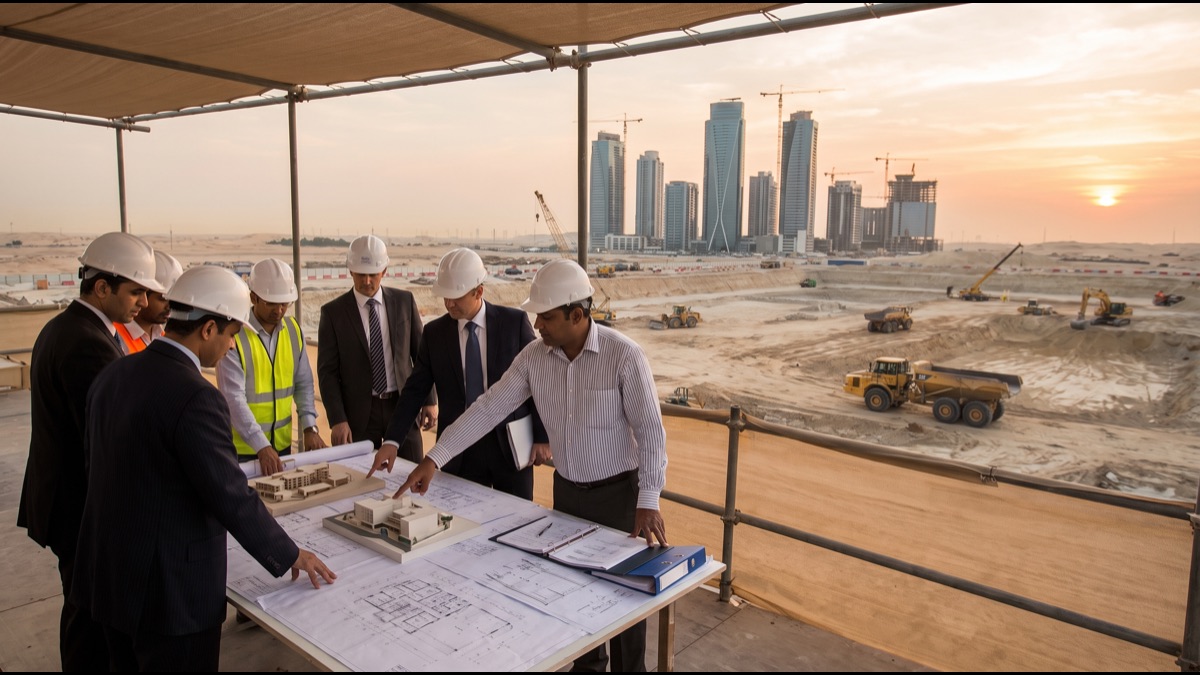
NEOM alone has been estimated by outside analysts to eventually require hundreds of billions of dollars in investment, and it is only one of more than a dozen giga-projects Saudi Arabia has launched as part of its Vision 2030 economic transformation program. Financing infrastructure and tourism developments at this scale, simultaneously, is not something any government can simply pay for out of its annual budget, which is why Saudi Arabia has built a layered financing structure spanning sovereign wealth, debt markets, oil revenue, and private capital. Understanding how that structure actually works helps explain both the ambition of the giga-project program and the financial questions increasingly being raised about its pace.
Building the Future at an Unprecedented Scale
Saudi Arabia's giga-projects were conceived as a central pillar of Vision 2030, the reform program launched in 2016 to diversify the kingdom's economy away from oil dependence and toward tourism, technology, entertainment, and advanced industry. Projects like NEOM, Qiddiya, the Red Sea Project, and Diriyah were designed not merely as individual developments but as flagship demonstrations of the kingdom's broader economic transformation ambitions.
Because these projects are being built concurrently rather than sequentially, and at a scale with few global precedents, their financing needs have consistently drawn close scrutiny from international investors, credit rating agencies, and economists tracking Saudi Arabia's fiscal position.
What Counts as a Giga-Project
Saudi officials generally use the term giga-project to describe developments whose scale, investment size, and strategic significance place them well above the country's typical large infrastructure projects. NEOM, envisioned as a futuristic region in the northwest of the country including the linear city development known as The Line, is the most prominent example, alongside Qiddiya, an entertainment-focused city near Riyadh, and the Red Sea Project, a luxury tourism destination along the Red Sea coast.
Other developments, including Diriyah, ROSHN's national housing program, and Soudah Peaks, are also frequently grouped under the giga-project label, though their financing structures and ownership arrangements differ somewhat from project to project.
The Public Investment Fund at the Center
Saudi Arabia's Public Investment Fund, commonly known as the PIF, sits at the center of giga-project financing, functioning both as the kingdom's sovereign wealth fund and as the direct owner or majority shareholder of most giga-project entities, including NEOM, Qiddiya, and Red Sea Global. The PIF has grown dramatically in assets under management over the past decade, transforming from a relatively modest sovereign fund into one of the world's largest, with a broad portfolio spanning domestic megaprojects and international investments.
The PIF's dual role — both as an international investment vehicle generating returns and as the primary funder of domestic transformation projects — has made its capital allocation decisions a subject of close attention among economists studying how Saudi Arabia balances global portfolio diversification against the capital demands of its own giga-projects.
Where the PIF Gets Its Own Money
The PIF's own capital comes from several sources: direct government capital injections, transferred state assets, retained investment returns from its global portfolio, and periodically, proceeds from asset sales including stakes in Saudi Aramco. The government transferred a significant equity stake in Aramco to the PIF in past years specifically to bolster the fund's balance sheet and give it a stronger independent revenue base beyond direct treasury transfers.
The PIF has also increasingly borrowed directly in international debt markets in its own name, issuing bonds and securing credit facilities from international banks, supplementing government capital injections with market-based financing that does not appear directly on the state budget in the same way a treasury transfer does.
Oil Revenue's Shrinking but Still-Important Role
Despite Vision 2030's explicit goal of reducing oil dependence, oil revenue continues to play an important indirect role in giga-project financing, since it remains the largest single source of Saudi government revenue and therefore underpins the government's capacity to make capital transfers to the PIF and to support its own infrastructure spending commitments. Periods of lower oil prices have historically coincided with more cautious commentary from Saudi officials about project timelines and prioritization.
The International Monetary Fund has periodically noted in its Saudi Arabia country assessments that the kingdom's fiscal breakeven oil price — the price needed to balance the budget — has remained elevated in part due to the scale of giga-project-related and other capital spending commitments, illustrating how closely giga-project financing capacity remains tied to oil market conditions even as the broader economy diversifies.
Sovereign Debt Issuance and International Bond Markets
Saudi Arabia has become a significant and increasingly regular issuer in international sovereign bond markets over the past decade, raising billions of dollars through dollar-denominated and other international bond issuances, with proceeds supporting both general government financing needs and, indirectly, the capital available for giga-project-related spending. The Saudi National Debt Management Center manages this issuance activity and has generally described a strategy of diversifying funding sources rather than relying primarily on oil revenue or reserve drawdowns.
Credit rating agencies including Moody's, S&P, and Fitch have continued to rate Saudi sovereign debt at investment-grade levels, which has helped keep the kingdom's borrowing costs relatively manageable even as overall debt levels have risen substantially from the very low base they started from a decade earlier.
Domestic Bank Lending and Riyal-Denominated Debt
Alongside international bond issuance, Saudi giga-project entities and the PIF have drawn on domestic and regional bank lending, including large syndicated loan facilities arranged with Saudi and international banks, as well as riyal-denominated sukuk and bond issuances targeting domestic institutional investors. This domestic financing channel allows some giga-project capital needs to be met without adding directly to international dollar-denominated sovereign debt figures.
The Saudi Central Bank, known as SAMA, has generally supported this expansion of domestic debt capital markets as part of a broader Vision 2030 objective of deepening the kingdom's financial sector and reducing reliance on foreign capital for large-scale development financing.
Foreign Direct Investment and Co-Investment Partners
Saudi officials have consistently emphasized attracting foreign direct investment and international co-investment partners as a core financing pillar for giga-projects, aiming to reduce the PIF's need to fund every dollar of development cost from its own balance sheet. Various giga-project entities have announced partnerships and investment agreements with international hospitality groups, technology firms, and sovereign wealth funds from other countries.
Independent economists tracking foreign direct investment flows into Saudi Arabia have generally noted that realized FDI has grown but has not yet reached the scale that some earlier Vision 2030 targets anticipated, meaning the PIF and government capital continue to shoulder a larger relative share of giga-project financing than originally envisioned in some early planning documents.
Asset Sales, Privatization, and Aramco Stake Sales
Beyond its initial Aramco equity transfer, the PIF and Saudi government have periodically pursued additional asset sales and privatization transactions specifically to generate proceeds that can be redirected toward giga-project and broader Vision 2030 capital needs. A secondary share offering of Aramco stock in 2024, for instance, was widely reported by financial media as intended in part to support the kingdom's broader capital spending program.
Privatization of state assets in sectors including utilities, ports, and other infrastructure has similarly been framed by Saudi officials as a mechanism for freeing up capital that can be redeployed toward strategic development priorities rather than remaining tied up in state-owned operating assets.
NEOM's Financing Structure Specifically
NEOM operates as a PIF-owned entity with its own project financing activities layered on top of PIF capital contributions, including reported efforts to secure project-specific debt financing and international investment partnerships tied to individual NEOM sub-projects such as The Line, Trojena, and Oxagon. Various components of NEOM have been financed somewhat independently, reflecting the scale and diversity of the broader NEOM development.
Financial media reporting, including from outlets such as Bloomberg and the Financial Times, has periodically described internal discussions within NEOM and the PIF regarding financing pace and project prioritization, particularly for The Line, whose most ambitious original scope has reportedly been scaled back in various public reports discussing the project's evolving timeline.
Qiddiya, Red Sea Global, and Smaller Giga-Projects
Qiddiya, developed by the Qiddiya Investment Company, a PIF-backed entity, and Red Sea Global, which oversees the Red Sea Project and Amaala, follow broadly similar financing patterns to NEOM: PIF capital as the foundational funding source, supplemented by project-level debt financing and efforts to attract international hospitality and investment partners for specific components like hotels and resorts.
Smaller-scale giga-projects, including Diriyah's historic district redevelopment and Soudah Peaks in the Asir region, similarly rely on PIF-backed development companies but generally involve smaller absolute capital commitments than NEOM, making their financing profiles somewhat less prominent in broader fiscal sustainability discussions.
Project Delays and Financing Recalibration
Several giga-projects have experienced reported delays, scope adjustments, or budget reviews in recent years, developments that financial analysts have generally linked at least partly to financing pace concerns amid a period of somewhat lower oil prices and rising global interest rates that increased the cost of debt-based financing. Saudi officials have periodically acknowledged phasing and prioritization adjustments across the giga-project portfolio without abandoning the underlying projects.
Economists studying the program have generally described this recalibration as a rational response to financing constraints rather than a fundamental retreat from Vision 2030's broader diversification goals, though the pace of adjustment has varied by project and has attracted continued market attention.
The Role of Local Content Requirements
Saudi Arabia's broader Vision 2030 program includes local content requirements intended to ensure a significant share of giga-project spending flows to domestic suppliers, contractors, and workers rather than being spent entirely on imported goods and international labor. The National Industrial Development and Logistics Program and related local content initiatives track and encourage this domestic spending share across major government and giga-project contracts.
While local content policy is not itself a financing mechanism, it shapes how giga-project capital circulates through the broader Saudi economy, with officials framing it as a way to ensure that giga-project spending generates lasting domestic economic capacity rather than functioning purely as capital outflow to foreign contractors.
Fiscal Risk and Sovereign Balance Sheet Exposure
The scale of giga-project commitments has raised legitimate questions among economists about concentrated fiscal risk, since a large share of the PIF's balance sheet and a meaningful share of overall Saudi capital spending is tied to a relatively small number of very large domestic projects rather than being spread across a broader diversified portfolio. The IMF has periodically flagged this concentration as a factor worth monitoring in its Saudi Arabia Article IV consultations, alongside broader observations about the kingdom's fiscal trajectory.
Saudi officials have generally responded to such concerns by emphasizing the PIF's diversified global investment portfolio outside the giga-projects themselves, arguing that returns from international holdings help offset the concentrated domestic capital commitment represented by NEOM and other major developments.
How Analysts and Rating Agencies View the Debt Load
Credit rating agencies have generally maintained investment-grade ratings on Saudi sovereign debt even as overall government and PIF-related debt levels have risen substantially from their historically very low starting point, reflecting continued confidence in the kingdom's underlying oil-linked revenue base and relatively low starting debt-to-GDP ratio compared internationally. Agencies have nonetheless flagged the pace of debt accumulation and giga-project spending commitments as factors they continue to monitor closely.
Independent economists have generally noted that Saudi Arabia's debt-to-GDP ratio, while rising, remains moderate by international standards, giving the kingdom meaningful additional borrowing capacity even as giga-project financing needs continue to grow, though this capacity is not considered unlimited by most analysts tracking the program.
Comparing Saudi Arabia's Approach to Gulf Peers
Saudi Arabia's giga-project financing model shares structural similarities with development strategies pursued by the UAE, particularly Dubai's earlier infrastructure and tourism development wave, though analysts generally note that Saudi Arabia's giga-project scale, population size, and diversification ambitions are considerably larger in absolute terms. Qatar's World Cup-linked infrastructure investment in the years before 2022 is sometimes cited as a comparable, though smaller-scale and more time-bounded, example of concentrated sovereign-backed development spending in the Gulf.
What distinguishes Saudi Arabia's approach most clearly is the sheer number of simultaneous giga-projects being pursued alongside a broader national economic transformation program, rather than a single flagship development or event-driven infrastructure push, which is part of why financing questions around the program have drawn sustained international economic attention.
What Happens After 2030
As the original 2030 target horizon approaches, Saudi officials and independent analysts alike have increasingly discussed which giga-project components are likely to be substantially complete by then versus which will extend well beyond the original Vision 2030 timeline, a reframing that several Saudi officials have themselves acknowledged in public remarks about project phasing. Financing plans have generally adjusted accordingly, with some project components stretched over longer timelines to manage capital deployment pace.
Regardless of exact completion timing, the giga-project financing model built over the past decade — anchored in the PIF, supplemented by international debt markets, oil-linked government capital, and a still-growing but below-target share of foreign direct investment — is likely to remain the template for how Saudi Arabia funds large-scale development well beyond the 2030 milestone itself.
Sources
- Public Investment Fund — Saudi Arabia's sovereign wealth fund and primary owner of giga-project entities including NEOM and Qiddiya.
- International Monetary Fund — Publishes Article IV consultations analyzing Saudi Arabia's fiscal position and giga-project-related spending.
- Vision 2030 — Official Saudi government platform detailing the giga-project program and broader economic diversification goals.
- Saudi Press Agency — Official state news agency reporting on giga-project announcements and financing developments.
FAQ
Who finances Saudi Arabia's giga-projects?
Saudi Arabia's giga-projects are financed primarily through the Public Investment Fund, supplemented by international and domestic debt issuance, oil-linked government capital transfers, and foreign direct investment from international partners.
What is the Public Investment Fund's role in NEOM and Qiddiya?
The PIF is the direct owner or majority shareholder of most giga-project entities, including NEOM, Qiddiya, and Red Sea Global, providing the foundational capital that project-level financing and partnerships build upon.
Why has Saudi Arabia increased its sovereign debt issuance?
Saudi Arabia has increasingly issued international and domestic bonds to diversify its funding sources beyond oil revenue, supporting both general government financing needs and the broader capital available for giga-project spending.
Why have some giga-projects faced delays or scope changes?
Financial analysts generally link reported delays and scope adjustments partly to financing pace concerns during a period of lower oil prices and higher global interest rates, prompting Saudi officials to recalibrate project phasing.
Is Saudi Arabia's giga-project debt considered a fiscal risk?
The IMF and independent economists have flagged the concentration of capital in a small number of very large domestic projects as worth monitoring, though Saudi Arabia's debt-to-GDP ratio remains moderate by international standards.
About the Author
We reference the Public Investment Fund, the International Monetary Fund, the official Vision 2030 platform, and the Saudi Press Agency to explain the background and current understanding of this topic.
Loved This Article?
Share it on WhatsApp → Share it on WhatsApp
Get more guides in your inbox — Subscribe to our newsletter for weekly surprising stories from Egypt, Saudi Arabia, Dubai, and beyond.