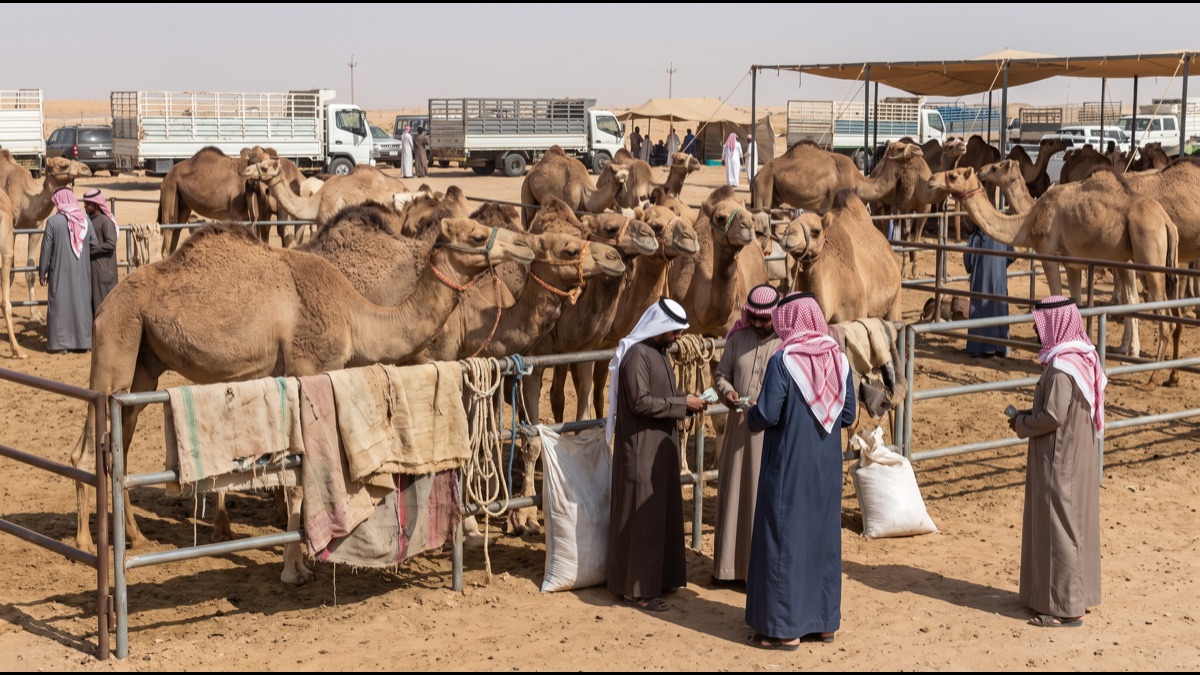
Long before oil, camels were the single most valuable asset a family in the Arabian Peninsula could own, and the markets where they were bought and sold were among the oldest continuously operating commercial institutions in the region. A camel souk is not a nostalgic reenactment kept alive for tourists, even though visitors do wander through the larger ones. It functions as a working commodity market, structured much like a livestock auction anywhere else in the world, except the animal being priced carries centuries of cultural weight alongside its purely economic value.
Understanding how these markets actually operate today means separating the ceremonial camel culture that draws international attention, particularly beauty festivals, from the daily business of buying, selling, breeding, and transporting an animal that still underpins parts of the rural Saudi economy.
Where the Major Souks Actually Operate
The best-known modern camel market sits at Al Ha'ir, south of Riyadh, a sprawling open-air facility where hundreds of animals can be present on a single trading day, arranged loosely by breed, age, and intended use rather than in any fixed stall system familiar from Western livestock auctions.
Smaller regional souks operate across the country, particularly in the Eastern Province and in areas historically tied to Bedouin herding routes, and these markets often serve local buyers looking for working or breeding stock rather than the show-quality animals that draw the highest prices at the larger venues.
Trading days are not random. Most souks follow a rhythm tied to the week, with certain days drawing heavier traffic because buyers and sellers have learned, over generations, when the best stock and the most serious buyers are likely to appear at the same time.
How a Camel Actually Gets Priced
Price is set by a combination of bloodline, physical conformation, age, sex, and health, plus the specific purpose a buyer has in mind, since a racing camel, a milk camel, a meat animal, and a show camel are effectively different products wearing the same silhouette.
Bloodline documentation matters enormously at the upper end of the market. Sellers of high-value animals can typically trace lineage back several generations, and buyers who intend to breed or show a camel scrutinize that lineage as carefully as a horse buyer would examine a pedigree at a thoroughbred sale.
At the lower end of the market, pricing is far more utilitarian, driven mainly by weight, apparent health, and age, since a buyer purchasing for meat or basic dairy production cares far less about ancestry than about whether the animal is sound and reasonably priced per kilogram of live weight.
The Grading Eye: What Buyers Are Actually Looking For
Experienced buyers assess a camel much as a car buyer might walk around a vehicle checking for damage, running through posture, gait, coat condition, hump shape, and leg alignment within seconds before deciding whether an animal is even worth a closer look.
For show-quality animals specifically, the criteria narrow toward features prized in beauty competitions: the shape and droop of the lips, the length and carriage of the neck, the size and symmetry of the head, and an overall silhouette that judges at events like the King Abdulaziz Camel Festival have effectively standardized into an informal but widely shared aesthetic.
This standardization has a real market effect. Animals that score well against festival-style criteria can command dramatically higher prices in the souk than working animals of similar physical soundness but less prized appearance, creating a distinct luxury tier inside what is otherwise a livestock commodity market.
Health Certification and Disease Control
Camels sold through formal souks are increasingly subject to veterinary oversight, including testing for conditions such as brucellosis, reflecting a broader push by Saudi agricultural authorities to formalize a trade that was historically conducted almost entirely on trust.
Cross-border movement of camels between Saudi Arabia and neighboring Gulf states adds another layer of regulation, since importing or exporting livestock typically requires health certificates and compliance with quarantine rules designed to prevent disease spreading across a region where camel populations move relatively freely along traditional routes.
Buyers at the more established souks increasingly expect paperwork rather than a handshake, particularly for higher-value transactions, a genuine shift from a trade that for generations relied almost entirely on reputation between herding families who had known each other for decades.
The Auction Mechanics: How a Sale Actually Closes
Unlike a formal Western-style auction with a raised podium and an auctioneer calling numbers to a seated crowd, most transactions in a Saudi camel souk happen through direct, often prolonged negotiation between buyer and seller, sometimes with a respected intermediary helping bridge a gap in price expectations.
Haggling is expected and can stretch over multiple visits to the same animal across a single trading day, with a seller occasionally walking away from an offer only to reconsider hours later once it becomes clear no better bid is coming before the market closes for the day.
Cash remains the dominant method of payment for smaller transactions, though bank transfers have become increasingly common for the highest-value animals, where sums involved can run into the hundreds of thousands of riyals for a genuinely elite bloodline.
The Economics of Breeding for the Souk
Breeders who supply the souks operate on a timeline measured in years rather than months, since a camel does not reach full physical maturity, let alone peak show or breeding condition, until well into its physical development, meaning a breeder's decisions today shape income that may not materialize for several years.
Female camels capable of producing valuable offspring are themselves a significant capital asset, and serious breeders track maternal lines with the same attention paid to sire lines, since strong genetics on both sides of a pairing meaningfully raise the odds of producing a foal with souk-worthy or festival-worthy conformation.
This long production cycle means the camel economy is comparatively insulated from short-term price swings compared to faster-turnover livestock, but it also means breeders who misjudge demand years in advance can be left holding animals that cost more to raise than the market is currently willing to pay.
Digital Marketplaces Are Changing the Trade
In recent years, online listings and dedicated livestock trading apps have begun supplementing, though not replacing, the physical souk, allowing sellers to post photographs, basic lineage information, and asking prices that buyers can review before ever making the drive to a physical market.
This shift has particularly benefited sellers in more remote areas, who previously depended on transporting animals to a central souk simply to find a buyer, and can now generate serious interest online before committing to the cost and logistics of moving a camel any real distance.
Even so, most serious buyers, particularly for high-value animals, still insist on an in-person inspection before finalizing a purchase, since photographs can flatter an animal's conformation in ways that become obvious the moment a buyer sees it walk in person.
Social media has added a further layer to this shift, with breeders and traders building followings around specific bloodlines, posting training footage and festival results, and effectively marketing individual animals the way a stable might promote a rising racehorse, generating buyer interest well before an animal ever appears at a physical souk.
Transport and Logistics
Moving camels to and from souks is itself a specialized logistics operation, typically relying on purpose-built trucks with loading ramps designed for an animal that is both tall and, when frightened or resistant, physically capable of injuring handlers or damaging equipment.
Longer-distance transport, including cross-border movement for major festivals or high-value sales, requires additional planning around rest stops, feeding, and the heat stress that can affect even a naturally heat-tolerant animal during multi-hour journeys through the Arabian summer.
Professional transporters who specialize in livestock, and camels specifically, have become their own small industry adjacent to the souk trade, with reputations built on reliability and low rates of injury during transit that buyers and sellers alike factor into whom they hire.
Cultural Weight Alongside Commercial Reality
For many families involved in the trade, camel ownership carries meaning that extends well beyond the balance sheet, tied to identity, heritage, and a continuous connection to Bedouin history that predates the modern Saudi state by many centuries.
This cultural dimension is not merely sentimental decoration on top of a commercial transaction; it actively shapes market behavior, since some sellers will decline a higher offer from an unfamiliar buyer in favor of a lower one from someone within their own tribal or regional network, prioritizing relationship continuity over maximizing price.
Government support for camel culture, including prize money at national festivals and promotion of the trade as part of Saudi Arabia's broader cultural heritage strategy, has reinforced rather than diminished this dynamic, giving the traditional trade renewed visibility even as its mechanics modernize.
Fraud, Disputes, and How the Market Polices Itself
Disputes do arise, most commonly over misrepresented age, health, or lineage, and the informal, relationship-based nature of much of the trade means resolution often happens through social pressure and reputation rather than formal legal channels.
A seller known to have misrepresented an animal will find it considerably harder to sell at the same souk in future, since word travels quickly within a trading community where many participants know each other by name or family, making reputation a genuinely powerful enforcement mechanism.
Formal regulation has grown alongside this informal system rather than replacing it, with agricultural authorities increasingly requiring documentation for higher-value transactions and cross-border sales, gradually layering official oversight on top of a trade that long policed itself through community trust.
DNA testing has begun to enter this picture too, offering a technical backstop to reputation-based trust by allowing a buyer to verify parentage claims directly rather than relying entirely on a seller's word or paperwork that, however well-intentioned, could reflect an honest record-keeping error rather than deliberate fraud.
Why the Souk Persists in a Modernizing Economy
Despite Saudi Arabia's rapid economic diversification away from traditional sectors, the camel trade has not shrunk into irrelevance, sustained by genuine demand for meat and dairy products, a thriving racing and beauty-festival circuit with substantial prize money, and continued cultural prestige attached to camel ownership.
Government cultural investment, tourism promotion around events like the King Abdulaziz Camel Festival, and steady export demand from neighboring Gulf states have if anything strengthened the commercial case for maintaining formal souks rather than letting the trade fade into purely informal, unregulated exchange.
The souk today sits at an unusual intersection: a genuinely old institution operating with increasingly modern tools, veterinary standards, and documentation, serving a market that prices centuries-old bloodlines using criteria that would be recognizable to a livestock trader anywhere in the world.
Racing Camels: A Separate, High-Stakes Track
Racing camels form a distinct sub-market with its own pricing logic entirely separate from beauty grading, since a racing prospect is judged primarily on stride length, lung capacity, and early-age performance data rather than on the aesthetic silhouette that dominates festival competitions.
Training a racing camel from a young age requires specialized handlers, purpose-built tracks, and increasingly the use of small robotic jockeys following regulatory reforms across the Gulf that phased out the use of child riders, a change that reshaped both the training industry and the profile of camels bred specifically for speed.
Successful racing camels, particularly those with a strong track record at major regional races, can be worth many multiples of an equivalent working animal, and owners of proven racing bloodlines increasingly treat breeding rights the way a stable might treat a champion racehorse, licensing access to a prized sire for a fee.
Milk and Meat: The Quieter, Larger Side of the Trade
Away from the headline-grabbing beauty and racing markets, the steady commercial backbone of the camel trade remains dairy and meat production, with camel milk in particular enjoying a growing domestic market driven by claims about its nutritional properties and suitability for people who struggle with cow's milk.
Commercial camel dairies have begun operating at a scale that would have been unfamiliar a generation ago, some using modern milking equipment adapted from cattle operations, which has started to pull a portion of milk-producing animals out of the traditional souk system and into more direct supply contracts between large-scale herders and processors.
Meat animals still move heavily through the traditional souk structure, however, since the smaller, more dispersed nature of meat production has not yet consolidated the way dairy has, leaving the souk as the primary marketplace where a rural family can convert livestock directly into cash on a given trading day.
What a First-Time Buyer Should Actually Know
A newcomer walking into a major souk for the first time without an experienced companion is at a real disadvantage, since the informal grading language used between regulars, covering conformation, temperament, and lineage, is rarely written down anywhere and is instead absorbed through years of watching transactions unfold.
Bringing a trusted local guide or broker, even for a modest fee, is standard practice among serious first-time buyers, both to help interpret an animal's condition accurately and to signal to sellers that the buyer is not an easy target for an inflated asking price.
Timing a visit around the cooler months, when both animals and sellers are more comfortable spending extended time in the open-air market, and arriving early in the trading day before the best stock has already changed hands, are two of the most consistently repeated pieces of practical advice among people who buy regularly.
Sources
- Wikipedia — overview of camel biology, domestication, and regional trading history
- Saudi Ministry of Environment, Water and Agriculture — livestock health and trade regulation
- Food and Agriculture Organization of the United Nations — global livestock market and disease-control standards
- World Organisation for Animal Health — cross-border livestock health certification standards
FAQ
Are Saudi camel souks mainly for tourists?
No — they are genuine working commodity markets. Tourists do visit the larger ones, but the core activity is real livestock trading for meat, dairy, breeding, racing, and show purposes.
What makes a camel expensive at a souk?
Bloodline, physical conformation against beauty-festival style criteria, age, health documentation, and intended use all combine to set price; show-quality animals with strong lineage command dramatically more than working stock.
Do camel sales require health certificates?
Increasingly yes, especially for higher-value and cross-border transactions, as Saudi agricultural authorities have pushed disease testing such as brucellosis screening and formal documentation into the trade.
How do buyers negotiate price at a souk?
Through direct, often extended haggling between buyer and seller, sometimes with a trusted intermediary, rather than a formal auctioneer-run bidding process.
Are online camel marketplaces replacing physical souks?
They supplement rather than replace them — listings help buyers screen options remotely, but most serious buyers still insist on an in-person inspection before finalizing a high-value purchase.
About the Author
We reference Wikipedia, the Saudi Ministry of Environment, Water and Agriculture, the Food and Agriculture Organization, and the World Organisation for Animal Health to explain the background and current understanding of this topic.
Loved This Article?
Share it on WhatsApp → Share it on WhatsApp
Get more guides in your inbox — Subscribe to our newsletter for weekly surprising stories from Egypt, Saudi Arabia, Dubai, and beyond.