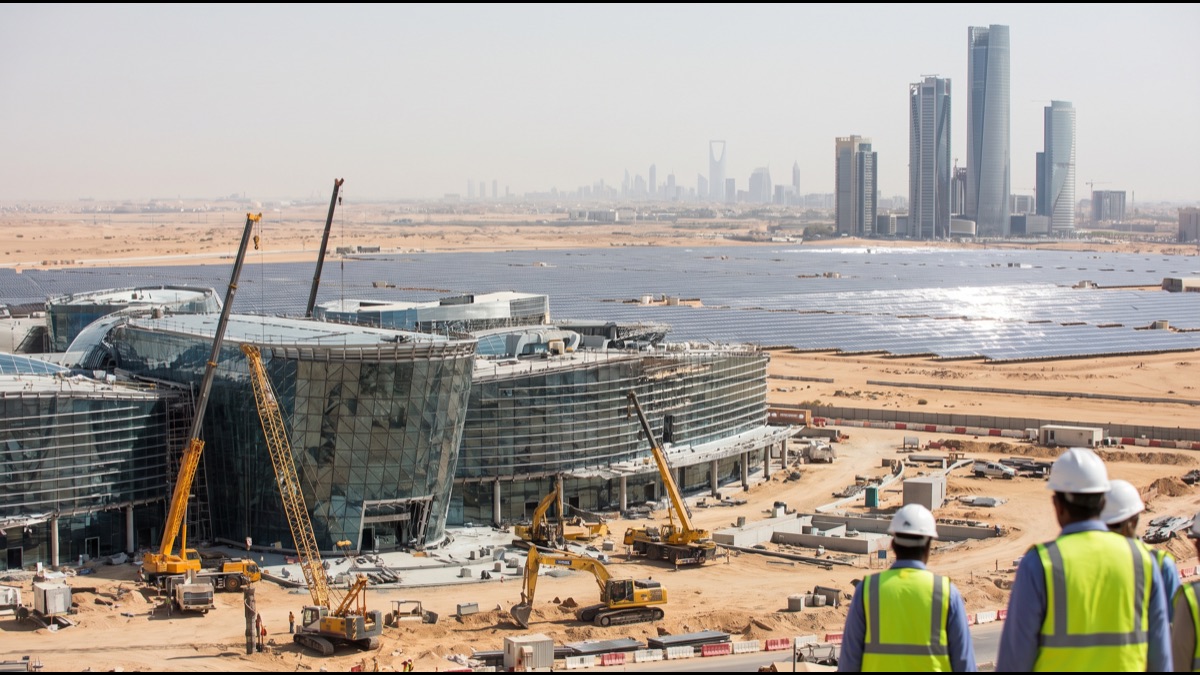
For most of the last century, the story of the Saudi economy could be summarized in a single number: the price of a barrel of oil. That is no longer sufficient to explain what is happening in the kingdom, and understanding why requires looking past headlines about futuristic megacities to the much less glamorous work of building entire industries almost from scratch.
Diversification is not a single policy but a decades-long restructuring effort touching tourism, entertainment, mining, manufacturing, finance, and the labor market simultaneously. It is being pursued with unusual urgency because the underlying vulnerability it addresses is real: a national budget and export base overwhelmingly tied to a commodity whose price the country cannot control.
Why Oil Dependence Became a Strategic Vulnerability
Saudi Arabia holds some of the largest proven oil reserves on the planet, and for decades oil exports funded the majority of government revenue, infrastructure, subsidies, and public-sector wages. That arrangement worked well when prices were high and demand appeared to have decades of runway, but it left the state budget exposed to swings in a global commodity market driven by forces far beyond Riyadh's control.
Price collapses in the 1980s, the late 1990s, and again after 2014 repeatedly forced painful budget adjustments, exposing how directly ordinary government spending was tied to a single volatile input. Each shock renewed internal debate about the wisdom of that dependence, but it took the sustained low-price environment of the mid-2010s to turn that debate into an organized national strategy.
There is also a longer-horizon concern layered on top of short-term price volatility: the global energy transition. Even a gradual worldwide shift away from oil consumption over coming decades would erode the value of Saudi Arabia's principal asset, giving planners a strong incentive to build alternative sources of national income while oil revenue is still available to fund that transition.
What Vision 2030 Actually Set Out to Change
Vision 2030, launched in 2016 under the leadership of Crown Prince Mohammed bin Salman, is the umbrella program under which most current diversification efforts are organized. It set out broad ambitions across three themes: a vibrant society, a thriving economy, and an ambitious nation, translated into dozens of specific programs covering everything from healthcare reform to entertainment licensing.
On the economic side, the plan's headline goals included raising the non-oil sector's contribution to GDP, growing non-oil government revenue substantially, reducing unemployment, and increasing the private sector's share of the economy relative to the state. These are not abstract slogans; each has associated tracking metrics published in annual progress reports.
Vision 2030 also functioned as a coordinating device internally, giving previously disconnected ministries and state entities a shared set of targets and a shared deadline, which helped align infrastructure spending, regulatory reform, and giga-project financing behind the same broad direction rather than pursuing diversification piecemeal.
How the Public Investment Fund Became the Engine of Diversification
The Public Investment Fund, Saudi Arabia's sovereign wealth fund, existed for decades before Vision 2030 but has since been transformed into the central financing and ownership vehicle for the diversification push. Its assets under management have grown enormously as oil revenue and other state assets have been channeled into it for redeployment into new industries.
Rather than functioning purely as a passive investment fund holding stakes in foreign companies, the PIF has taken an active role in founding and directly owning new domestic entities, from entertainment and gaming companies to giga-project developers and manufacturing ventures, effectively acting as a state-backed venture builder at national scale.
This model lets the state direct capital toward strategic non-oil sectors more quickly than waiting for private investors to independently identify and fund the same opportunities, though it also means the pace and shape of diversification remains heavily influenced by decisions made within a single, powerful institution.
How Tourism Became a New Pillar
Saudi Arabia issued its first tourist visas for international leisure travelers only in 2019, a striking fact given how central tourism has since become to diversification planning. Religious tourism tied to Hajj and Umrah had existed for centuries, but leisure tourism as an economic sector was effectively built from a standing start.
New destinations including heritage sites, Red Sea resort developments, and desert experiences have been developed specifically to attract international visitors, supported by visa liberalization, new airline capacity, and hospitality investment. The stated ambition is to make tourism a major contributor to non-oil GDP and a significant source of new private-sector jobs.
The sector still faces genuine headwinds, including social and regulatory adjustments needed to make the country comfortable for a broader range of international visitors, and competition from long-established regional tourism destinations that have decades of brand recognition and infrastructure already in place.
How Entertainment and Sport Became Economic Tools
The rapid expansion of cinemas, concerts, festivals, and major sporting events after 2016 reflected both a social liberalization agenda and a deliberate economic calculation: entertainment spending previously conducted abroad by Saudi citizens could instead be captured domestically, while also making the country a more attractive destination for international visitors and residents.
Large-scale investment in sports, including major golf, boxing, football, and esports events, alongside stakes in international sports organizations, has drawn criticism internationally as a strategy sometimes labeled "sportswashing," but from a purely economic-diversification perspective it is treated internally as building a genuine entertainment and hospitality sector with associated jobs and ancillary spending.
These investments also serve a soft-power function, raising the country's international visibility in ways that planners hope will support tourism and foreign investment goals simultaneously, making entertainment spending difficult to evaluate purely as a standalone commercial sector.
How Mining and Minerals Fit Into the Plan
Saudi Arabia has identified its mineral wealth, including gold, phosphate, and base metals, as a potential "third pillar" of the economy alongside oil and petrochemicals. Government geological surveys have suggested substantial untapped mineral reserves across the kingdom, and new mining licensing rounds and dedicated investment funds have been introduced to accelerate exploration and extraction.
The strategic logic is that mining, unlike tourism or entertainment, plays directly to the country's existing industrial and engineering strengths and could support downstream manufacturing of metals and materials domestically rather than exporting raw ore, extending value capture further into the supply chain.
Developing a mining sector at meaningful scale nonetheless requires years of exploration, permitting, and infrastructure build-out, meaning its contribution to diversification is likely to be realized over a longer horizon than faster-moving sectors like tourism and entertainment.
Building a Domestic Manufacturing Base
A National Industrial Strategy has targeted growth in domestic manufacturing across sectors including automotive assembly, defense production, pharmaceuticals, and renewable energy equipment, aiming to substitute imports with locally produced goods and eventually build an export-oriented manufacturing base.
Special economic zones, tax incentives, and localization requirements attached to major government contracts have been used to encourage both domestic and foreign manufacturers to establish production facilities inside the kingdom rather than simply exporting finished goods into the Saudi market.
Manufacturing diversification faces structural challenges common to newly industrializing economies, including the need to build supplier ecosystems, technical training pipelines, and logistics infrastructure that took decades to mature in more established manufacturing hubs elsewhere in the world.
Chasing Foreign Direct Investment Targets
Attracting foreign direct investment is treated as both a direct source of capital and a signal of international confidence in the broader reform agenda. Regulatory changes have simplified foreign ownership rules in many sectors that previously required a local partner, and dedicated investment authorities actively court multinational companies to establish regional operations in the kingdom.
A widely publicized requirement that international companies wanting to do business with Saudi government entities establish their regional headquarters inside the country has been used as explicit leverage to convert commercial relationships into physical investment and local job creation.
FDI inflows have grown from previously modest levels, though officials have at times acknowledged that headline targets set early in the Vision 2030 process were highly ambitious relative to what has been achieved so far, reflecting the genuine difficulty of rapidly reorienting global investment flows.
How Privatization Reduces State Dependence
A privatization program has targeted the partial or full sale of state assets across sectors including airports, water utilities, healthcare, and education, aiming both to raise capital for reinvestment elsewhere and to introduce private-sector efficiency and competition into services traditionally run entirely by the state.
The initial public offering of a minority stake in the national oil company itself, one of the largest listings in stock market history, was framed partly as a diversification move, generating capital that could be redirected into the Public Investment Fund and non-oil investments rather than remaining tied entirely to oil operations.
Privatization has proceeded at an uneven pace across sectors, with some transactions completed on schedule and others delayed, reflecting the genuine complexity of restructuring long-standing state monopolies while maintaining service quality and managing politically sensitive questions about pricing and employment.
Workforce Nationalization and Human Capital
Diversification depends on having enough trained citizens to staff new industries, which has made workforce nationalization programs, requiring companies to employ a minimum proportion of Saudi nationals in certain sectors and roles, a central and sometimes controversial policy lever running alongside the industrial strategy.
Education and training reforms have targeted skills gaps in tourism, hospitality, technology, and advanced manufacturing specifically, alongside scholarship programs sending Saudi students abroad for technical education intended to eventually feed back into the domestic economy.
Rapidly increasing female labor force participation has also been treated as both a social reform and an economic necessity, expanding the available domestic talent pool for new industries that would otherwise struggle to recruit enough qualified nationals quickly enough to meet localization targets.
What Renewable Energy Contributes to the Non-Oil Economy
Large-scale solar and wind projects serve a double economic purpose beyond their environmental benefits: they reduce the volume of oil that would otherwise be burned domestically for power generation, freeing more crude for export, while also building a renewable energy construction and operations sector that can itself generate jobs and, potentially, export expertise regionally.
International and domestic developers have been contracted for major solar and wind installations, with government targets for renewable electricity generation set well above the country's historical near-total reliance on oil and gas for domestic power.
Renewable energy investment also supports the manufacturing diversification agenda directly, since components including solar panels and related equipment are targeted for domestic production as part of the broader industrial localization strategy.
Giga-Projects as Diversification Vehicles
Large futuristic developments, most prominently the NEOM region and the Red Sea tourism developments, function simultaneously as construction-phase economic stimulus, long-term tourism and residential infrastructure, and international marketing tools designed to reposition the country's global image.
These projects are financed substantially through the Public Investment Fund and are intended to eventually operate as self-sustaining economic zones combining tourism, technology, and residential development under distinct regulatory frameworks separate from the rest of the country.
Construction on this scale has already generated substantial short-term employment and contracting activity, though the longer-term economic payoff depends on these projects successfully attracting the residents, businesses, and visitor numbers their long-term plans assume, which remains to be demonstrated at full scale.
What the Numbers Actually Show So Far
Non-oil GDP growth has generally outpaced oil-sector GDP growth in recent years, and non-oil government revenue has expanded considerably from its historical base, both suggesting genuine structural change rather than purely rhetorical rebranding of existing activity.
Oil nonetheless still accounts for the large majority of total export earnings and a substantial share of total government revenue, meaning the practical dependence on oil pricing for the overall fiscal position remains significant even as the non-oil economy expands in absolute terms.
Independent economic analysts generally characterize progress as real but slower than the most ambitious original targets implied, a pattern common to large-scale economic transformation programs where early rhetoric tends to outpace the multi-decade reality of building entirely new industries.
What Obstacles Remain
Financing giga-projects and new industries simultaneously at the scale currently underway has required substantial borrowing and drawing on state reserves, raising questions among some analysts about the fiscal sustainability of the pace of spending if oil prices remain lower than planning assumptions for an extended period.
Building genuinely competitive private-sector industries also requires more than capital; it requires deep supplier networks, technical expertise, and business cultures that typically take much longer than a single decade to mature, meaning many new ventures currently depend heavily on continued state support rather than standing fully on independent commercial footing.
Global economic conditions, including interest rates, capital availability, and international investor sentiment toward the region, also shape how quickly foreign direct investment and giga-project financing can realistically be secured, introducing external variables the strategy cannot fully control.
Why Full Diversification Is a Decades-Long Project
Economic historians studying other resource-dependent economies that have attempted diversification generally find it to be a multi-decade undertaking even under favorable conditions, since building competitive non-resource industries from a limited existing base requires patient accumulation of skills, institutions, and market relationships that cannot be purchased outright.
Saudi Arabia's effort is distinguished by the scale of capital being deployed and the speed of social and regulatory change accompanying it, but the underlying economic challenge, building genuinely competitive industries outside a dominant resource sector, follows patterns observed in other diversification attempts worldwide.
The most realistic framing, echoed by many independent economists studying the program, treats Vision 2030 not as a fixed 2030 finish line but as the opening phase of a much longer economic transition whose ultimate success will only be clear well beyond the program's original target date.
Sources
- Wikipedia — overview of Saudi Vision 2030 and its economic goals
- Vision 2030 official program site — government-published targets and progress reports
- International Monetary Fund — economic analysis of Saudi non-oil growth and fiscal indicators
- World Bank — data on Saudi GDP composition and diversification indicators
- Public Investment Fund — official information on PIF-backed sectors and giga-projects
FAQ
Is Saudi Arabia still dependent on oil revenue?
Oil remains a very large share of government revenue and exports, but its share of overall GDP has fallen as non-oil sectors like tourism, entertainment, and services have expanded significantly.
What is Vision 2030?
Vision 2030 is Saudi Arabia's long-term reform program launched in 2016 that sets targets for reducing oil dependence, growing the private sector, and developing tourism, entertainment, and other non-oil industries.
What role does the Public Investment Fund play?
The Public Investment Fund is Saudi Arabia's sovereign wealth fund and acts as the primary financing and ownership vehicle for many of the giga-projects and new industries central to diversification.
Why does Saudi Arabia want to grow tourism?
Tourism generates non-oil revenue, creates jobs outside the public sector and energy industry, and supports the broader goal of building a services economy less exposed to oil price swings.
How is the diversification effort being measured?
Officials track non-oil GDP growth, non-oil revenue as a share of the budget, foreign direct investment inflows, and private-sector employment, alongside sector-specific targets for tourism visits and giga-project completion.
About the Author
We reference Wikipedia, the official Vision 2030 program, the International Monetary Fund, the World Bank, and the Public Investment Fund to explain the background and current understanding of this topic.
Loved This Article?
Share it on WhatsApp → Share it on WhatsApp
Get more guides in your inbox — Subscribe to our newsletter for weekly surprising stories from Egypt, Saudi Arabia, Dubai, and beyond.