What Provenance Actually Means
Provenance is the documented chain of ownership of an artwork, tracing who has owned it, where it has been kept, and how it moved from hand to hand, from the moment it left the artist's studio to the present day. A complete provenance record functions like an unbroken chain, with each link naming an owner, a location, and roughly when that stage of custody began and ended.
The word itself comes from the French for 'origin', but modern provenance research covers far more than simply where a work was made. It is now a specialised discipline combining archival research, art history, and increasingly forensic science, undertaken specifically because an artwork's ownership history materially affects its legal status, market value, and moral standing.
Why Museums and Buyers Care So Much
A painting with a documented, unbroken provenance is safer to buy or exhibit because it substantially reduces the risk that the work was stolen, looted, or exported illegally at some point, any of which could expose a buyer or institution to a legal ownership claim years or decades later.
Major auction houses and reputable museums now conduct provenance checks as standard practice before a significant acquisition, and a gap in the ownership chain, particularly one spanning the 1930s and 1940s in Europe, is treated as a serious red flag requiring active investigation rather than something to simply note and move past.
The Paper Trail Researchers Actually Search
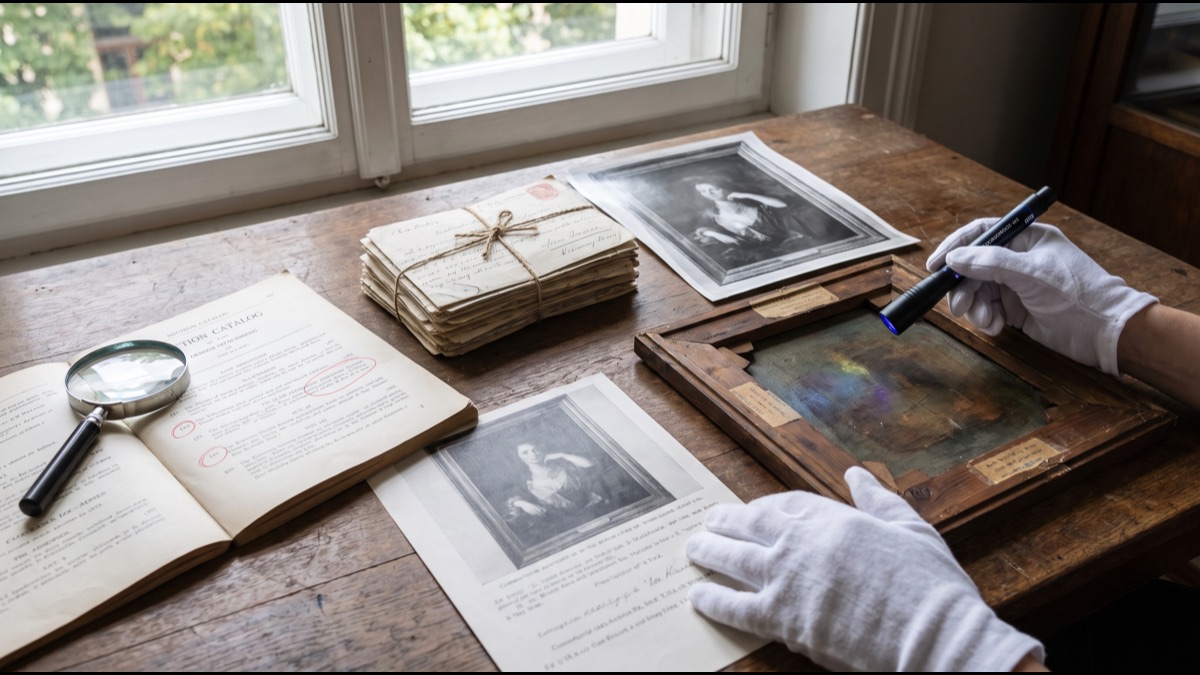
The core of provenance research is archival: exhibition catalogues, auction house records, gallery inventories, insurance documents, customs and export records, wills and probate records, and correspondence between dealers, collectors, and artists, all of which can place a specific work in a specific location at a specific time.
Photographs are a particularly valuable source, since a period photograph showing the artwork hanging in a named collector's home, or appearing in the background of an unrelated news photograph, can independently corroborate or contradict a written ownership claim in ways paper documents alone sometimes cannot.
How Physical Evidence on the Work Itself Helps
The painting itself often carries physical clues researchers examine directly: collector's stamps, gallery labels, inventory numbers, or wax seals affixed to the back of the canvas or frame, many of which can be matched against known archives of specific dealers or collections to confirm a stage of ownership.
Customs stamps and shipping labels from international transport, exhibition labels from specific institutions, and even frame styles characteristic of a particular period or country can each narrow down where and when a work travelled, sometimes providing the only surviving evidence for a period with no matching paper documentation.
Why the Nazi-Era Gap Is Especially Scrutinised
The period from roughly 1933 to 1945 receives particularly intensive scrutiny because of the scale of art looting and forced sales carried out under Nazi rule across occupied Europe, affecting an estimated several hundred thousand artworks taken from Jewish collectors and other victims of persecution.
International agreements adopted since the late 1990s committed museums and governments to actively research this period specifically, publish findings, and work toward just and fair solutions with the heirs of original owners when looted works are identified, which has driven a substantial expansion of dedicated provenance research departments at major institutions.
How Restitution Claims Actually Get Resolved
When provenance research or a claimant's own evidence identifies a work as having been looted or sold under duress, the resolution process typically begins with direct negotiation between the current holding institution and the heirs of the original owner, informed by the historical evidence both sides can produce.
Dedicated commissions and panels exist in several countries specifically to mediate or arbitrate these disputes when direct negotiation fails, and outcomes have ranged from full restitution of the artwork, to financial settlement while the institution retains the piece, to negotiated shared arrangements, with no single universal legal rule governing every case.
How Scientific Analysis Supports Provenance Research
Alongside archival work, technical examination increasingly supports provenance conclusions: pigment analysis can confirm or rule out whether materials used are consistent with the claimed period of creation, and canvas or panel dating techniques can establish a plausible window for when the physical support was produced.
Infrared reflectography and X-radiography can reveal underdrawings, earlier compositions painted over, or restoration work, any of which can help distinguish an original work from a later copy or confirm that a work matches historical photographs taken before it changed hands.
Dendrochronology, the dating of wood panels by matching their tree-ring patterns against regional reference chronologies, has proven particularly valuable for Northern European Old Masters, since it can establish the earliest plausible date a panel could have been felled and seasoned, ruling out claimed dates that predate when the physical wood itself could have existed.
How Forgeries Complicate Provenance Investigations
A sophisticated forger sometimes fabricates a plausible provenance alongside the physical forgery itself, inventing a chain of ownership complete with forged labels, invented gallery stamps, and even doctored photographs intended to make a fake object appear to have a genuine, traceable history.
This is precisely why experienced provenance researchers treat physical evidence and archival documentation as mutually reinforcing checks rather than relying on either alone, since a forger who successfully fabricates convincing paperwork may still be caught by material analysis, and vice versa.
Who Actually Does This Work
Provenance research is carried out by dedicated in-house researchers at major museums and auction houses, independent specialist consultants hired for specific acquisitions or disputed cases, and increasingly by academic and government-funded projects building shared, searchable databases of known looted and disputed works.
International databases compiling stolen and looted art, along with archives from wartime art-recovery operations, now let researchers cross-reference a specific painting against records of confirmed thefts, substantially speeding up work that once required physically visiting dispersed archives across multiple countries.
How Digital Databases Are Changing Provenance Tracking
For most of the twentieth century, provenance research meant physically visiting scattered archives, auction house libraries, and private collections in different countries, often reading handwritten ledgers and correspondence in multiple languages, a process that could consume months or years for a single contested work.
That labour-intensive baseline is worth remembering whenever a provenance conclusion is reported as settled, since even a well-resourced investigation often closes only some of the gaps in a work's history rather than every one, and a summary presented publicly as definitive frequently glosses over specific years or owners that remain genuinely unverified.
Large searchable digital databases compiled by museums, governments, and research foundations have substantially compressed this timeline, allowing a researcher to cross-reference a specific object against thousands of documented sales, seizures, and known looted-art records in minutes rather than months, though digitisation remains incomplete and older or less prominent archives are still often accessible only in person.
A newer development is the use of durable, tamper-resistant digital registries to record ownership transfers for contemporary works going forward, intended to prevent the kind of documentation gaps that make older works so difficult to trace, though this approach only helps for works entered into such systems from the point of creation onward and does nothing to resolve gaps in historical works already in circulation.
How Provenance Matters Differently for Contemporary Art
For living artists and recently created work, provenance research looks quite different from the archival detective work required for centuries-old paintings, since the chain of ownership is typically short, well documented by galleries and the artist's own studio records, and verifiable directly with the artist or their estate in many cases.
The more common provenance concern in the contemporary market is authenticity fraud rather than looting, since a short and recent ownership history is easier to fabricate convincingly than a centuries-long one, which is why galleries representing major contemporary artists frequently maintain a formal catalogue raisonné, an authoritative documented list of every known genuine work, specifically to make fraudulent claims easier to identify and reject.
How Colonial-Era Acquisitions Add a Separate Layer of Scrutiny
Beyond wartime looting, a growing body of provenance research now examines objects, including paintings and sculpture, acquired during colonial rule, where the line between a legitimate purchase and an acquisition made under coercive or deeply unequal power relationships is often genuinely difficult to draw using only surviving documentation.
Several major European museums have begun publishing dedicated colonial-era provenance reviews and, in a growing number of cases, returning specific objects to countries and communities of origin, treating this as a distinct research category from Nazi-era looting with its own historical context, evidentiary challenges, and negotiation frameworks.
The people doing this work sit at an unusual professional intersection, combining archival research skills closer to a historian's training with an art market fluency closer to a dealer's, and the field has grown into its own specialised career track distinct from either curatorial or conservation work, with dedicated graduate programmes and professional associations that did not exist in a formal sense a few decades ago.
What a Formal Provenance Report Actually Contains
A professional provenance report is a structured document rather than a narrative essay, typically listing each known owner in chronological order with dates of acquisition and disposal where known, the type of transaction involved, supporting documentary evidence for each entry, and an explicit, honest note of any unexplained gap in the chain.
Reputable auction houses and museums now routinely publish a summary version of this report alongside a significant work when it is offered for sale or exhibited, allowing outside researchers, potential claimants, and interested members of the public to review the documented history and raise questions before a transaction is finalised rather than only after.
Why Some Owners Resist Full Provenance Disclosure
Not every owner welcomes intensive provenance scrutiny, and resistance is not automatically a sign of wrongdoing, though it inevitably invites more public suspicion than quiet silence would in a market where reputational trust functions as its own component of a work's underlying value. Legitimate collectors sometimes decline to publicise ownership for personal security, insurance, or family privacy reasons that have nothing to do with a work's authenticity, particularly for extremely high-value works, while others simply lack complete records for stretches of a work's history despite having acquired it entirely properly.
Genuine bad actors, by contrast, tend to show a more specific pattern: reluctance extends specifically to the periods and details most relevant to a potential looting or theft claim rather than to ownership information in general, which is one of several signals experienced provenance researchers weigh when deciding how much additional scrutiny a particular case warrants.
Owners weighing whether to commission a full report also have to consider that the process itself can surface uncomfortable findings, since a request for thorough documentation occasionally uncovers evidence undermining rather than confirming a work's assumed history, a genuine risk that shapes some owners' documented reluctance discussed elsewhere in this piece, and a factor collectors weigh carefully before agreeing to any independent research they cannot fully control the ultimate outcome of.
Why Complete Provenance Is Still Rare
Despite decades of dedicated research, a genuinely complete, unbroken provenance record from creation to the present remains relatively rare for older works, since archives were destroyed in wars, private sales were often undocumented by design, and many historical owners kept no formal records of their acquisitions at all.
Museums generally handle this reality by publishing what is known with explicit gaps clearly marked rather than presenting an artificially tidy narrative, treating an honest, incomplete record as more valuable and more trustworthy than a confident but unverifiable claim of full ownership history.
Provenance research sits at the intersection of art history, archival detective work, and increasingly hard science, driven by the recognition that an artwork's ownership history is not a footnote to its value but a central part of it. The discipline exists because the alternative, treating paintings as objects with no history worth questioning, has repeatedly allowed theft, looting, and fraud to pass quietly into legitimate collections, and the ongoing work of closing gaps in that history remains one of the more consequential forms of historical justice the art world still actively pursues.
Insurance and lending practices have also shifted around provenance research in ways that rarely make headlines but genuinely affect how art moves through the world. Major museums increasingly require a documented provenance summary before agreeing to borrow a work for a temporary exhibition, and insurers factor unresolved provenance gaps directly into the premium charged to cover a piece while it is in transit or on loan, which gives lenders a concrete financial incentive to commission research they might otherwise defer indefinitely.
Auction houses occupy a particularly exposed position in this system, since they are simultaneously expected to conduct meaningful provenance due diligence before accepting a consignment and to move quickly enough to meet sale calendars driven by market demand rather than research timelines. The tension between thorough investigation and commercial pace is one of the genuinely unresolved pressures in the contemporary art trade, and it is a large part of why gaps that a careful researcher would flag sometimes still slip through into a public sale.
Sources
- Wikipedia — overview of provenance research across art and other collectible fields
- UNESCO — international framework on cultural property protection and illicit trafficking
- The Getty Provenance Index — major research database of historical art ownership records
- International Council of Museums (ICOM) — professional standards guidance on museum acquisitions and due diligence
FAQ
Can a painting with a gap in its provenance still be genuine?
Yes — gaps are common for older works and do not automatically indicate a problem, though institutions treat unexplained gaps, particularly during the 1933-1945 period, as requiring active investigation before acquisition.
How long does a full provenance investigation typically take?
It varies enormously by case, from weeks for a well-documented recent work to years for an older painting requiring archival research across multiple countries and languages.
Does a museum label listing 'private collection' mean the owner is hidden deliberately?
Not necessarily — it often simply reflects a genuine owner's preference for privacy, though researchers still attempt to verify the underlying chain of custody regardless of what is publicly displayed.
Can scientific dating alone prove where a painting has been?
No — scientific analysis can help confirm when and sometimes where a work was physically made, but establishing where it travelled afterward still relies primarily on archival and documentary evidence.
Are restitution claims only about Nazi-era looting?
No — provenance disputes also arise from colonial-era acquisitions, wartime looting in other conflicts, and ordinary theft, though the Nazi era remains the most extensively documented and litigated category.
About the Author
We reference Wikipedia, UNESCO, The Getty Provenance Index, International Council of Museums (ICOM) to explain the background and current understanding of this topic.
Loved This Article?
Share it on WhatsApp → Share it on WhatsApp
Get more guides in your inbox — Subscribe to our newsletter for weekly surprising stories from Egypt, Saudi Arabia, Dubai, and beyond.