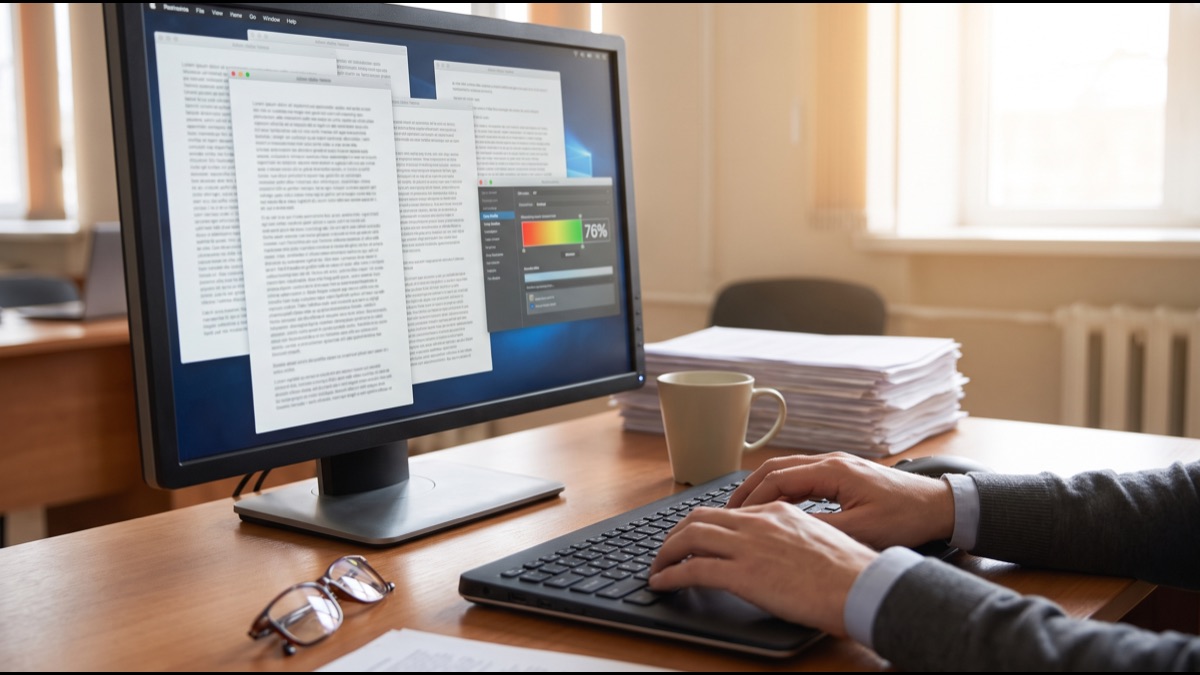
Plagiarism detection software has become a routine part of academic life, silently scanning millions of student essays every day and returning a percentage score that can determine whether a paper is accepted, flagged, or sent to a disciplinary committee. Yet the tool most students dread is not actually reading their work in any meaningful sense, and understanding what it is genuinely doing under the hood explains both its real usefulness and its well-documented limitations.
The gap between what students assume the software does, catch stolen ideas, and what it actually does, find matching sequences of characters, is the source of most confusion and most disputes over flagged papers. Closing that gap requires looking at the actual mechanics of text comparison rather than the marketing language surrounding these tools.
What a Plagiarism Checker Actually Compares Text Against
A submitted paper is compared against several distinct pools of text: a continuously updated crawl of publicly accessible web pages, a large licensed archive of academic journals and published books, and, critically, an internal database built from millions of previously submitted student papers from other institutions using the same service.
This last category is often the source of the highest-stakes matches, since a student who reuses a paper submitted by someone else, whether a purchased essay or a shared file, is compared directly against that prior submission even if it was never published anywhere on the open web and would be completely invisible to a general search engine.
The web-crawl component itself is not a live, real-time search of the entire internet at the moment a paper is checked, since that would be both slow and unreliable; instead the service maintains its own continuously refreshed index of crawled pages, meaning very recently published web content may not yet be represented, and pages later removed from the live web can still persist in the archived index for years, occasionally producing a flagged match against a source a human reviewer can no longer independently verify by visiting the original page.
The licensed academic corpus typically includes content publishers have specifically agreed to make available for comparison purposes, which is a meaningfully smaller and more curated set than the open web crawl, but one that carries particular weight in graduate-level and research contexts where the concern is less about undergraduate essay reuse and more about detecting overlap with prior published scholarship, including a researcher's own earlier work, a practice known as self-plagiarism that many journals now screen for using the same underlying comparison technology.
How Text Gets Broken Into Comparable Fragments
Rather than comparing whole documents to whole documents, which would be computationally impractical at the scale these services operate, the software breaks submitted text into small overlapping fragments, commonly called shingles or n-grams, typically spanning a handful of consecutive words each.
Each fragment is converted into a compact numerical representation, often through a hashing function, and these hashes are checked against a pre-built index of hashes generated from the entire comparison corpus, a process that allows the system to flag potential matches in seconds across a database containing billions of documents rather than performing a slow direct text search.
The overlapping nature of the fragments matters because it allows the system to detect a matching passage even if it begins or ends at an unusual point in a sentence, catching partial reuse that a simpler whole-sentence comparison would miss entirely.
What a Similarity Score Actually Measures
The percentage figure most students fixate on represents the proportion of the submitted document's text that matched some fragment somewhere in the comparison database, nothing more and nothing less, and critically it carries no built-in judgment about whether that matched text was properly cited, quoted, or otherwise legitimate.
A paper built almost entirely from a student's own original analysis but containing a lengthy, properly quoted and cited passage from a well-known source can register a surprisingly high similarity percentage purely because that quoted passage matches the source text word for word, which is exactly what a direct quotation is supposed to do.
The specific threshold institutions treat as concerning varies considerably and is not standardized by the software itself, which simply reports the raw percentage and leaves the interpretation entirely to institutional policy; some departments treat anything above roughly fifteen percent as warranting a closer look, while others set a much higher or lower bar depending on the discipline, the assignment type, and how heavily that particular field relies on standardized phrasing and shared source material in ordinary academic writing.
Why a High Score Does Not Automatically Mean Cheating
Because the algorithm cannot distinguish a properly attributed quotation from an unattributed one, most services explicitly instruct instructors to open the detailed match report and manually review each flagged passage rather than making any decision based on the headline percentage alone, a distinction that is frequently lost in casual classroom conversation about "the plagiarism score."
Bibliographies, reference lists, and standard boilerplate phrasing common to a particular academic discipline also reliably generate matches, since these elements are, by their nature, meant to be reused verbatim across many different papers, and most detection interfaces allow instructors to exclude bibliography sections and small matches from the calculated percentage for exactly this reason.
How Institutional Databases Grow With Every Submission
Many major detection services add each newly submitted paper to their comparison database by default once it has been processed, meaning the corpus a checker searches against grows continuously with every essay submitted anywhere in the world using that same platform, which is a major reason the same service can catch reused papers years after original submission.
This growth model has raised genuine intellectual-property and consent concerns, since a student's original written work becomes part of a commercial database used to screen other students' submissions without the original author necessarily having agreed to that specific use beyond the fine print of a submission portal, a tension some universities have addressed by offering an opt-out or a locally hosted comparison archive instead.
Legal challenges over exactly this database-retention practice have been brought in several jurisdictions, generally centered on whether a student's mandatory submission to a for-profit database constitutes an unauthorized commercial use of their copyrighted written work, and while courts in the most prominent cases have largely sided with the service providers on the grounds that comparison-only storage constitutes fair use rather than redistribution, the underlying policy debate about student consent and data ownership has continued to shape how individual institutions choose to implement these tools.
Why Paraphrasing Complicates Detection
Because the underlying method relies substantially on matching sequences of actual words, a passage that has been heavily reworded, with synonyms substituted and sentence structure rearranged while preserving the original meaning, can score a very low similarity percentage even though the ideas and argument structure were lifted wholesale from another source.
Some more advanced detection systems now supplement pure text matching with statistical checks for unusual word-choice patterns characteristic of automated paraphrasing tools, since these tools tend to select synonyms in ways that read as subtly unnatural to a careful human reader, but this supplementary layer is considerably less reliable than direct text matching and produces a meaningfully higher rate of both missed cases and false accusations.
How AI-Text Detection Differs From Plagiarism Detection
AI-generated text detection is a fundamentally different technical problem from plagiarism detection, since there is frequently no single source document to match against; instead these tools attempt to infer, from statistical patterns in word predictability and sentence structure, whether a passage was more likely produced by a human writer or a language model.
This statistical approach is considerably less reliable than straightforward text matching, and independent testing has repeatedly found meaningful false-positive rates, including cases where genuinely human-written text by non-native English speakers or writers with an unusually formal style has been flagged as likely AI-generated, a problem that has led some universities to treat AI-detection scores as suggestive at most rather than as standalone evidence in disciplinary proceedings.
Why Contract Cheating Is Especially Hard to Catch
Contract cheating, where a student pays another person to write an original custom essay specifically for them, defeats text-matching detection almost entirely, because the resulting document is genuinely new text that has never appeared anywhere in any comparison database and will therefore return a very low, seemingly clean, similarity score.
Institutions have responded to this specific gap with methods entirely separate from text-matching software, including analyzing writing-style consistency against a student's previously submitted work, oral examinations covering the submitted paper's content, and monitoring known essay-mill websites and payment patterns, none of which the standard plagiarism-checking software is designed to address at all.
Some vendors have begun layering stylometric analysis on top of traditional similarity checking specifically to address contract cheating, comparing sentence-length patterns, vocabulary choices, and grammatical habits across a student's submission history to flag documents that read as stylistically inconsistent with that student's established writing, though this remains a considerably less mature and more error-prone technique than straightforward text matching.
How Instructors Are Expected to Use the Report
Detection-service providers and academic-integrity offices generally publish explicit guidance stating that the similarity score should never serve as the sole basis for an academic-misconduct finding, and that instructors are expected to open the underlying match report, examine each individual flagged passage in context, and apply their own subject-matter judgment about whether the matched material represents a genuine integrity violation.
In practice, adherence to this guidance varies considerably by institution and by individual instructor workload, and cases of students being penalized based largely on an unreviewed percentage figure, later overturned on appeal once the underlying matches were actually examined, have been documented at multiple institutions, reinforcing why academic-integrity offices continue to emphasize manual review as a mandatory step rather than an optional courtesy.
What False Positives Look Like in Practice
Common technical or field-specific terminology, standard experimental-methods language in scientific writing, and even a student's own prior coursework submitted to the same database can all generate matches that look identical in the report to genuine misconduct, requiring the same careful human review regardless of the underlying cause.
Group projects present a particular edge case, since two students who collaborated on shared background research and then wrote their individual sections independently can end up with legitimately overlapping passages that trigger a match against each other, a scenario detection software cannot distinguish from one student copying directly from the other without additional context that only the instructor possesses.
Self-plagiarism, where a student resubmits work they themselves wrote for an earlier assignment, produces a similarly ambiguous match, since the flagged text is genuinely the submitting student's own prior writing rather than anyone else's, yet many institutions still classify reusing one's own previously graded work without permission as a form of academic dishonesty on the grounds that it misrepresents new effort, meaning the software correctly identifies a technical match while the underlying ethical question remains a matter of institutional policy rather than anything the algorithm itself can resolve.
Why Some Universities Limit or Reject These Tools
A number of institutions and individual academic departments have scaled back or entirely rejected mandatory plagiarism-software submission, citing the database-consent concerns around student intellectual property, documented bias in AI-detection add-ons against non-native English writers, and a pedagogical argument that surveillance-style tools can undermine the trust relationship between instructor and student that many educators consider central to genuine learning.
Where these tools remain in use, the more defensible framing many academic-integrity offices now promote treats the similarity report as one diagnostic input among several, alongside direct conversation with the student and review of drafting history where available, rather than as an automated verdict machine, a shift in framing that reflects growing institutional awareness of the tool's real technical limits rather than a rejection of academic-integrity enforcement itself.
Understanding the actual mechanics behind the similarity score, string matching against an ever-growing database rather than genuine comprehension of meaning, ultimately explains both why the tool remains useful for catching straightforward copy-paste plagiarism and reused papers, and why it was never designed to be, and should never be treated as, a fully automated verdict on academic honesty. The percentage on the report is a starting point for human judgment, not a replacement for it, and the institutions that get the most value from these tools tend to be the ones that train instructors to read the underlying match report carefully rather than simply glancing at the headline number.
Sources
- Wikipedia — overview of plagiarism-detection methods and history
- Turnitin — publisher documentation on similarity reports and database mechanics
- Association for Computing Machinery — research on text-similarity and n-gram matching algorithms
- iThenticate — publisher guidance on academic and research plagiarism screening
- Jisc — UK higher-education guidance on academic integrity technology
FAQ
Does a plagiarism checker actually understand what an essay means?
No — it matches strings and patterns of text against a large database. It has no comprehension of meaning, which is why it can miss paraphrased plagiarism and flag legitimate quotations.
Why does a high similarity score not automatically mean cheating?
Properly cited quotations, bibliographies, common technical phrases, and even a student's own previously submitted work can all trigger matches, so instructors are expected to review flagged passages rather than act on the score alone.
Can plagiarism software detect AI-generated text?
Dedicated AI-detection tools attempt this using statistical patterns in word choice, but they are considerably less reliable than text-matching plagiarism detection and produce meaningful false-positive rates.
Does submitting a paper add it to the database other students are checked against?
Many major services do add submitted papers to their comparison database by default, which is one reason some institutions require students to consent explicitly before submission.
Can paraphrasing tools reliably beat plagiarism detection?
Heavy paraphrasing can reduce the literal text-match score, but many detection systems now also flag unusual sentence patterns typical of paraphrasing software, and the underlying academic-integrity violation remains regardless of the score. Different institutions also license entirely different providers with different underlying comparison databases, which is why the exact same paper can genuinely produce a different similarity percentage depending on which specific service, and which configured database scope, it happens to be checked against, a variability that is rarely explained to students but that instructors weighing a flagged report should keep firmly in mind.
About the Author
We reference Wikipedia, Turnitin, the Association for Computing Machinery, iThenticate, and Jisc to explain the background and current understanding of this topic.
Loved This Article?
Share it on WhatsApp → Share it on WhatsApp
Get more guides in your inbox — Subscribe to our newsletter for weekly surprising stories from Egypt, Saudi Arabia, Dubai, and beyond.