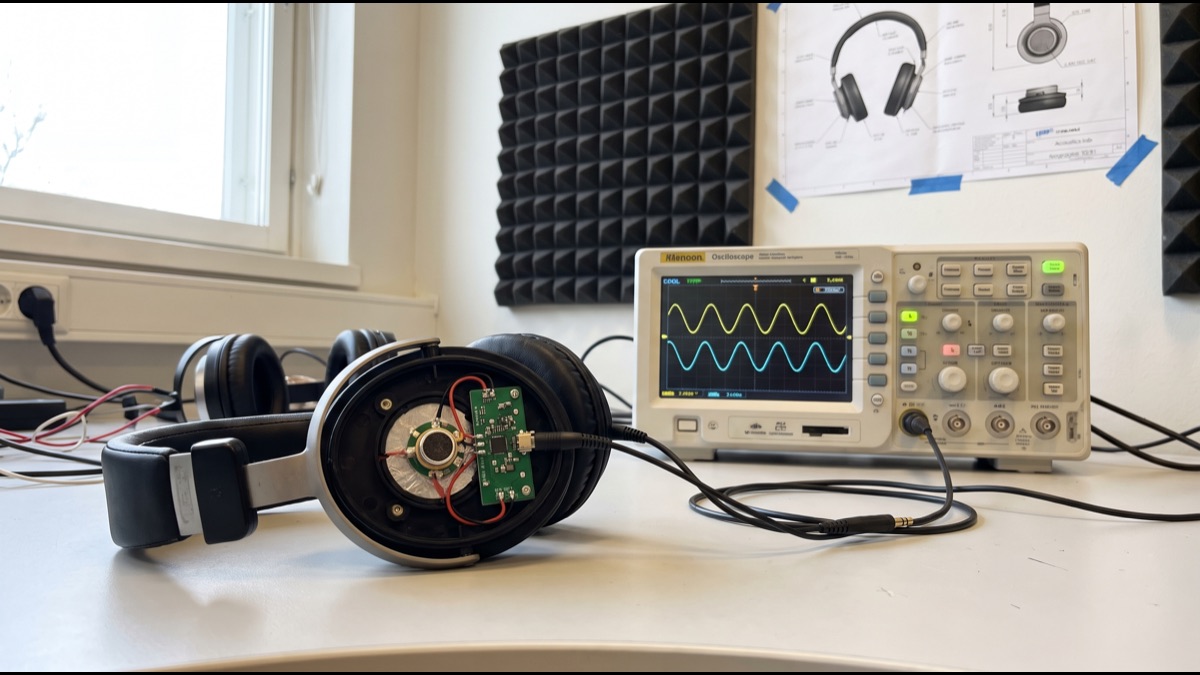
Slide on a pair of active noise-cancelling headphones on a plane and the engine roar seems to drop away almost instantly, even though nothing physically blocked the sound from reaching your ears. That effect feels like magic, but it is closer to a fast, continuous math problem: tiny microphones sample the incoming noise, a chip calculates its mirror image, and a speaker plays that mirror image back fast enough to cancel much of the original wave before it fully forms in your ear canal. Understanding how this actually works also explains why noise cancellation is dramatically better at silencing a jet engine's low drone than a crying baby two rows back, and why no headphone, however expensive, can cancel every kind of sound.
The Basic Physics: Cancelling Sound With Sound
Active noise cancellation (ANC) relies on a principle called destructive interference: every sound wave has a matching 'anti-wave' that is identical in shape but inverted, so that when the two combine, their peaks and troughs cancel each other out and the result is close to silence.
A headphone's ANC system does not physically block sound the way a foam earplug does; instead, it generates that inverted wave electronically and plays it through the same driver that produces music, layering the cancellation signal directly on top of whatever audio is already playing.
This is fundamentally different from passive noise isolation, which simply forms a physical barrier, and the distinction matters because it explains both ANC's biggest strength — cancelling sound that has no physical barrier stopping it — and its biggest weakness, which is timing.
Feedforward Microphones: Listening Before Sound Reaches Your Ear
Feedforward microphones sit on the outside of the ear cup, facing the outside world, and their job is to capture ambient noise before it has a chance to reach the eardrum, giving the processing chip a small head start to calculate and generate a cancelling wave.
Because sound travels fast and the processing has to happen in a fraction of a millisecond, this head start is not generous, which is one reason feedforward-only systems tend to struggle with fast, unpredictable, or high-frequency sounds compared to steady, droning noise.
Engineers generally favor feedforward microphones for handling low-frequency, continuous noise like an engine hum, since that kind of sound is comparatively predictable and gives the system's prediction model something consistent to work against.
Feedback Microphones: Correcting From Inside the Ear Cup
Feedback microphones are placed inside the ear cup, close to the eardrum, and instead of predicting incoming noise, they measure what the ear is actually hearing after the feedforward system has already tried to cancel it, correcting for whatever leaked through.
This inside-the-cup placement lets a feedback system catch errors specific to an individual listener's head shape, hair, glasses, or how snugly the headphones fit, none of which a feedforward microphone facing outward can account for on its own.
The tradeoff is that feedback systems work with less advance warning than feedforward microphones, since the sound has already partially reached the ear by the time it is measured, making them better suited to fine correction than to the initial heavy lifting of cancellation.
Hybrid ANC: Combining Both Microphone Systems
Most modern premium headphones, including well-reviewed models from Sony and Bose, use hybrid ANC systems that combine feedforward and feedback microphones, letting the outward-facing microphones handle prediction while the inward-facing ones fine-tune the result in real time.
This combination generally produces noticeably better cancellation across a wider range of frequencies and listening conditions than either microphone type could achieve alone, which is part of why hybrid systems have become the standard in higher-end consumer headphones.
Independent audio-focused reviewers and outlets that run controlled measurement tests, such as RTINGS, consistently find that hybrid systems outperform single-microphone designs on most real-world noise profiles, though the gap narrows for very simple, steady low-frequency noise.
Why ANC Excels at Low-Frequency Drone
ANC systems are dramatically more effective against low-frequency, continuous sounds — an airplane engine's drone, a car's road noise, an air conditioner's hum — than against sudden or high-pitched sounds, and this is not a marketing limitation but a consequence of basic acoustics.
Low-frequency sound waves are longer and change more slowly over time, giving the processing chip enough of a window to accurately predict the wave's shape and generate a matching inverted signal before the original sound fully arrives.
This is why ANC headphone marketing so consistently uses airplane cabins as the flagship use case: it is close to the ideal scenario for the underlying physics, not just a coincidentally popular one.
The DSP Chip That Makes Real-Time Cancellation Possible
The real-time calculation behind ANC happens on a dedicated digital signal processing (DSP) chip built specifically to perform this kind of rapid waveform math continuously, sampling incoming sound and generating a cancelling signal many thousands of times per second.
This chip has to work with almost no perceptible delay, because even a small timing error between the original noise and the cancelling wave can cause the two to only partially overlap, reducing cancellation effectiveness or, in poorly tuned systems, introducing an audible artifact.
Advances in DSP chip design and manufacturing efficiency over the past decade, alongside improvements documented in audio engineering research published through outlets like the Audio Engineering Society, are a large part of why modern ANC performs noticeably better than headphones from a decade ago.
Passive Isolation Is Doing More Work Than People Realize
Passive noise isolation — the physical seal created by ear cups pressing against the head, or foam ear tips sealing the ear canal — actually accounts for a meaningful share of the noise reduction people attribute entirely to 'noise cancelling' technology.
This passive component works the old-fashioned way, simply blocking sound waves from reaching the ear at all, and it is especially effective against mid-to-high frequency sounds that active cancellation struggles with, making the two approaches complementary rather than redundant.
Headphone reviewers sometimes measure this by testing cancellation performance with ANC switched off, which reveals that a well-sealed pair of over-ear headphones already blocks a surprising amount of noise before any electronics are involved at all.
Why a Poor Ear-Cup Seal Ruins ANC Performance
Because ANC depends on the physical relationship between the microphones, the ear, and the surrounding seal, a poor fit — glasses arms breaking the seal, hair caught under the ear cup, or an ill-fitting ear tip — can noticeably degrade cancellation performance even on a well-engineered pair of headphones.
This happens for two compounding reasons: the passive isolation portion of the noise reduction drops immediately, and the feedback microphone's error-correction measurements become less reliable because the acoustic environment inside the ear cup no longer matches what the system was calibrated for.
Manufacturers commonly recommend testing multiple ear tip sizes for in-ear ANC models specifically because of this sensitivity, since even a small air gap can measurably reduce how much of the incoming noise the whole system is able to cancel.
The Physics Limit: Why Voices and High Frequencies Resist Cancellation
Voices, particularly speech in the 500 Hz to 4 kHz range, are exactly the kind of sound ANC struggles most with, because that range is high enough in frequency and irregular enough in pattern that the system cannot reliably predict its shape far enough in advance.
This is a physics constraint, not an engineering oversight: the wavelength of higher-frequency sound is short enough that a tiny timing error, one that would be irrelevant for a slow-changing engine hum, becomes large relative to the wave itself, breaking the cancellation.
This explains a common consumer complaint that ANC headphones 'don't work' against a nearby conversation the way they do against airplane engine noise — both experiences are consistent with how the underlying technology is actually built to behave, not a defect in either case.
Adaptive ANC and Real-Time Environmental Sensing
Newer flagship headphones increasingly use adaptive ANC, which continuously adjusts the cancellation profile in response to changing environmental conditions rather than applying a single fixed setting, using onboard sensors and more capable processing to reassess the sound environment many times per second.
Some systems also factor in data like whether the headphones are being worn, air pressure changes during a flight's ascent, or detected wind noise, adjusting the cancellation algorithm's behavior specifically for that changing scenario rather than a generic, one-size-fits-all profile.
Independent testing of these adaptive systems generally shows a real, measurable improvement over static ANC in variable environments like a moving train or a windy street, though the improvement over already-strong steady-state performance, like on a plane, tends to be smaller.
Transparency Mode Is the Mirror-Image Problem
Transparency or 'ambient sound' mode does roughly the opposite job of ANC: rather than generating a cancelling wave, it uses the same external microphones to pick up outside sound and deliberately pipes it into the ear canal alongside or instead of any music playing.
This mode exists largely for safety and social convenience — hearing approaching traffic, a boarding announcement, or someone talking to you — and engineering it well requires making piped-in sound feel natural rather than processed, tinny, or artificially amplified.
Some higher-end implementations use the same microphone array and DSP chip that power ANC, simply flipping the processing goal from cancellation to faithful reproduction, which is part of why premium models tend to handle both modes more convincingly than budget ones.
Battery Life and Processing Tradeoffs
Running ANC continuously draws meaningfully more power than playing audio alone, since the microphones, DSP chip, and cancellation-signal generation all have to run constantly regardless of whether music is playing, and headphone manufacturers generally publish separate battery-life figures with ANC on versus off.
This tradeoff has narrowed considerably as chip efficiency has improved, and current flagship wireless headphones from major manufacturers commonly claim battery life with ANC enabled that would have been difficult to achieve even with ANC disabled a decade ago.
Engineers designing these systems have to balance more aggressive, power-hungry cancellation algorithms against battery life targets, which is one reason different headphone models from the same manufacturer can offer noticeably different real-world cancellation strength even when using broadly similar hardware.
The 'Ear Pressure' Sensation Some Listeners Report
A subset of ANC users report a subjective sensation of pressure or fullness in the ears when cancellation is active, sometimes described as similar to the feeling during rapid altitude change, even though no actual air pressure change is occurring.
Audio engineers and some published acoustics research suggest this sensation may relate to how the brain processes the near-silence created by cancelling low-frequency ambient noise, since human hearing is not accustomed to an environment with very little low-end sound energy present.
This effect appears to vary significantly between individuals, and while it is not considered evidence of any physical harm, it is a real enough experience that some headphone models let users dial back ANC intensity rather than only offering a fully on or off toggle.
Wind Noise and Physical Vibration Complicate the System
Wind hitting the outward-facing feedforward microphones creates a rushing sound that those microphones can mistake for genuine ambient noise, sometimes causing the ANC system to generate a cancelling signal that itself produces an audible whooshing or pumping artifact rather than actual silence.
Manufacturers address this with wind-detection algorithms that reduce ANC intensity or shift more heavily onto feedback microphones when wind noise is detected, since feedback microphones positioned inside the ear cup are comparatively shielded from direct wind exposure.
Physical vibration, such as a headphone cable brushing against clothing or bone-conducted footstep noise while running, presents a similar challenge, since it can register on internal microphones in ways that are harder for the cancellation algorithm to distinguish from genuine external sound.
Why Calibration Differs Across Headphone Models and Ear Shapes
Ear canal shape, head size, and even hair thickness affect how sound waves behave inside and around the ear cup, which is why the same headphone model can measurably perform differently in third-party test labs depending on the exact test rig or mannequin head used.
Manufacturers typically calibrate ANC systems using average measurements from a representative range of head and ear shapes, which produces strong results for most listeners but explains why some individuals report noticeably weaker cancellation with a headphone model that reviewers rated highly.
This variability is one reason audio publications increasingly emphasize trying headphones in person or checking return policies before committing, since published lab measurements, however rigorous, are still an average rather than a guarantee for any specific listener's anatomy.
What ANC Cannot Do: Hearing Protection Myths
A persistent misconception is that ANC headphones function as hearing protection equivalent to industrial earmuffs or earplugs; they do not, because ANC targets steady ambient noise and does almost nothing against the sudden, very loud transient sounds — gunfire, machinery impacts — that cause the most serious hearing damage.
Guidance from occupational health bodies such as the U.S. National Institute for Occupational Safety and Health (NIOSH) treats consumer ANC headphones as a listening-comfort product, not a certified hearing-protection device, and recommends purpose-built hearing protection for genuinely hazardous noise environments.
ANC also does nothing to reduce the risk from listening to music itself at unsafe volumes; because it makes quiet listening more pleasant by removing competing background noise, it can indirectly encourage safer listening habits, but it is not a substitute for keeping playback volume within recommended limits.
Noise-cancelling headphones work by continuously measuring incoming sound and generating an inverted version of it fast enough to cancel much of that wave before it fully reaches the ear, a process that depends on precise microphone placement, dedicated real-time processing, and a good physical seal working together rather than any single component. The technology is genuinely most effective against steady, low-frequency noise like engine drone, and genuinely limited against irregular, high-frequency sound like nearby conversation, a pattern that follows directly from the underlying acoustics rather than inconsistent engineering. Understanding this distinction sets realistic expectations: a good pair of ANC headphones can transform a noisy commute or flight, but it remains a comfort technology rather than hearing protection, and no amount of processing power changes what basic physics allows a cancelling wave to actually cancel.
Sources
- Acoustical Society of America — Professional society publishing peer-reviewed research on acoustics, including noise cancellation and psychoacoustics.
- Audio Engineering Society — International professional organization for audio engineering research, including digital signal processing standards.
- National Institute for Occupational Safety and Health (NIOSH) — U.S. federal agency providing guidance on hearing protection and occupational noise exposure.
- RTINGS — Independent lab that publishes standardized, measured noise-cancellation performance tests across headphone models.
FAQ
Do noise-cancelling headphones protect your hearing like earplugs?
No. ANC targets steady ambient noise and does little against sudden loud sounds like impacts or gunfire, so occupational health bodies like NIOSH do not treat consumer ANC headphones as certified hearing protection.
Why does ANC work so much better on a plane than against nearby conversation?
Low-frequency engine drone changes slowly and predictably, giving the processing chip enough time to generate an accurate cancelling wave, while higher-frequency, irregular speech is too fast and unpredictable for the system to reliably cancel.
Can ANC headphones fully cancel someone's voice?
Not fully. Voices fall in a frequency range and pattern that is inherently harder to predict and cancel than steady low-frequency noise, so ANC typically reduces speech volume somewhat rather than eliminating it.
Does using ANC drain the battery faster?
Yes, running the microphones, chip, and cancellation processing continuously uses more power than audio playback alone, which is why manufacturers usually publish separate battery-life figures for ANC on versus off.
Is transparency mode just the same as taking your headphones off?
Not exactly. Transparency mode uses the headphones' own microphones to pipe outside sound back in, which can sound slightly processed compared to natural hearing, though well-engineered implementations come close.
About the Author
We reference the Acoustical Society of America, the Audio Engineering Society, NIOSH, and independent lab testing from RTINGS to explain the background and current understanding of this topic.
Loved This Article?
Share it on WhatsApp → Share it on WhatsApp
Get more guides in your inbox — Subscribe to our newsletter for weekly surprising stories from Egypt, Saudi Arabia, Dubai, and beyond.