At the peak of the market in 2021, a single digital collage sold at Christie's for just over sixty-nine million dollars, and a JPEG of a bored-looking cartoon ape could trade hands for the price of a house. By late 2022, trading volume across the same marketplaces had collapsed by more than ninety percent from its peak, and headlines shifted from record sales to mass write-offs. Neither story on its own explains what an NFT actually is or how these marketplaces function today, several years past both the mania and the crash, in a market that is smaller, more sober, and arguably more honest about what it's actually selling.
What an NFT Actually Is, Technically
A non-fungible token, or NFT, is a unique entry recorded on a blockchain, most commonly Ethereum, that points to a specific piece of digital content and establishes a verifiable, tamper-resistant record of who currently holds that token.
Unlike a cryptocurrency, where each unit is interchangeable with any other unit of the same currency, each NFT is deliberately distinct, carrying its own unique identifier even if it's part of a large collection of visually similar images.
Crucially, the actual image, video, or audio file an NFT represents is typically not stored directly on the blockchain itself, since that would be prohibitively expensive at scale; instead, the token usually contains a link or reference to the file, which is often stored on separate, sometimes decentralized, storage systems.
What Buying an NFT Actually Gets You
Purchasing an NFT transfers ownership of the token itself, a blockchain-recorded record of possession, which is legally and technically distinct from acquiring copyright over the underlying artwork unless a specific agreement explicitly transfers those intellectual property rights.
In most standard NFT sales, the artist retains full copyright, meaning the buyer typically cannot legally reproduce, license, or commercially exploit the image beyond whatever limited personal-use rights the project's specific terms grant, a distinction that caused significant confusion and disappointment for buyers during the market's early boom.
Some higher-profile collections have explicitly built commercial licensing rights into their terms, allowing holders to build businesses or merchandise around their specific token's image, but this remains the exception rather than the default across the broader market.
How the Minting Process Actually Works
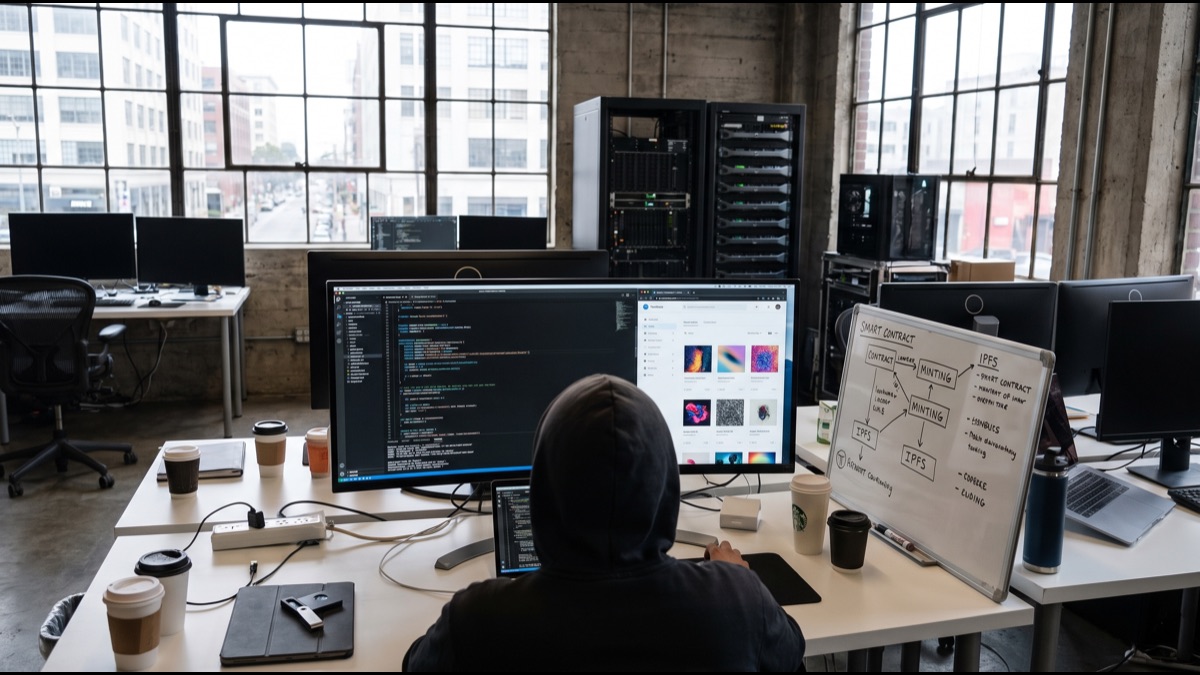
Minting is the process of creating a new NFT by uploading a digital file to a marketplace or platform, which then generates the token on the blockchain, permanently recording the creation event along with metadata describing the piece, its creator, and often the intended edition size.
Artists typically choose between minting a one-of-one unique piece or minting a larger collection of algorithmically generated variations, a format especially common in profile-picture projects where thousands of images share a base template with randomized trait combinations.
Once minted, the token exists permanently on the blockchain regardless of whether the marketplace where it was created continues to operate, though the actual image file's long-term availability depends entirely on where and how it was stored outside the blockchain itself.
Gas Fees and Why They Matter
Every blockchain transaction, including minting and transferring an NFT, requires a gas fee paid to the network's validators to process and confirm the transaction, a cost that is entirely separate from the marketplace's own commission and fluctuates based on how congested the network is at that moment.
During the peak of the 2021 boom, Ethereum gas fees regularly spiked to tens or even hundreds of dollars per transaction during high-demand minting events, a cost structure that priced out many casual buyers and became a frequent source of criticism of the ecosystem.
The broader shift toward layer-two scaling solutions and alternative, lower-fee blockchains in subsequent years significantly reduced typical transaction costs, making NFT minting and trading meaningfully more accessible than during the original Ethereum-dominated boom.
How Marketplaces Like OpenSea Actually Function
NFT marketplaces function primarily as a browsing and transaction layer sitting on top of the underlying blockchain, providing search, discovery, bidding, and wallet-connection tools rather than actually holding or custodying the artwork itself.
Listing an NFT for sale typically involves signing a transaction that grants the marketplace's smart contract permission to transfer the token on the seller's behalf once a buyer's payment clears, a process designed to avoid requiring a trusted third-party escrow.
Marketplaces generate revenue primarily through a percentage-based transaction fee charged on each completed sale, a business model that made them heavily dependent on trading volume and correspondingly hard-hit by the dramatic volume decline following the 2022 crash.
The 2021 Boom and What Drove It
The 2021 NFT boom was driven by a combination of factors: a broader cryptocurrency bull market that put significant capital in the hands of crypto-wealthy buyers, high-profile celebrity and brand endorsements that brought mainstream media attention, and a genuine wave of interest in digital art ownership as a novel concept.
Profile-picture collections in particular became a social status symbol within crypto communities, with ownership functioning partly as an art purchase and partly as a visible membership badge within a specific online community, a dynamic that drove speculative demand well beyond what any underlying artistic merit alone would explain.
Flipping, buying an NFT with the specific intent of reselling it quickly for a profit, became a dominant trading pattern during this period, contributing to trading volumes that in retrospect reflected speculative momentum more than sustained collector demand.
What Actually Caused the 2022 Crash
Rising interest rates through 2022 reduced the broader appetite for speculative, non-yield-generating assets across financial markets generally, and cryptocurrency markets, including NFTs, were hit particularly hard as capital rotated toward safer, income-generating investments.
The collapse of major crypto exchanges and lending platforms during 2022 removed significant liquidity from the broader crypto ecosystem and damaged general market confidence, effects that spilled directly into NFT trading volume since much of that trading depended on the same pool of crypto-denominated capital.
The exhaustion of the flipping-driven demand that had inflated 2021 volumes also played a structural role, since a market substantially built on short-term resale speculation was always vulnerable to a sharp correction once new buyer inflow slowed, regardless of what happened in the broader crypto market simultaneously.
The Royalty Enforcement Problem
Early NFT marketplaces popularized the idea of automatically enforced creator royalties, a percentage of every secondary sale paid back to the original artist, a mechanism widely marketed as a major improvement over traditional art markets where creators typically receive nothing from resales.
Starting around 2022, competitive pressure between marketplaces led several major platforms to make royalty payment optional for buyers rather than mandatory, since enforcing royalties technically required trade-offs that some competitors were willing to skip in order to offer lower-cost transactions and attract trading volume.
This shift significantly undermined one of the concept's most attractive selling points for artists, and while some blockchain-level and marketplace-level tools have attempted to restore stronger royalty enforcement, no fully universal solution has emerged across the fragmented marketplace ecosystem.
Wash Trading and Market Manipulation
Wash trading, where an entity buys and sells the same asset between accounts it effectively controls to create artificial trading volume, became a documented problem across NFT marketplaces, particularly during periods when trading rewards or airdrop incentives were tied directly to trading activity.
Blockchain analytics firms studying marketplace data have identified significant volumes of trading activity across major platforms consistent with wash-trading patterns, complicating any straightforward reading of headline trading volume figures as a genuine measure of market health or demand.
This manipulation problem has pushed more sophisticated collectors and analysts toward looking at unique-wallet holder counts and floor-price stability over raw volume figures when assessing whether a given NFT collection reflects genuine collector interest.
How Provenance and Authenticity Actually Work
The blockchain record itself provides a permanent, publicly verifiable history of every transaction a given token has been part of, which is frequently cited as NFTs' core value proposition for digital art provenance compared to easily duplicated standard digital files.
This on-chain provenance only verifies the token's transaction history, not necessarily that the minter had the legal right to create an NFT of the underlying artwork in the first place, a gap that has enabled a documented pattern of unauthorized minting of artwork stolen from artists who never consented to its tokenization.
Several marketplaces have introduced verification systems and takedown processes specifically to address unauthorized minting, though enforcement remains inconsistent and reactive rather than preventive across the broader, largely permissionless ecosystem.
The Market Today: Smaller and More Specialized
Total NFT trading volume today remains dramatically below 2021 peaks, but a persistent, smaller market has continued operating among collectors genuinely interested in digital art rather than short-term speculation, alongside continued activity in specific established blue-chip collections.
Major auction houses have continued periodically including select NFT works in broader contemporary art sales, treating certain established digital artists similarly to how they'd treat any other contemporary medium rather than as a separate speculative category.
Industry participants generally describe the current market as healthier in composition even at much lower volume, since remaining activity is more heavily weighted toward genuine collecting and established artistic reputation rather than the flip-driven speculation that dominated the 2021 peak.
Generative Art and On-Chain Art Explained
Generative art, created through code-based algorithms that produce unique visual outputs from a defined set of rules and randomized parameters, found a particularly strong fit with NFT technology, since the blockchain provides a natural mechanism for issuing and verifying ownership of each unique algorithmic output.
On-chain art takes this further by storing the actual generative code, and sometimes the rendering logic itself, directly on the blockchain rather than relying on external storage, an approach that trades higher minting cost for stronger long-term preservation guarantees independent of any third-party server staying online.
This technically demanding subset of the market has retained a dedicated collector base throughout the broader market downturn, partly because generative and on-chain art projects tend to attract collectors more interested in the underlying technical and artistic craft than in short-term price speculation.
Environmental Concerns and the Shift to Proof-of-Stake
Early NFT activity drew significant environmental criticism because Ethereum, the dominant blockchain for NFTs at the time, ran on a proof-of-work consensus mechanism that required enormous computational energy expenditure to validate transactions.
Ethereum's transition to a proof-of-stake consensus mechanism in 2022, an upgrade widely referred to as the Merge, reduced the network's energy consumption by more than ninety-nine percent according to Ethereum Foundation estimates, substantially undercutting the environmental argument that had driven meaningful public criticism of NFTs.
This shift came too late to prevent lasting reputational damage from the environmental criticism during the market's peak visibility, and some artists and collectors who left the space over environmental concerns during 2021 have not returned despite the technical changes since.
Legal and Copyright Disputes That Followed
The NFT boom generated a wave of legal disputes, including cases involving unauthorized minting of copyrighted characters and artwork, disputes over whether specific NFT projects constituted unregistered securities offerings, and trademark conflicts between NFT collections and existing brands.
Regulatory bodies in several major jurisdictions have since issued guidance or taken enforcement action treating certain NFT offerings as securities when they were marketed with explicit promises of profit derived primarily from the efforts of the project's organizers, applying long-standing securities law frameworks to a genuinely novel asset type.
These legal developments have pushed more recent NFT projects toward more conservative marketing language and clearer legal terms specifically to avoid triggering securities regulation, a notably more cautious posture than the marketing common during the 2021 boom.
NFT Art and Digital Collecting in the Gulf
Digital art and NFT-focused exhibitions have appeared at cultural events and galleries across the UAE and wider Gulf in recent years, part of a broader regional push to build credibility as a hub for digital and technology-forward art forms alongside more traditional collecting categories.
Regional collectors and crypto-investment communities in the UAE, drawn partly by the country's relatively developed crypto regulatory framework compared to many jurisdictions, were active participants in both the 2021 boom and the subsequent, more measured collecting activity that followed.
As global NFT art activity has settled into its smaller, more specialized post-crash form, regional interest in the Gulf has similarly shifted from broad speculative participation toward more focused engagement with established digital artists and generative art projects specifically.
NFT art marketplaces today bear little resemblance to the frenzy of 2021, but they haven't disappeared either, settling instead into a smaller, more technically sophisticated ecosystem built around genuine digital art collecting rather than pure speculation. Understanding the actual mechanics, what an NFT purchase legally grants, how minting and gas fees work, and why royalty enforcement quietly broke down, makes clear that the current market reflects real lessons learned from both the boom and the crash rather than a technology that simply failed.
Sources
- Ethereum Foundation — Technical documentation on Ethereum's blockchain architecture and the Merge upgrade.
- Christie's — Auction records and market commentary on major NFT and digital art sales.
- U.S. Securities and Exchange Commission — Regulatory guidance and enforcement actions relevant to NFT securities classification.
- Chainalysis — Blockchain analytics research on NFT trading volume, wash trading, and market patterns.
- Reuters — Financial and market reporting on NFT market trends and the 2022 downturn.
FAQ
Does buying an NFT give you the copyright to the artwork?
Not automatically; in most cases the artist retains copyright unless a specific licensing agreement transfers it, meaning an NFT purchase typically grants ownership of the token and usually a personal-use license rather than the underlying intellectual property rights.
Why did the NFT market crash so severely after 2021?
A combination of rising interest rates reducing speculative crypto investment broadly, the collapse of major crypto exchanges and lenders that had fueled trading liquidity, and the exhaustion of a hype cycle built heavily on flipping rather than long-term collecting all contributed to the decline.
What is a gas fee in NFT transactions?
It is the transaction fee paid to the blockchain network's validators or miners to process and confirm a transaction, and it varies based on network congestion rather than being set or collected by the marketplace itself.
Can creators actually enforce NFT resale royalties?
Enforcement has become significantly weaker since major marketplaces made royalty payment optional for buyers around 2022 and 2023, and while some platforms and blockchain-level tools attempt to enforce royalties technically, there is no universal guarantee across the ecosystem.
Is the NFT art market completely dead now?
No; trading volume and speculative hype have fallen sharply from 2021 peaks, but a smaller, more specialized market persists among serious digital art collectors, generative artists, and specific blockchain-native art communities.
About the Author
We reference the Ethereum Foundation, Christie's, the U.S. Securities and Exchange Commission, Chainalysis, and Reuters to explain the background and current understanding of this topic.
Loved This Article?
Share it on WhatsApp → Share it on WhatsApp
Get more guides in your inbox — Subscribe to our newsletter for weekly surprising stories from Egypt, Saudi Arabia, Dubai, and beyond.