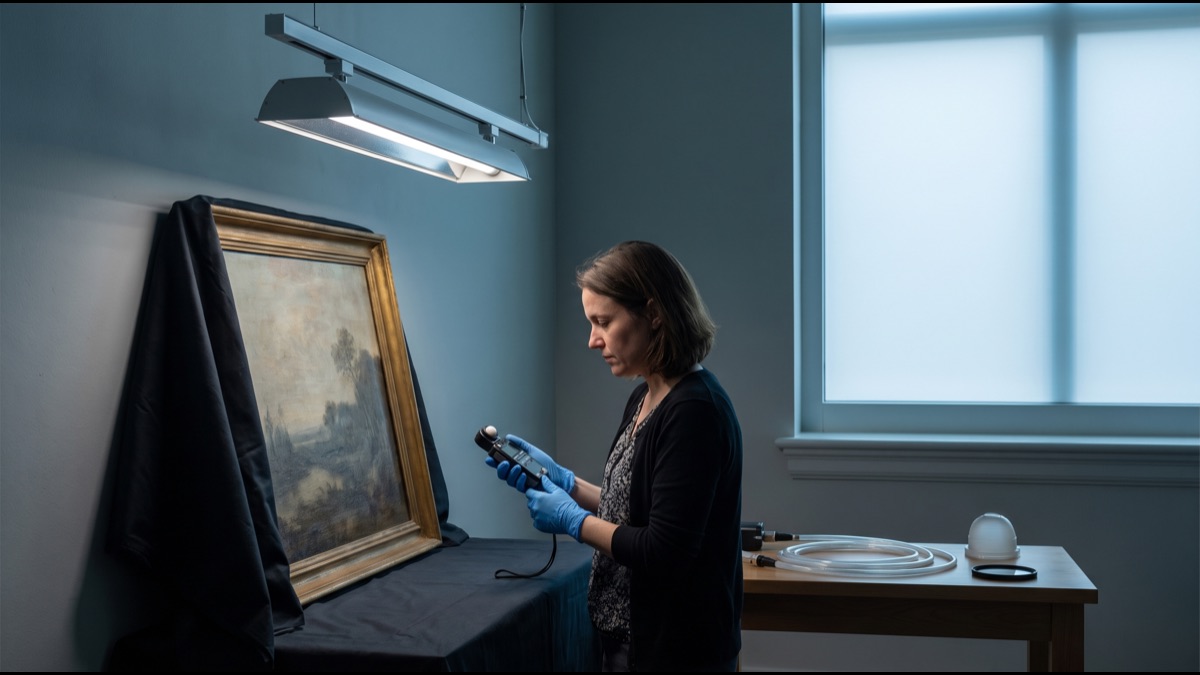
Step from a bright gallery of Renaissance oil paintings into an adjoining room of historic textiles or works on paper, and the change in lighting is immediate and deliberate. Museum lighting is never simply an aesthetic choice — it is a carefully engineered conservation system, calibrated by material science to slow an invisible, cumulative, and ultimately irreversible process of light damage. Understanding how and why museums control light so precisely reveals a surprisingly technical discipline hiding behind the hushed, dim atmosphere of many gallery spaces.
Why Light Is a Slow, Cumulative Threat to Art
Visible light, along with the ultraviolet and infrared radiation that often accompanies it, causes gradual, irreversible chemical damage to many artworks, a process conservators generally describe as photochemical degradation rather than sudden physical harm.
Unlike breakage or theft, light damage accumulates quietly over years and decades, meaning a painting or textile can look completely normal on any given day while still sustaining measurable, permanent harm to its pigments and fibers.
Because this damage cannot be reversed once it occurs, museum lighting design is treated by conservation scientists as a preventive discipline, aimed at slowing an inevitable process rather than stopping it entirely.
The Science of Photochemical Damage
Light energy striking a pigment or dye molecule can break chemical bonds over time, a process that conservation scientists at institutions including the Getty Conservation Institute have studied extensively across different pigment classes and organic materials.
Fading, yellowing, and embrittlement are the most common visible symptoms of cumulative light damage, though the underlying chemical changes generally begin long before any visible alteration becomes apparent to the naked eye.
Different wavelengths of light carry different amounts of damaging energy, with ultraviolet radiation generally considered the most destructive per unit of exposure, followed by visible light itself, and then infrared radiation, which primarily causes damage through heat rather than photochemistry.
Lux Levels and How Conservators Measure Light Exposure
Museum lighting is measured in lux, a unit describing the intensity of light falling on a surface, and conservation guidelines set maximum recommended lux levels for different categories of artwork based on their sensitivity to light damage.
Highly sensitive materials such as works on paper, textiles, and photographs are typically limited to roughly 50 lux in professional conservation guidelines, a level noticeably dimmer than typical home or office lighting, which often exceeds 300 lux.
More light-tolerant materials such as oil paintings and most sculpture are generally permitted higher lux levels, often in the range of 150 to 200 lux, reflecting their comparatively more stable pigments and support materials.
Lux-Hours: Why Cumulative Exposure Matters More Than Peak Brightness
Conservation scientists generally consider cumulative exposure, measured in lux-hours, to be more important than the peak brightness of any single lighting setup, since a moderately lit gallery open for long hours can deliver as much total light damage as a brighter gallery open briefly.
This lux-hour framework explains why museums frequently combine moderate lux levels with limited opening hours, rotating displays, and rest periods in dark storage for their most sensitive objects, rather than relying on dim lighting alone.
Annual lux-hour exposure limits, sometimes set as low as 50,000 to 150,000 lux-hours per year for highly sensitive works, function as an overall damage budget that conservators actively manage across a work's exhibition schedule.
Ultraviolet and Infrared Filtering
Because ultraviolet radiation causes disproportionate photochemical damage relative to the visible light it accompanies, most professional museum lighting systems include UV-filtering glass, laminate films, or filters engineered to block the large majority of UV wavelengths before they reach an artwork.
Modern LED lighting has made UV filtering considerably simpler than in the era of incandescent and halogen bulbs, since most LED sources emit little to no ultraviolet radiation in the first place, reducing the need for separate filtering hardware.
Infrared filtering, while less discussed than UV filtering, remains important for heat-sensitive materials and light sources that generate significant infrared output, since heat buildup near a work can accelerate chemical degradation independent of visible-light exposure.
Different Materials, Different Risk Tiers
Conservation professionals generally sort artworks into risk tiers based on their light sensitivity: highly sensitive organic materials including textiles, watercolors, and photographs; moderately sensitive materials including many oil paintings; and largely light-insensitive materials including most stone, metal, and ceramic sculpture.
This tiered system, broadly consistent across major institutions including the Smithsonian and the National Gallery in London, allows museums to apply different lighting rules gallery by gallery rather than adopting one blanket standard for an entire building.
The practical effect is immediately visible to attentive visitors: a gallery of Old Master oil paintings is typically noticeably brighter than an adjacent gallery of Japanese woodblock prints or historic textiles displayed nearby.
Why Works on Paper and Textiles Get the Dimmest Rooms
Watercolors, drawings, historic photographs, and textiles are generally considered the most light-sensitive category of museum object, since the dyes, inks, and organic fibers involved are chemically prone to rapid fading under even moderate light exposure.
Museums frequently limit public display time for these especially fragile categories, sometimes rotating a specific drawing or textile out of view for months or years at a time to preserve its remaining light-exposure budget for future display.
This is also why many museum print rooms and textile galleries feel noticeably dim compared with painting galleries, and why some institutions use motion-activated lighting that only illuminates a case fully when a visitor approaches.
Oil Paintings and Sculpture: More Forgiving, Not Immune
Oil paintings generally tolerate higher light levels than works on paper because their pigments are typically bound in relatively stable oil media and applied more thickly, though certain organic pigments used historically remain genuinely light-sensitive even in oil form.
Stone, bronze, and most ceramic sculpture are considered largely insensitive to light damage in conservation terms, since their materials do not undergo the same organic photochemical breakdown that affects dyes, inks, and many pigments.
Even relatively light-tolerant materials are not entirely immune to display-related risk, since heat generated by lighting fixtures placed too close to a surface can still cause physical stress, particularly for painted wood panels or gilded surfaces.
The Shift From Incandescent and Halogen to LED
Museum lighting has undergone a significant technological shift over the past two decades, moving away from incandescent and halogen bulbs, which generate substantial heat and some ultraviolet output, toward LED lighting systems that run considerably cooler and can be engineered to emit minimal UV radiation.
This transition has been driven by a combination of conservation benefits and energy efficiency, since LED fixtures generally use significantly less electricity than the halogen systems many major museums relied on through the early 2000s.
Early LED museum lighting drew some criticism from conservators and curators over color rendering quality, though rapid improvements in LED technology over the past decade have substantially narrowed the gap with traditional light sources for accurate color reproduction.
Color Rendering Index and the Tradeoff With Visitor Experience
The Color Rendering Index, a standard measure of how accurately a light source reveals the true colors of an illuminated object compared with natural daylight, is a major consideration in museum lighting design alongside conservation limits on brightness.
Conservators and lighting designers generally aim for light sources with high color rendering scores even at conservation-mandated low lux levels, since visitors need to see accurate color to properly appreciate a painting, even in a dimly lit gallery.
This creates a genuine design tension: achieving vivid, accurate color rendering at very low lux levels is technically more difficult than at brighter settings, requiring more sophisticated and often more expensive lighting technology to satisfy both conservation and visitor-experience goals simultaneously.
Daylight in Museum Galleries: A Historical Debate
Many historic museum buildings were originally designed with skylights and large windows intended to bathe galleries in natural daylight, reflecting an early twentieth-century belief that daylight was both aesthetically superior and healthier for viewing art than artificial lighting.
Modern conservation science has substantially revised this view, since uncontrolled daylight delivers highly variable, often intense light exposure, including significant ultraviolet radiation, that can cause far more cumulative damage than carefully controlled artificial lighting.
Many institutions with historic skylit galleries have since retrofitted UV-filtering glazing, motorized shades, and diffusion systems to moderate daylight exposure, preserving the architectural character of these spaces while bringing their actual light exposure closer to modern conservation standards.
Rotating Light-Sensitive Works and Rest Periods
Rotating especially fragile works out of permanent display and into dark, climate-controlled storage for extended rest periods is one of the most effective conservation strategies available, since time spent unlit does not count against a work's cumulative light-exposure budget.
Some of the world's most famous light-sensitive works, including certain historic tapestries and important works on paper, are displayed only intermittently or for limited annual periods specifically to manage their long-term light-exposure allowance.
This rotation practice is one reason a museum's featured special exhibitions sometimes include works rarely seen by the public, since curators may be using a temporary loan or short-term display window as part of a deliberate long-term conservation rest schedule.
Standards Bodies and Guidelines
The International Commission on Illumination, commonly known by its French acronym CIE, publishes widely referenced technical guidelines on museum lighting that many conservation departments around the world use as a baseline reference for lux limits and lighting quality standards.
The Getty Conservation Institute has published extensive research on light damage mechanisms and museum lighting best practices, informing conservation policy at institutions well beyond its own Los Angeles-based galleries.
Professional bodies including the American Institute for Conservation provide additional guidance and training resources that help museum staff translate general scientific lighting principles into practical gallery-by-gallery lighting plans for specific collections.
Smart Lighting, Sensors, and Adaptive Systems
A growing number of museums have adopted motion-activated and daylight-responsive lighting systems that automatically adjust brightness based on gallery occupancy or ambient daylight levels, reducing unnecessary light exposure when a gallery is empty.
Some institutions now use light-monitoring sensors embedded near especially sensitive works to track real-time and cumulative lux-hour exposure, giving conservators continuously updated data rather than relying solely on periodic manual light readings.
These adaptive systems represent a meaningful shift toward data-driven conservation management, allowing museums to fine-tune lighting exposure more precisely than older, fixed-schedule lighting plans allowed.
Balancing Conservation With Visitor Experience
Museum lighting design ultimately requires balancing two goals that are frequently in tension: protecting fragile collections for future generations and providing a visually satisfying, legible viewing experience for today's visitors.
Visitor surveys conducted by several major museums have found that overly dim galleries can genuinely detract from the viewing experience, prompting conservation and design teams to work closely together on lighting plans that satisfy strict lux limits while still rendering color and detail as vividly as possible.
Curatorial choices such as gallery wall color, spacing between works, and case design can meaningfully affect how bright a gallery feels to visitors even at a fixed, conservation-mandated lux level, giving museums additional tools beyond raw brightness to shape visitor perception.
What Museum Visitors Can Learn From Gallery Lighting Choices
Attentive visitors can often infer a great deal about an object's material sensitivity simply by noticing how a gallery is lit, since dimmer rooms generally signal higher-risk materials like textiles, works on paper, or historic photographs rather than an aesthetic choice alone.
Museums increasingly explain these lighting decisions directly to the public through wall text and gallery guides, treating conservation science as an accessible part of the visitor experience rather than a hidden behind-the-scenes process.
Understanding the reasoning behind museum lighting can also help visitors appreciate why certain beloved works are only occasionally on view, reframing what might initially seem like a frustrating absence as evidence of careful, long-term stewardship.
Lighting Challenges in Historic and Regional Museums
Museums housed in older, architecturally significant buildings, including many in the Middle East and North Africa working to modernize colonial-era gallery spaces, often face additional lighting challenges balancing historic preservation of the building itself with contemporary conservation standards for the art inside it.
Institutions such as the Louvre Abu Dhabi and Egypt's Grand Egyptian Museum have incorporated conservation lighting standards from the outset of their design, reflecting how newer regional museums increasingly build lux limits and UV filtering into architectural planning rather than retrofitting it later.
This growing regional investment in conservation-grade lighting infrastructure reflects a broader global trend of newer museums treating lighting design as a core engineering discipline from day one, rather than an afterthought layered on top of a finished building.
The dim lighting that some visitors experience as merely atmospheric is, in most professionally run museums, the visible result of decades of conservation science measuring exactly how light damages pigments, dyes, and fibers, and how much cumulative exposure a given object can safely tolerate over its lifetime. From lux limits and lux-hour exposure budgets to UV filtering, LED adoption, and rotating displays for the most fragile works, museum lighting design represents a continuous negotiation between preserving irreplaceable objects for future generations and giving today's visitors a genuinely satisfying view of them. As sensor technology and adaptive lighting systems continue to improve, that balance is likely to keep tilting incrementally further toward precision conservation without necessarily requiring visitors to sacrifice a vivid, legible view of the art in front of them.
Sources
- Getty Conservation Institute — Research on light damage mechanisms and museum lighting best practices.
- Smithsonian Institution — Conservation guidance and lighting standards applied across its museum collections.
- International Commission on Illumination (CIE) — Technical guidelines on lighting standards referenced by museum conservation departments worldwide.
- American Institute for Conservation — Professional guidance and training on conservation practices, including light exposure management.
FAQ
Why are some museum galleries so much dimmer than others?
Galleries displaying light-sensitive materials like textiles, works on paper, and photographs are kept dimmer because these materials are far more prone to irreversible fading than oil paintings or stone sculpture.
What is a lux-hour and why does it matter?
A lux-hour measures cumulative light exposure over time, and conservators generally consider it more important than peak brightness, since total exposure across months or years drives the actual damage to a work.
Does natural daylight damage art more than artificial lighting?
Uncontrolled daylight generally delivers more variable and often more intense light, including ultraviolet radiation, making it more damaging than carefully controlled and UV-filtered artificial lighting used in most modern galleries.
Why do museums rotate certain artworks out of display?
Rotating fragile works into dark storage lets them rest, since time spent unlit does not count against their limited cumulative light-exposure budget, extending how long they remain viewable over their lifetime.
Has LED lighting changed how museums protect art?
Yes — LED lighting generally produces less heat and minimal ultraviolet radiation compared with older incandescent and halogen bulbs, simplifying conservation while also improving energy efficiency.
About the Author
We reference the Getty Conservation Institute, the Smithsonian Institution, the International Commission on Illumination, and the American Institute for Conservation to explain the background and current understanding of this topic.
Loved This Article?
Share it on WhatsApp → Share it on WhatsApp
Get more guides in your inbox — Subscribe to our newsletter for weekly surprising stories from Egypt, Saudi Arabia, Dubai, and beyond.