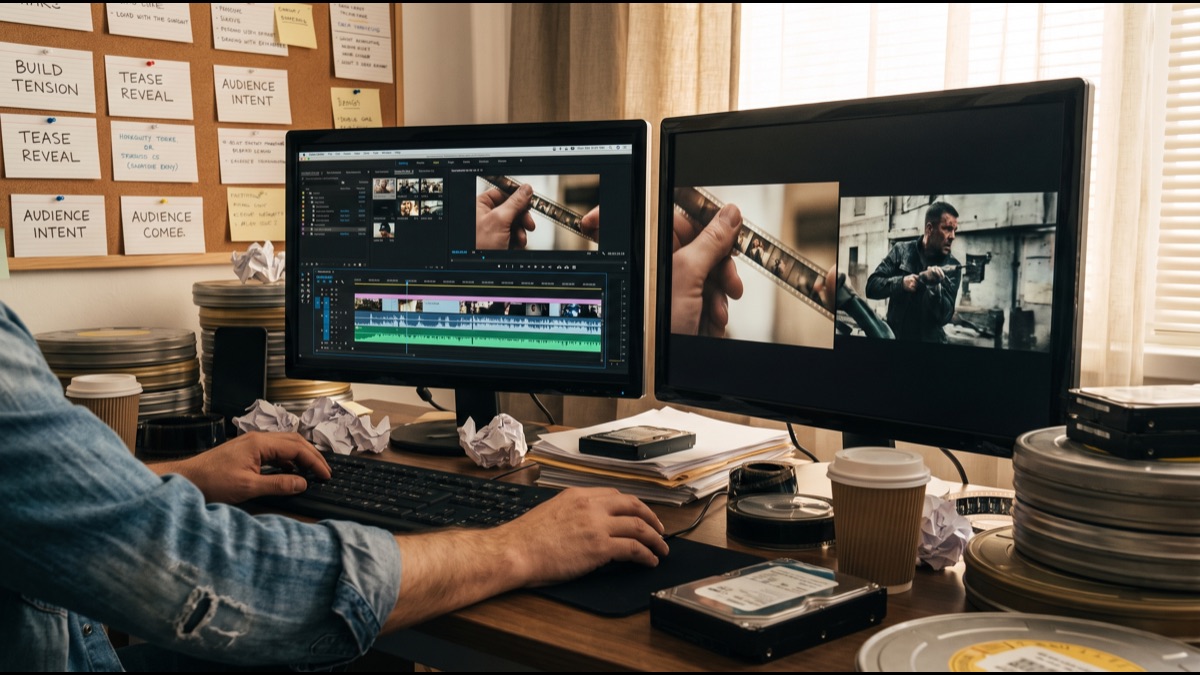
A striking number of shots in a movie trailer never appear in the finished film at all, cut from footage that was reshot, reordered, or abandoned entirely before release. That is not an accident or a leftover mistake. It is the visible edge of a distinct editorial craft that operates on its own timeline, with its own goals, largely separate from the film it is promoting.
Trailer editing is a specialized discipline with dedicated houses, freelance cutters, and studio marketing teams who often never worked on the film itself, hired specifically because cutting two minutes to create desire is a genuinely different skill from cutting two hours to tell a story. Understanding how that craft actually works explains why trailers feel the way they do, and why they can mislead without technically lying.
Why Trailers Are a Distinct Craft From the Film Itself
A trailer's job is not to summarize a movie accurately. Its job is to generate a specific emotional response, curiosity, excitement, or anticipation, in roughly two minutes, using whatever available footage best produces that reaction, regardless of how representative any individual shot is of the finished film's tone or pacing.
This is why trailer houses are frequently separate companies entirely, competing for the marketing contract on a given film the same way a visual effects vendor might, and why a studio sometimes commissions several competing houses to cut different versions of the same trailer before selecting the one that tests best with audiences.
The editor cutting the trailer is often working from raw dailies and early assembly cuts long before the director has locked a final edit, which means the trailer team is essentially making its own independent creative interpretation of the material, one that does not have to match the director's eventual choices at all.
How Trailer Editors Decide What to Show and Hide
Trailer editors typically work from a strategy document, often called a marketing brief, that specifies the target audience, the core promise of the film, and which plot elements are safe to reveal versus which must stay hidden to protect the theatrical experience, a document usually written before a frame of trailer footage is cut.
Comedies tend to front-load recognizable jokes because audiences use trailer laughs as a direct proxy for whether the whole film will be funny, while thrillers and dramas more often withhold their strongest moments entirely, relying on tone and mood rather than plot specifics to generate interest.
Footage that reveals a twist, kills off a beloved character, or spoils a reveal the studio considers central to the experience is generally excluded outright, even when that footage would otherwise make for a genuinely compelling trailer moment, because protecting the theatrical surprise is treated as a higher priority than maximizing any single trailer's impact.
Why Trailers Rarely Follow the Movie's Actual Story Order
Trailers are almost never cut in the film's actual chronological sequence. Instead editors build an artificial narrative arc designed purely for the trailer itself, often opening with a hook unrelated to the film's actual opening scene, then escalating through unrelated moments toward a climactic beat that may occur at a completely different point in the real story.
This reordering lets editors combine the most visually striking shots from across the entire film into a tighter, more propulsive sequence than the film's own pacing would allow, since a trailer has roughly two minutes to build tension that a film might spend two hours developing gradually.
The consequence is that a trailer can accurately represent individual moments while still misrepresenting the film's actual structure, tone, or genre balance, which is a large part of why some audiences leave a screening feeling the trailer promised something meaningfully different from what they actually watched.
How Trailer Music Gets Chosen Before a Score Exists
Most trailers are cut and released before a film's original score is finished, sometimes before it has even been commissioned, which means trailer editors rely heavily on a library of pre-existing music, commonly called trailer music or temp tracks, licensed specifically for marketing use rather than pulled from the film's own soundtrack.
A specialized industry of composers writes music exclusively for trailers, producing pieces engineered around a very specific structural formula, a slow atmospheric build followed by a sudden tempo shift into a percussive, escalating climax, precisely because that arc reliably produces excitement regardless of what film it accompanies.
This explains why trailers for wildly different films sometimes share a nearly identical musical structure, and why a trailer's music can feel disconnected from a film's eventual actual score, since the two were frequently created independently by entirely different composers working from different briefs.
Why the Same Movie Gets Multiple Different Trailer Cuts
Major releases commonly get several distinct trailers across a promotional campaign, a teaser released far in advance, a full theatrical trailer closer to release, and sometimes additional cuts targeted at specific audience segments, each built with a different emotional goal and often a completely different selection of footage.
Studios also frequently test multiple competing edits of the same trailer with focus groups before choosing which version to release publicly, tracking metrics like recall, purchase intent, and emotional response to decide which specific shot order, music choice, or pacing produces the strongest measured reaction.
International markets often receive their own distinct trailer cuts entirely, built around different cultural expectations and different actors' regional star power, meaning the trailer a viewer sees can genuinely differ depending on where in the world they are watching it.
How Test Screenings Shape Trailer Edits
Before a trailer goes public, studios frequently screen rough cuts to recruited test audiences, gathering structured feedback on which specific moments generated the strongest positive reaction and which moments confused or bored viewers, data that directly shapes the final edit released to the public.
This process can significantly change a trailer's structure late in production, removing a shot that tested poorly even if it was a favorite of the film's own director, since trailer marketing decisions are generally made by a studio's marketing division rather than by the filmmaking team.
This occasionally creates friction between directors and marketing departments, with some directors publicly objecting to a trailer's tone or reveals, illustrating that the trailer is fundamentally a separate creative product controlled by different decision-makers than the film it promotes.
Why Some Trailers Reveal Plot Twists Studios Later Regret
Despite the general principle of protecting major reveals, marketing pressure to make a trailer compelling sometimes wins out over narrative caution, particularly for films the studio worries will not generate enough interest from tone or premise alone without showing a genuinely surprising moment.
Several high-profile films have faced public criticism after their trailers revealed plot twists, character deaths, or major reveals that significantly undercut the theatrical experience for audiences who had already seen the marketing, a tension that has become more visible as fans increasingly scrutinize trailers frame by frame online.
This has led some studios to adopt explicit no-spoiler policies for certain franchises, deliberately cutting trailers that show almost nothing of the actual plot, relying instead entirely on tone, returning characters, and brand recognition to generate ticket sales without risking any narrative reveal at all.
How Teaser Trailers Differ From Full Trailers
A teaser trailer, typically released many months before a film, is deliberately built to communicate the barest minimum, often just a title, a release window, and a single striking image or moment, designed to generate anticipation without providing enough material to form real expectations about plot or tone.
Teasers are frequently cut from extremely limited footage, sometimes from just a few days of principal photography, since they are often locked for release before most of the film has even been shot, which is why teasers rely so heavily on mood, music, and a single memorable visual rather than narrative content.
The full theatrical trailer that follows months later has access to substantially more finished footage and is built with a completely different goal, communicating enough of the story and tone to convert general awareness into an actual intention to buy a ticket.
Why Trailer Pacing Is Engineered Around Attention Spans
Trailer editors work within an extremely tight time budget, typically ninety seconds to two and a half minutes, which forces a pacing discipline the finished film never has to apply, compressing entire subplots into a single shot or a few seconds of dialogue.
Cut frequency itself is a deliberate tool, with editors often accelerating the rate of shot changes as the trailer progresses to create a physiological sense of rising tension, a technique borrowed directly from action filmmaking and applied specifically to manipulate a viewer's sense of momentum within a very short runtime.
This compressed pacing is part of why some trailers feel more energetic or tense than the actual film they promote, since a trailer can sustain a rapid cutting rhythm for ninety seconds that would feel exhausting if maintained across an entire two-hour runtime.
How International Trailers Get Re-Cut for Different Markets
Trailers released outside a film's home market are frequently re-edited rather than simply subtitled or dubbed, adjusting shot selection to emphasize actors with stronger regional recognition, removing cultural references that would not translate, and sometimes restructuring the pacing to match different regional preferences in trailer style.
Marketing teams in different regions often have significant autonomy over their own trailer cuts, working from the same raw footage pool as the domestic team but making genuinely independent editorial choices about what best appeals to their specific market's audience expectations and viewing habits.
This is why a fan comparing trailers for the same film across different countries can sometimes find genuinely different footage, different music, or an entirely different emotional emphasis, reflecting real creative decisions rather than simple localization.
Why Trailer Voiceover Narration Declined Over Time
Trailers for decades relied heavily on a booming voiceover narrator explaining plot and stakes directly to the audience, a style now largely associated with older marketing conventions, as modern trailer editing shifted toward letting footage, music, and on-screen text carry the narrative weight instead.
This shift partly reflects changing audience taste, with contemporary viewers generally responding better to trailers that feel like a condensed cinematic experience rather than an overt sales pitch, and partly reflects the industry's move toward trailers designed for silent autoplay on social media feeds, where spoken narration is often muted by default.
Voiceover narration has not disappeared entirely and remains common in certain genres, particularly broad comedies and family films, where a clear explanatory voice still tests well with target audiences who respond to a more direct sales-oriented pitch.
How Trailer Release Timing Is Strategically Planned
Trailer release dates are planned almost as carefully as the film's own release date, frequently timed to coincide with a major competing blockbuster's own opening weekend specifically to attach to that larger audience's attention, a tactic sometimes called trailer-jacking within the marketing industry.
Studios also stagger the release of teasers, full trailers, and additional promotional cuts across many months, following an established rhythm designed to build sustained anticipation rather than a single burst of attention, spacing releases around major cultural moments like award shows or other tentpole releases.
The specific platform a trailer premieres on, a late-night talk show, a dedicated online reveal, or a major sporting event broadcast, is itself a strategic choice weighed against cost and expected audience reach, treated as seriously as the trailer's actual content.
Whether Trailers Can Actually Hurt a Movie's Box Office
A trailer that sets inaccurate expectations can genuinely damage a film's box office performance, since audience word-of-mouth and review sentiment often measure a film against the expectations the trailer created rather than against the film on its own terms, meaning a mismatched trailer can produce disappointment even for a well-made film.
This risk is particularly acute for films that defy genre expectations, a marketing team that cuts a trailer to look like a straightforward genre film when the movie itself is something stranger or more ambiguous can generate an opening weekend audience that walks away actively unhappy, hurting the crucial word-of-mouth that drives a film's second and third weekends.
Conversely, a trailer that accurately signals a film's actual tone, even an unconventional one, tends to filter for an audience more likely to respond positively, which is why marketing teams increasingly research audience expectation management as carefully as raw excitement generation.
What Makes a Trailer Genuinely Effective
Industry research and box office analysis generally agree that the most effective trailers create a clear, specific promise about the emotional experience a film will deliver, rather than simply compressing as much plot and spectacle as possible into the available runtime.
Trailers that test best typically balance genuine information about tone and premise against calculated withholding of specific plot mechanics, giving an audience enough to form accurate expectations without giving away the experience the film itself is built to deliver.
Understood this way, a trailer is not a shrunken version of the film but a separate piece of persuasive filmmaking with its own craft, its own editors, its own testing process, and its own success metrics, one whose real purpose is managing expectation rather than delivering an honest preview.
Sources
- Wikipedia — history and structure of film trailers as a marketing form
- Academy of Motion Picture Arts and Sciences — industry context on film marketing and promotion
- British Film Institute — research and archival material on trailer history and film marketing
- Motion Picture Association — industry data on film marketing and theatrical release practices
- Variety — trade reporting on trailer strategy, marketing campaigns, and box office analysis
FAQ
Why do trailers sometimes show scenes that are not in the final movie?
Trailers are often cut from early footage, reshoots, or abandoned scenes before the film is finished, and because trailer teams work independently from the final edit, some shots never make it into the theatrical release.
Why don't trailers follow the movie's actual story order?
Editors build an artificial narrative arc designed purely to create tension within roughly two minutes, combining the most striking shots from across the whole film rather than following its real chronological sequence.
Why does trailer music sound similar across different movies?
Trailers are often cut before a film's own score exists, so editors use licensed trailer music built around a reliable formula, a slow build followed by a percussive climax, regardless of which film it is attached to.
Can a trailer actually hurt how well a movie does?
Yes — a trailer that sets inaccurate expectations can produce disappointment even for a well-made film, since audience word-of-mouth often measures the film against the expectations the trailer created.
Do different countries see different trailers for the same movie?
Often, yes — regional marketing teams frequently re-cut trailers with different footage, music, and pacing to match local audience preferences, working independently from the domestic marketing team.
About the Author
We reference Wikipedia, the Academy of Motion Picture Arts and Sciences, the British Film Institute, the Motion Picture Association, and Variety to explain the background and current understanding of this topic.
Loved This Article?
Share it on WhatsApp → Share it on WhatsApp
Get more guides in your inbox — Subscribe to our newsletter for weekly surprising stories from Egypt, Saudi Arabia, Dubai, and beyond.