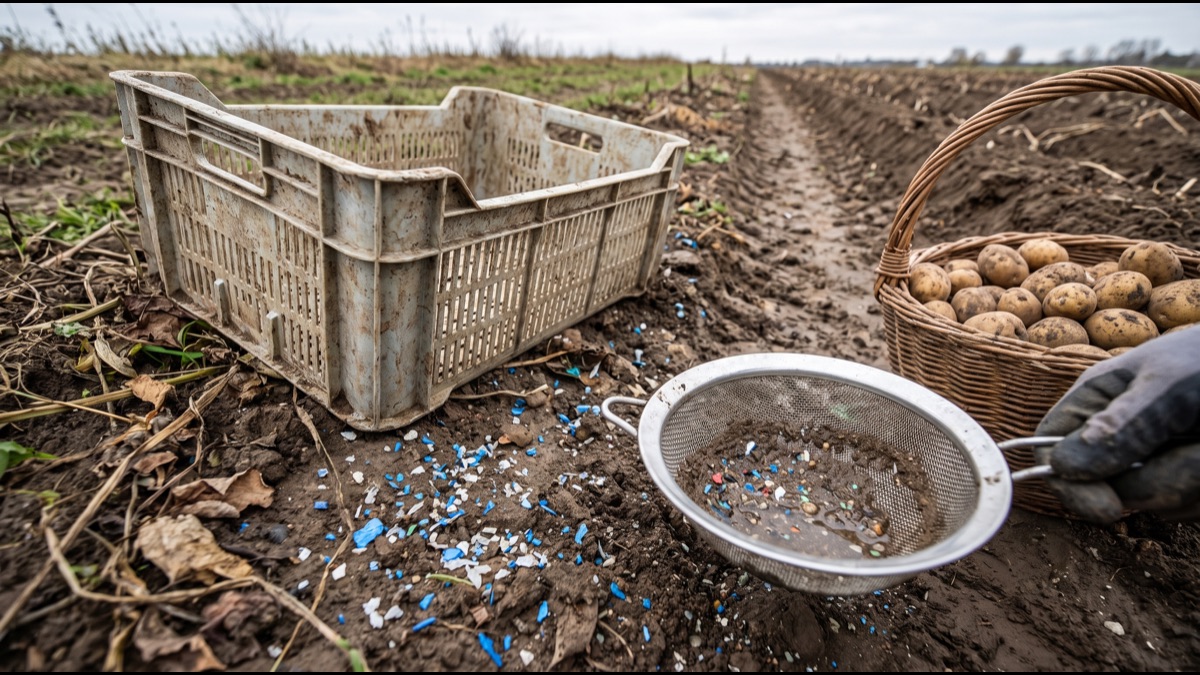
Microplastics have been found in bottled water, table salt, tea bags, seafood, and even fruits and vegetables, to the point that headlines regularly claim people eat a credit card's worth of plastic every week. The reality is more complicated and, in some ways, less settled than either the most alarming headlines or the most dismissive rebuttals suggest. Researchers agree that microplastics are genuinely present in much of the food supply; what remains actively debated is how much of it there really is, how it gets there, and what it actually does inside the human body.
What Microplastics Actually Are
Microplastics are generally defined as plastic fragments smaller than five millimeters, a category that includes everything from visible pellets down to particles only detectable under a microscope. They are typically split into primary microplastics, manufactured at that small size for products like cosmetics, and secondary microplastics, created when larger plastic items break down over time.
Because the category spans such a wide size range, and because plastic itself is a broad family of chemically different materials including polyethylene, polypropylene, and polystyrene, researchers caution that lumping all microplastics together can obscure meaningful differences in how various particle types behave in the environment and in the body.
This definitional breadth is one reason comparing studies on microplastics can be difficult; a study measuring particles down to one micron will report very different totals than one that only counts particles visible to the naked eye, even when sampling the same food.
How Plastic Breaks Down Into Microscopic Fragments
Plastic does not biodegrade the way organic material does; instead, exposure to sunlight, heat, and mechanical stress causes it to become brittle and fragment into progressively smaller pieces, a process that can continue for decades or longer without the material ever fully disappearing.
Ultraviolet radiation breaks down the polymer chains that give plastic its strength, while wave action, abrasion, and temperature swings physically grind larger fragments into smaller ones, a process researchers at institutions including Plymouth Marine Laboratory have studied extensively in marine environments.
This fragmentation happens on land as well as in water, meaning agricultural plastic mulch, synthetic textile fibers, and tire wear particles from roads all contribute to a growing background presence of microplastics across soil, air, and waterways that eventually intersects with food production.
The Main Pathways Microplastics Take Into Food
Microplastics reach food through several distinct routes rather than a single source, which is part of why addressing the issue is more complicated than eliminating one product or practice.
Environmental contamination is one major pathway: microplastics present in soil, irrigation water, and the atmosphere can be taken up by crops or settle onto food during growth and harvest. A second pathway is direct contact during processing, packaging, and food preparation, where plastic equipment, containers, and films can shed particles into the product itself.
A third pathway involves the food chain in aquatic environments, where smaller organisms ingest microplastics that then accumulate, though generally not to extreme degrees, as they move up through larger species that eventually reach human consumers.
Why Seafood Is a Major Entry Point
Seafood, particularly bivalves like mussels and oysters that filter large volumes of water and are often eaten whole, including their digestive tissue, has been among the most studied and most consistently documented sources of dietary microplastic exposure.
Researchers studying coastal waters near urban areas and major rivers have generally found higher microplastic concentrations in shellfish from those regions compared with more remote fishing grounds, tracking a plausible link between human plastic waste and what ends up in commercially harvested seafood.
It is worth noting that for most fish, humans generally do not eat the gut, where the bulk of ingested microplastic tends to concentrate, which somewhat limits, though does not eliminate, direct dietary exposure through fish compared with whole-body shellfish consumption.
How Packaging and Food Processing Add Plastic Particles
Food packaging, plastic cutting boards, conveyor belts, and processing equipment can all shed microscopic plastic particles through routine wear, friction, and contact with hot or acidic foods, a pathway some researchers argue may contribute more total microplastic exposure than environmental contamination for many packaged foods.
Studies examining plastic cutting boards have found that the act of chopping food on them can transfer measurable amounts of plastic shavings onto the food itself, with harder, more aggressive chopping motions generally producing more particle shedding than gentler use.
Reheating food in plastic containers, especially in a microwave, and using plastic kettles or coffee makers repeatedly, has similarly been shown in various studies to release more microplastic particles than using glass, ceramic, or stainless steel equivalents, particularly with hot liquids and fatty foods.
Salt, Sugar, and Other Surprising Sources
Table salt, particularly sea salt harvested through evaporation from coastal seawater, has repeatedly turned up in studies as containing measurable microplastic contamination, since the seawater it's derived from already carries whatever plastic particles are present in that marine environment.
Researchers have also found microplastics in commercial sugar, honey, and various packaged spices, generally attributing this to a combination of environmental background contamination during production and contact with plastic equipment and packaging during processing and transport.
The concentrations reported in these studies vary considerably by brand, region, and testing methodology, making it difficult to draw firm conclusions about which specific products or origins carry meaningfully more contamination than others without consulting current, methodologically comparable research.
Bottled Water Versus Tap Water
Multiple independent studies have found that bottled water generally contains more detectable microplastic particles than tap water, an effect researchers largely attribute to the bottle itself, its cap, and the bottling process rather than the source water.
A widely cited 2024 study using newer, more sensitive detection technology reported substantially higher nanoplastic and microplastic particle counts in bottled water than earlier studies using less sensitive methods had found, illustrating how quickly measured concentrations can shift as detection technology improves.
Tap water is not free of microplastics either, since municipal water systems draw from environmental sources and pass through infrastructure that itself can shed particles, but the bulk of comparative research to date points toward bottled water generally carrying a higher particle load on average.
Tea Bags and Kitchen Items as Overlooked Sources
Some modern tea bags, particularly the increasingly popular pyramid-shaped mesh bags, are made partly or entirely from plastic polymers like nylon or polyethylene terephthalate rather than traditional paper, and steeping these in near-boiling water has been shown in laboratory studies to release substantial numbers of microscopic and nanoscopic plastic particles directly into the beverage.
Researchers, including a frequently cited study from McGill University, found that a single plastic tea bag steeped normally could release billions of sub-micron particles into a cup of tea, a finding that drew significant attention precisely because it involved a widely consumed, seemingly low-risk household product.
Non-stick cookware coatings, plastic food storage containers, and synthetic sponges used in food preparation are other commonly overlooked kitchen sources that researchers have identified as contributing modestly to overall dietary microplastic exposure over time.
How Scientists Actually Measure Microplastics in Food
Detecting and counting microplastic particles in a food sample is technically demanding, generally requiring a combination of chemical digestion to remove organic material, filtration to isolate remaining particles, and spectroscopic techniques like Fourier-transform infrared spectroscopy to confirm that a given particle is actually plastic and identify its polymer type.
Contamination control is a major practical challenge in this kind of research, since plastic is so ubiquitous in laboratory equipment, clothing, and air that researchers must take extensive precautions, including running blank control samples, to avoid falsely attributing airborne or equipment-derived particles to the food sample itself.
Because methodologies differ significantly between research groups and have improved substantially over time, directly comparing particle counts across studies published even a few years apart can be misleading, which is one reason scientific bodies reviewing this research generally emphasize methodological consistency over any single dramatic headline figure.
What Happens to Microplastics Once Ingested
Research using animal models and limited human studies suggests that the great majority of ingested microplastic particles pass through the digestive system and are excreted, similar to other indigestible material, rather than being permanently retained in the body.
A smaller fraction of the very smallest particles, particularly in the nanoplastic size range, appears able to cross the intestinal lining and enter the bloodstream, from which studies have detected plastic particles in various tissues, including, in some recent human studies, blood, placental tissue, and other organs.
Researchers are still working to establish how much of this translocated material accumulates over time, how the body processes or clears it, and whether typical dietary exposure levels are sufficient to produce measurable biological effects, questions that remain genuinely open rather than settled.
What Research Has Found About Health Effects So Far
Laboratory studies using cell cultures and animal models have found that microplastics can, under certain exposure conditions, trigger inflammatory responses, oxidative stress, and in some cases disrupt normal cell function, particularly at concentrations considerably higher than typical human dietary exposure.
Human epidemiological research directly linking typical dietary microplastic exposure to specific disease outcomes remains limited and largely preliminary; some observational studies have reported associations between detected microplastics in tissue samples and certain cardiovascular or inflammatory markers, but these studies generally cannot establish that the microplastics themselves caused the observed effect.
Major health bodies, including the World Health Organization, have reviewed the existing evidence and generally concluded that while the presence of microplastics in food and water is well documented and warrants continued research and monitoring, current evidence is not yet sufficient to establish clear, quantified health risks at typical exposure levels.
Nanoplastics: An Even Smaller, Less Understood Category
Nanoplastics, generally defined as particles smaller than one micrometer, are small enough to potentially cross biological barriers, including the intestinal wall and, in some animal studies, the blood-brain barrier, in ways that larger microplastic particles typically cannot.
Because nanoplastics are far more technically difficult to detect and measure reliably than larger microplastics, research in this area is newer and comparatively sparse, though recent improvements in detection technology have begun revealing nanoplastic concentrations in common foods and beverages that earlier studies simply could not detect.
Researchers generally view nanoplastics as a higher research priority than larger microplastics precisely because of this greater potential for biological penetration, even though the practical health implications remain considerably less understood than for the broader microplastic category overall.
Why Exposure Estimates Vary So Widely
Published estimates of how much microplastic the average person consumes annually vary enormously, from figures in the tens of thousands of particles to considerably higher numbers, largely because studies differ in which foods they sample, what size range of particles they count, and which detection method they use.
The widely circulated claim that people ingest a credit card's worth of plastic weekly originated from a 2019 review commissioned by WWF and conducted by researchers at the University of Newcastle, a figure that several independent scientists have since publicly disputed as an overestimate based on extrapolation from limited data.
This doesn't mean dietary microplastic exposure is negligible, but it illustrates why researchers generally urge caution around any single widely quoted exposure figure, since the underlying science is evolving quickly and earlier estimates are regularly revised as measurement techniques improve.
What Regulators Are, and Are Not, Doing
Food safety regulators including the European Food Safety Authority and the U.S. Food and Drug Administration have acknowledged microplastic contamination as an area of active concern and ongoing research, but as of the current understanding, none have established binding maximum limits for microplastic content in food or drinking water.
The European Union has moved further than most jurisdictions by restricting intentionally added microplastics in some consumer products, such as certain cosmetics, but this differs meaningfully from regulating the unintentional microplastic contamination that occurs through environmental and processing pathways in food.
Regulatory caution in this area generally reflects the state of the underlying science: setting a health-based exposure limit requires a clearer dose-response relationship than currently exists, and most agencies have stated they are prioritizing improved measurement standards and continued monitoring before moving toward binding regulatory limits.
Practical Ways to Reduce Exposure
People concerned about dietary microplastic exposure can take some reasonably well-supported steps, including avoiding heating food in plastic containers, using glass, ceramic, or stainless steel for hot liquids, and switching from plastic mesh tea bags to loose-leaf tea or paper tea bags.
Reducing consumption of bottled water in favor of properly filtered tap water, where available and safe, and choosing wooden or stainless steel cutting boards over plastic ones, are additional changes supported by the specific studies that identified those items as meaningful contributors to exposure.
Researchers generally caution that no realistic set of consumer choices can eliminate microplastic exposure entirely, given how widespread environmental contamination already is, so these steps are more accurately framed as reducing avoidable exposure rather than achieving a plastic-free diet.
Common Misconceptions About Microplastics in Food
A common misconception is that the credit-card-a-week figure is a precise, well-established scientific measurement; in reality it traces back to a single industry-commissioned review that has been publicly challenged by other researchers as methodologically overstated.
Another misconception treats all plastic particles as equally risky regardless of size, polymer type, or dose, when in reality researchers generally consider these factors to matter considerably, with the smallest nanoplastic particles of greatest current research concern precisely because of their ability to cross biological barriers that larger particles cannot.
A third misconception assumes that because microplastics are frequently detected, their health effects at typical exposure levels must already be scientifically proven; major health bodies have been explicit that detection and demonstrated harm are two separate questions, and the second remains an active, unresolved area of research.
Microplastics reach everyday food through several overlapping pathways, environmental contamination, food packaging and processing, and, in some notable cases, common kitchen items like plastic tea bags and cutting boards, making the issue considerably more complex than any single source or fix. The science of measuring exposure is still maturing quickly, which is why widely cited figures like the credit-card-a-week estimate deserve more skepticism than they typically receive in headlines. What researchers agree on is that microplastics are genuinely present in much of the food supply and deserve continued study; what remains unsettled is exactly how much ends up in a typical diet and what, if anything, that means for long-term health.
Sources
- World Health Organization — Review of microplastics in drinking water and current health evidence.
- European Food Safety Authority — Scientific opinions on microplastics and nanoplastics in food.
- National Oceanic and Atmospheric Administration (NOAA) — Research on marine microplastic pollution and its sources.
- U.S. Environmental Protection Agency — Research on microplastics in water systems and the environment.
FAQ
Is it true people eat a credit card's worth of plastic every week?
That widely repeated figure traces back to a single 2019 industry-commissioned review, and several independent scientists have since publicly disputed it as an overestimate based on limited underlying data.
What foods contain the most microplastics?
Shellfish eaten whole, sea salt, bottled water, and beverages steeped in plastic mesh tea bags are among the most consistently documented sources in current research, though exposure varies by product and region.
Are microplastics in food actually harmful to health?
Laboratory studies show potential effects at high concentrations, but major health bodies like the World Health Organization say current evidence is not yet sufficient to establish clear health risks at typical human dietary exposure levels.
What is the difference between microplastics and nanoplastics?
Microplastics are generally defined as plastic particles under five millimeters, while nanoplastics are under one micrometer, small enough to potentially cross biological barriers that larger microplastic particles typically cannot.
Can you actually reduce your microplastic exposure from food?
Yes, to some degree; avoiding heating food in plastic, switching from plastic mesh tea bags to loose-leaf tea, and reducing bottled water use are steps supported by specific studies, though total elimination isn't realistic given widespread environmental contamination.
About the Author
We reference the World Health Organization, the European Food Safety Authority, the National Oceanic and Atmospheric Administration, and the U.S. Environmental Protection Agency to explain the background and current understanding of this topic.
Loved This Article?
Share it on WhatsApp → Share it on WhatsApp
Get more guides in your inbox — Subscribe to our newsletter for weekly surprising stories from Egypt, Saudi Arabia, Dubai, and beyond.