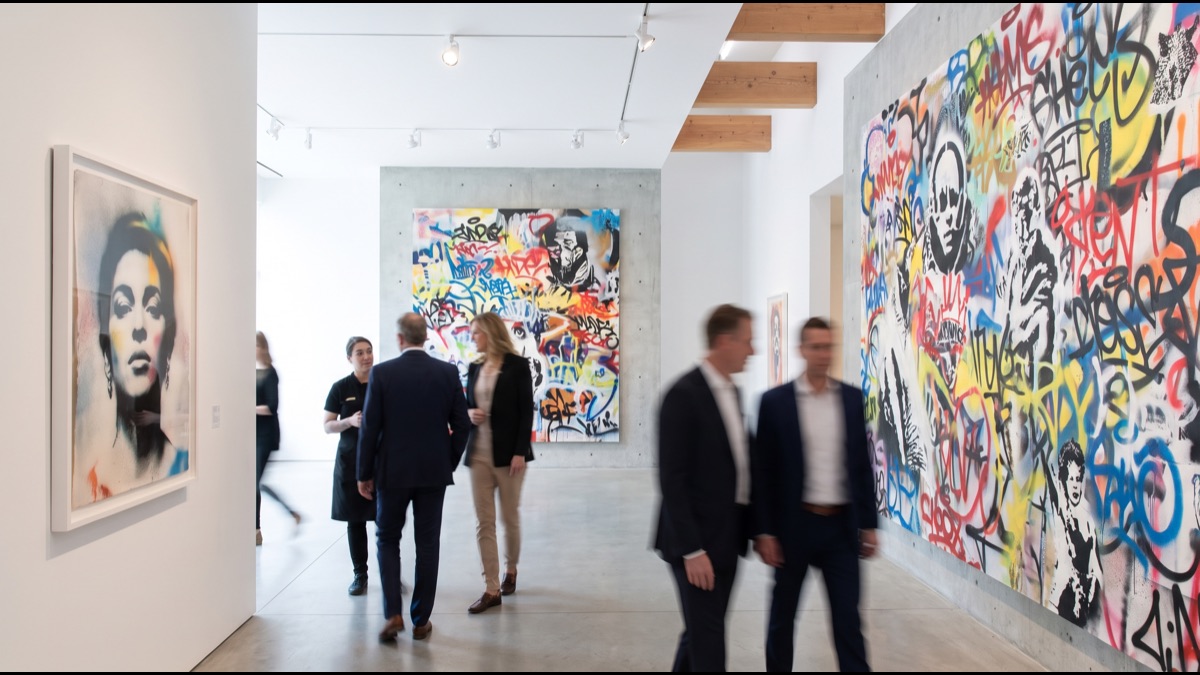
For most of the twentieth century, spray paint on a wall meant one thing to city authorities: vandalism to be scrubbed off as fast as budget allowed. Today, a single spray-painted canvas by an artist who came up writing on subway cars can sell at a major auction house for tens of millions of dollars, and museums that once refused to acknowledge graffiti as art now build entire wings around it. Understanding how that reversal actually happened requires separating several overlapping stories: a genuine art movement, a market that learned how to price it, and a legal tension with anti-vandalism law that has never fully gone away.
The Origins of Modern Graffiti Writing
Modern graffiti writing as a distinct youth culture is generally traced to Philadelphia and New York City in the late 1960s and early 1970s, where young writers began tagging their names, often paired with their street number, across public surfaces as a way of claiming visibility across a city that otherwise ignored them.
The practice quickly evolved into a competitive subculture with its own internal hierarchy, where writers judged each other on the size, placement, style, and risk involved in getting a tag seen in as many places as possible, particularly on subway cars that would carry a writer's name across the entire city.
This early period established graffiti's foundational identity as an unauthorized, anonymous, reputation-driven practice rooted specifically in public transit systems and working-class neighborhoods, a origin story that would remain central to debates about its legitimacy for decades afterward.
Tagging, Throw-Ups, and Wildstyle Explained
A tag is the most basic unit of graffiti, a stylized signature usually executed quickly with a single color, functioning primarily as a claim of presence rather than a fully developed artistic composition.
A throw-up sits a level above a tag in complexity, typically using bubble letters filled with one or two colors and executed fast enough to avoid detection, while still being more visually developed than a simple signature.
Wildstyle represents the most technically demanding form, a deliberately complex, interlocking lettering style that can be nearly illegible to outsiders but is read as a serious display of skill within the writing community, and it's this level of technical complexity that first drew serious attention from artists and critics outside the subculture.
New York's Subway Era and Its Crackdown
Through the 1970s and into the mid-1980s, New York City's subway system became the era's defining canvas, with writers competing to cover entire train cars in what became known as "whole cars," pieces designed to be seen traveling through the city rather than displayed in one fixed location.
The city responded with escalating enforcement, including the Metropolitan Transportation Authority's Clean Car Program launched in 1984, which committed to immediately removing any tagged car from service rather than allowing painted trains to run, a policy specifically designed to eliminate the incentive of citywide visibility.
By the early 1990s, the subway-painting era had effectively ended through a combination of aggressive cleaning policy, improved rail-yard security, and stiffer legal penalties, pushing the culture that had defined it toward walls, canvases, and eventually galleries as its primary surfaces.
The First Galleries to Take Graffiti Seriously
In the late 1970s, a small number of New York gallerists, most notably figures associated with spaces in the East Village and SoHo, began actively showing subway and street writers, treating tags and pieces as a legitimate extension of an existing visual language rather than a novelty borrowed from the street.
Group exhibitions in the early 1980s brought together graffiti writers alongside painters working in more conventional fine-art traditions, a deliberate curatorial choice that framed the work as part of a broader contemporary art conversation rather than as an isolated subcultural curiosity.
These early shows drew real critical attention and sales, establishing a commercial precedent that graffiti-derived work could function as fine art within a gallery context, even as much of the broader art establishment remained skeptical or openly dismissive for years afterward.
Jean-Michel Basquiat's Path From SAMO to Museums
Jean-Michel Basquiat began as half of SAMO, a pseudonymous graffiti tag pairing cryptic, poetic text fragments across Lower Manhattan in the late 1970s, work that drew attention precisely because it read as more literary and conceptually ambitious than typical tagging.
Basquiat's transition from street writing to gallery painting through the early 1980s is widely treated as the single most consequential individual career in graffiti's move toward fine-art legitimacy, since his work retained visible stylistic DNA from his tagging years while being embraced by major galleries and collectors during his lifetime.
Basquiat's posthumous market has become one of the most valuable in contemporary art, with major auction results for his paintings now routinely reaching tens of millions of dollars, a commercial trajectory that retroactively legitimized graffiti-adjacent work in the eyes of much of the traditional art market.
Keith Haring and the Public Art Bridge
Keith Haring built his early reputation drawing chalk figures directly on blank advertising panels in New York subway stations throughout the early 1980s, a practice that was technically unauthorized but visually distinct from traditional lettering-based graffiti.
Haring deliberately maintained a public, accessible practice even after achieving significant gallery and commercial success, painting large-scale public murals worldwide and explicitly rejecting the idea that success required abandoning street-facing work entirely.
His career is frequently cited as proof that street-originated work and institutional recognition weren't mutually exclusive, a model that influenced how later street artists approached balancing gallery careers with continued public, unauthorized work.
The Rise of Street Art as a Distinct Movement
Beginning in the 1980s and accelerating through the 1990s and 2000s, a broader "street art" movement developed alongside traditional letter-based graffiti, incorporating stencils, wheatpaste posters, stickers, and large-scale figurative or conceptual imagery that didn't depend on stylized text.
This shift broadened the audience for unauthorized public art considerably, since stencil and image-based work was often more immediately legible to non-writers than wildstyle lettering, helping street art cross over into mainstream visibility faster than traditional tagging culture had.
The distinction between graffiti and street art remains genuinely contested within the community itself, with some writers viewing street art as a separate, more commercially palatable movement that diluted graffiti's original competitive, text-based identity.
Banksy and the Anonymous Market Phenomenon
Banksy emerged from the UK stencil-based street art scene in the 1990s and built a global reputation while maintaining strict anonymity, a choice that has itself become central to both the artistic mystique and the commercial value of the work.
Pest Control, the authentication body Banksy established to verify genuine work, has become a critical gatekeeper for the secondary market, since authenticated pieces carry dramatically higher value than unverified attributions, formalizing exactly the kind of provenance system traditional fine art has long relied on.
Banksy's secondary-market results, including pieces that have sold for tens of millions of dollars at major auction houses, represent the clearest evidence that street-originated, unauthorized public work can achieve blue-chip market status entirely independent of traditional academic art training or gallery-system credentials.
How Auction Houses Learned to Price Street Art
Major auction houses began adding dedicated street art and urban contemporary sales categories in the 2000s and 2010s, developing pricing frameworks based on factors including documented provenance, rarity, condition, and an artist's broader market trajectory, closely mirroring how they evaluate any other contemporary art category.
Works removed directly from walls, as opposed to canvases created specifically for sale, present unique valuation and authentication challenges, since removal itself can be legally and ethically contested even when the resulting sale price is high.
The growth of a formal secondary market has also created feedback effects on the primary market, since gallery representation and museum interest in a given street artist now often follows, rather than precedes, strong initial auction performance.
Legal Walls and Commissioned Murals Today
Many cities now designate specific legal walls where graffiti and street art can be created with explicit permission, a policy response intended to channel creative energy into sanctioned spaces while reducing unauthorized painting on private and public property elsewhere.
Commissioned murals have become a significant income source for established street artists, commonly funded by property developers, municipal beautification programs, or brands seeking association with street culture's cultural credibility, a shift that has itself generated debate about commercialization diluting the movement's original oppositional character.
Some writers view legal walls and paid commissions as a welcome professional pathway, while others argue that sanctioned work fundamentally changes the meaning of the practice, since risk and lack of permission were historically central to what made graffiti and early street art culturally significant in the first place.
The Ongoing Tension With Anti-Graffiti Law
Despite the movement's institutional legitimization, unauthorized painting on private or public property without consent remains illegal in the overwhelming majority of jurisdictions worldwide, a legal reality entirely separate from any artistic or market recognition a given artist may have achieved.
This creates a genuinely unusual situation where an artist's unauthorized street work can be actively prosecuted as vandalism in one context while a canvas by the same artist sells at a prestigious auction house for a substantial sum in another, a contradiction critics and supporters both regularly point to.
Cities continue to weigh the reputational and tourism value that murals and sanctioned street art can bring against ongoing enforcement costs tied to unauthorized tagging, producing genuinely inconsistent policy that varies significantly not just between countries but between neighborhoods of the same city.
Authentication, Forgery, and the Removal Debate
As street art prices climbed, so did incentives for forgery and misattribution, prompting some prominent artists to establish formal authentication processes similar to those long used for traditional fine art, specifically to protect both buyers and their own market value.
The physical removal of unauthorized wall pieces for resale has generated significant controversy, since property owners, art dealers, and sometimes the artists themselves have disagreed publicly over who has the right to profit from work that was created without a commission or formal agreement.
Some jurisdictions' moral-rights frameworks give artists limited ongoing legal standing over how their work is presented or altered even after a physical piece changes ownership, adding another layer of legal complexity specific to unauthorized public art that doesn't typically apply to commissioned studio work.
Museums Building Permanent Street Art Collections
Major museums worldwide have moved from occasional street-art exhibitions toward building permanent collections and dedicated curatorial expertise in the field, treating graffiti and street art history as a legitimate area of art historical scholarship rather than a temporary trend.
Institutional acquisition has itself become a marker of legitimacy that feeds back into market value, since museum ownership and exhibition history function as a form of validation that meaningfully affects how collectors and auction houses price an artist's broader body of work.
This institutional embrace has occurred alongside, not instead of, continued academic debate over how graffiti and street art history should be framed relative to more traditional twentieth-century art movements, a scholarly conversation that remains genuinely unresolved.
Criticism From Within the Graffiti Community
Not everyone within graffiti culture views its institutional and commercial embrace positively, with some longtime writers arguing that gallery and auction-house success has fundamentally changed a practice that was originally defined by anonymity, risk, and rejection of mainstream validation.
Critics within the scene also point out that gallery and market success has disproportionately rewarded a small number of individual artists, often ones whose work was most easily adapted to canvas and gallery presentation, while the broader competitive tagging culture that originated the movement receives comparatively little institutional recognition or financial benefit.
This internal tension reflects a broader pattern seen across many subcultures that achieve mainstream commercial success, where the version of the culture that becomes marketable and museum-friendly often differs meaningfully from the version practiced by the wider community that originated it.
Street Art and Murals in the Gulf Today
Dubai and other Gulf cities have actively commissioned large-scale murals and street art installations in recent years, particularly in dedicated arts districts, treating public art as part of a broader strategy to build cultural tourism infrastructure and creative-industry credibility.
Regional street art programming has generally followed the commissioned, sanctioned model rather than the unauthorized origins of the original New York movement, reflecting both stricter property and public-space regulation regionally and a deliberate curatorial approach that prioritizes formally invited artists and festivals.
As Gulf cultural institutions continue expanding contemporary art programming, street art and mural-based public art have become an increasingly visible part of how cities like Dubai position themselves within the wider global contemporary art conversation, even as the underlying legal relationship to unauthorized public painting remains as strict as it is in most jurisdictions worldwide.
Graffiti's path from subway tags to seven-figure auction lots was never a single clean transition but a decades-long negotiation between an unauthorized street practice, a handful of galleries willing to take it seriously early, and a market that eventually learned how to price scarcity, provenance, and cultural significance in work that began entirely outside its traditional systems. That history, and the legal tension that persists alongside it, is exactly why the same spray-painted line can mean vandalism in one context and museum-worthy fine art in another.
Sources
- Museum of Modern Art (MoMA) — Curatorial research and exhibition history on graffiti and street art movements.
- Tate — Art historical analysis and artist biographies covering street art's institutional history.
- Christie's — Auction house market data and provenance standards for urban contemporary art.
- Metropolitan Transportation Authority (MTA) — Historical records on New York subway graffiti and the Clean Car Program.
- Smithsonian Magazine — Cultural and historical reporting on graffiti and street art's evolution.
FAQ
Is graffiti still technically illegal in most places?
Yes; painting on property without the owner's permission remains illegal in most jurisdictions regardless of artistic merit, which is legally separate from commissioned murals or work created with landlord or city consent.
How did graffiti first move from the street into galleries?
In the late 1970s and early 1980s, a small number of New York gallerists and collectors began showing subway and street writers on canvas, treating their work as a continuation of a genuine visual language rather than a novelty.
Why do Banksy pieces sell for so much at auction?
Scarcity, anonymity that fuels media attention, documented provenance through Banksy's own authentication body, and consistent institutional and celebrity collector demand have combined to push secondary-market prices for his work dramatically higher over the past two decades.
What is the difference between graffiti and street art?
Graffiti traditionally centers on stylized lettering and a writer's tag as the core content, while street art is a broader term covering stencils, wheatpaste, murals, and installation work that isn't necessarily text-based, though the two scenes overlap heavily.
Do artists get paid when their street pieces are removed and sold?
Generally no; unauthorized street pieces removed from walls and resold have created real legal disputes, since many jurisdictions and moral-rights frameworks give artists some ongoing say over how their work is presented even after a physical piece changes hands.
About the Author
We reference the Museum of Modern Art, Tate, Christie's, the Metropolitan Transportation Authority, and Smithsonian Magazine to explain the background and current understanding of this topic.
Loved This Article?
Share it on WhatsApp → Share it on WhatsApp
Get more guides in your inbox — Subscribe to our newsletter for weekly surprising stories from Egypt, Saudi Arabia, Dubai, and beyond.