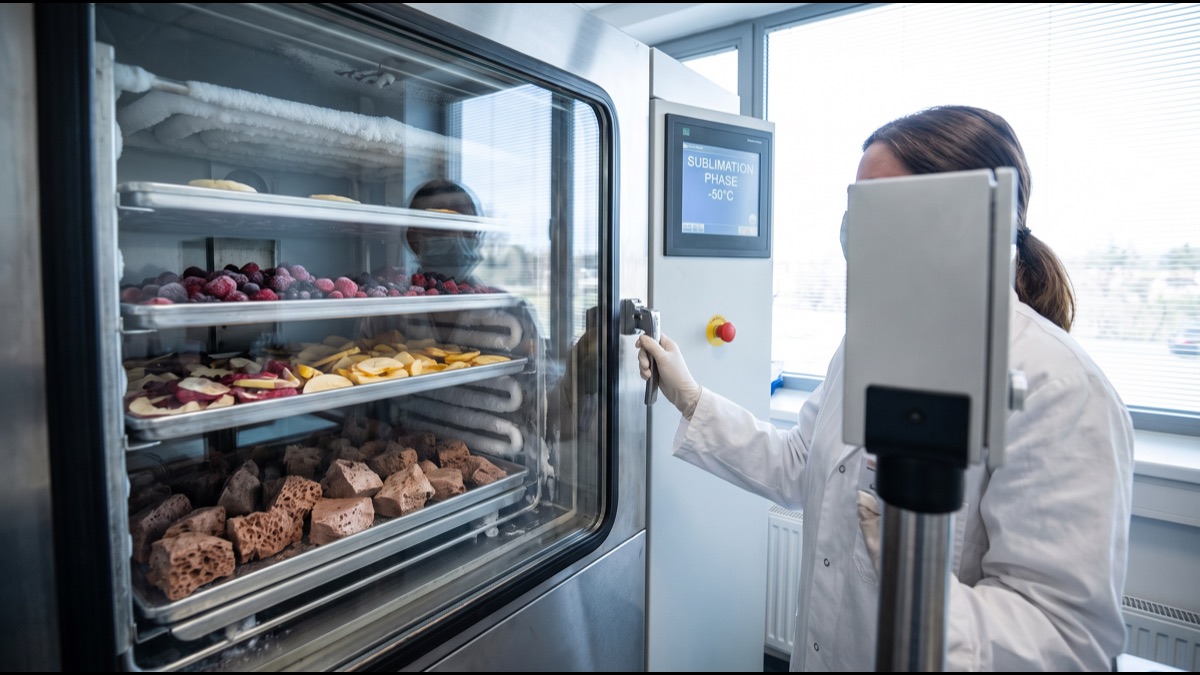
Freeze-dried strawberries crunch like styrofoam and rehydrate into something almost recognizable as fresh fruit within seconds of hitting water. That transformation is not a chemical trick but a physical one, built entirely around removing water from food without ever letting it pass through its ordinary liquid state on the way out. Understanding that one detail explains almost everything unusual about freeze-dried food, from its featherweight texture to its remarkably long shelf life to why it costs so much more than a bag of raisins.
The process, known formally as lyophilization, has quietly become one of the most important food-preservation technologies of the past century, used everywhere from emergency ration kits and camping meals to pharmaceutical manufacturing and, most famously, the freeze-dried ice cream sold as a novelty souvenir of space travel.
Why Freeze-Drying Is Fundamentally Different From Ordinary Drying
Conventional food dehydration works by applying heat, which evaporates water directly from a liquid state into vapor, a process that inevitably cooks the food somewhat, breaks down its cellular structure, and concentrates flavors while shrinking and toughening the texture.
Freeze-drying takes an entirely different physical route. Rather than heating food to evaporate its water, the food is first frozen solid, and the ice inside it is then removed directly as vapor without ever melting back into liquid, a process that leaves the food's original cellular scaffolding largely intact.
This structural preservation is the single biggest practical difference between the two methods, and it explains why freeze-dried fruit looks and rehydrates so differently from sun-dried or oven-dried fruit, which has visibly collapsed and toughened during its water loss.
What Sublimation Actually Means for Food
The physical process making this possible is called sublimation, the direct transition of a substance from a solid state to a gas state without passing through a liquid phase in between, a phenomenon most people encounter informally when they notice ice cubes shrinking in a freezer over many months.
For sublimation to occur reliably and quickly at an industrial scale, both temperature and pressure must be carefully controlled together, since water can only sublimate directly from ice to vapor within a specific combination of low temperature and low pressure defined by its phase diagram.
Freeze-drying equipment is engineered specifically to hold food within that narrow physical window for an extended period, which is why the process takes considerably longer than ordinary heat-based drying, often running for many hours or even several days depending on the food's density and water content.
How the Freeze-Drying Process Actually Runs
Commercial freeze-drying begins with rapidly freezing the food, usually to a temperature well below standard household freezer levels, ensuring the water inside forms into fine ice crystals throughout the food's structure before any drying begins.
The frozen food is then placed inside a sealed chamber, and a vacuum pump dramatically reduces the internal air pressure, creating the low-pressure environment sublimation requires. A carefully controlled amount of heat is then applied, just enough to encourage the ice to sublimate directly into vapor without ever raising the food itself above freezing.
A refrigerated condenser plate elsewhere in the chamber captures that escaping water vapor and refreezes it onto its own surface, continuously pulling moisture away from the food and keeping the whole system moving toward completion rather than reaching equilibrium.
Why Freezing Speed Determines the Final Texture
How quickly food is frozen before drying substantially affects its final quality, because the size of the ice crystals that form during freezing directly determines how much physical damage is done to the food's cell walls.
Slow freezing allows large ice crystals to form, and those large crystals physically rupture cell walls as they grow, which is why slowly frozen and thawed food often turns mushy: the cellular structure holding its texture together has been mechanically destroyed.
Rapid freezing, sometimes called flash freezing, produces many small ice crystals instead of a few large ones, causing far less structural damage and helping the food retain a texture much closer to its original state once it is eventually rehydrated by the end consumer.
How Vacuum Pressure Makes Sublimation Possible
At standard atmospheric pressure, ice simply melts into liquid water once its temperature rises past freezing rather than sublimating directly into vapor, which is exactly the outcome freeze-drying is engineered to avoid.
By dramatically lowering the pressure inside the drying chamber, the equipment shifts the physical conditions so that ice can transition straight to vapor at a temperature still safely below freezing, allowing water removal to happen without the food ever experiencing a liquid-water phase during the primary drying stage.
Maintaining this vacuum consistently across a large batch of food, at industrial scale, over many hours, is the main engineering challenge of freeze-drying equipment and a significant reason the machinery itself is costly to build, operate, and maintain.
Why Freeze-Dried Food Rehydrates So Quickly
Because the ice crystals sublimate directly out of the food's existing cellular structure rather than that structure collapsing under heat, freeze-dried food is left with a porous, sponge-like internal architecture riddled with the tiny channels the ice crystals once occupied.
Those channels give water added during rehydration a direct physical pathway back into the food's interior, which is why freeze-dried meals and fruit typically rehydrate in seconds to a few minutes, dramatically faster than heat-dried food, whose collapsed structure resists water penetration.
This same porous structure is also why freeze-dried food is so lightweight, since the volume the ice crystals previously occupied remains largely as empty space within the dried product rather than collapsing inward the way heat-dried food does.
How Freeze-Drying Protects Nutrients Better Than Heat
Many vitamins, particularly heat-sensitive ones such as vitamin C and several B vitamins, degrade measurably when exposed to the sustained heat used in conventional dehydration, a degradation that accumulates the longer and hotter the drying process runs.
Because freeze-drying keeps food at or below freezing throughout its primary drying stage, it avoids the bulk of this thermal degradation, which is a major reason freeze-dried fruits and vegetables generally retain more of their original nutritional content than their heat-dried counterparts.
This nutrient advantage, combined with long shelf stability, is precisely why freeze-drying is the preferred preservation method for high-value nutritional applications including infant formula ingredients, certain pharmaceuticals, and specialized nutritional supplements where nutrient retention is commercially critical.
Why Packaging Matters as Much as the Drying Itself
Freeze-dried food's porous structure that enables fast rehydration is a double-edged advantage, since that same open architecture also makes the food highly vulnerable to reabsorbing moisture and oxygen from the surrounding air if it is not sealed properly.
Commercial freeze-dried products are therefore typically packaged in airtight, moisture-proof containers, frequently with an oxygen absorber included in the packaging, since exposure to even small amounts of ambient humidity can rapidly undo much of the shelf-life benefit the drying process achieved.
This dependence on intact packaging explains why freeze-dried emergency food kits are rated for shelf lives measured in decades only under sealed, unopened conditions, and why manufacturers warn that shelf life drops dramatically once a package has been opened and resealed imperfectly, even when the food inside still looks and smells perfectly fine.
How the Space Program Popularized the Technique
Although freeze-drying predates space travel by decades, having been used earlier for blood plasma preservation and other medical applications, its association in popular culture with astronaut food comes from genuine early space-program adoption, where lightweight, shelf-stable, easily rehydrated meals solved a real logistical problem for missions with strict weight limits.
Freeze-dried "astronaut ice cream" sold today as a novelty souvenir is largely a commercial product marketed around that space association rather than something regularly eaten during actual space missions, though genuine freeze-dried meals have remained part of space-agency food planning for practical reasons unrelated to marketing.
The broader outdoor recreation and emergency-preparedness industries later adopted the same underlying technology for camping meals and survival food kits, drawn by the identical combination of low weight, long shelf life, and fast rehydration that made it useful for space missions in the first place.
Why Freeze-Drying Is Expensive Compared to Other Methods
The extended processing time, specialized vacuum and refrigeration equipment, and substantial energy consumption required to maintain a controlled low-temperature, low-pressure environment for many hours make freeze-drying meaningfully more expensive per unit of finished food than simple air-drying or heat-dehydration.
Industrial freeze-dryers represent a significant capital investment, and their batch-based operation, rather than a continuous production line, limits throughput compared to faster drying methods, both factors that get reflected directly in the higher retail price of freeze-dried products on supermarket shelves.
Consumer-grade freeze-drying equipment has become increasingly available for home use in recent years, allowing enthusiasts to freeze-dry their own produce, though home units run much longer cycles and handle far smaller batches than the industrial equipment used for commercial products.
What Freeze-Drying Cannot Do
Freeze-drying removes water but does not sterilize food or apply cooking heat, meaning raw meat, poultry, and similar ingredients generally still need to be fully cooked before freeze-drying, since the process itself will not eliminate pathogens the way heat-based cooking does.
Foods with very high fat content freeze-dry poorly, since fat does not contain the water that sublimates away and can also oxidize over long storage periods, which is why freeze-dried products tend to favor lean proteins, fruits, vegetables, and grains over fatty ingredients.
Freeze-drying also cannot fully restore the exact original texture of every food once rehydrated, since some degree of cellular change is unavoidable even under ideal conditions, which is why certain foods, particularly those valued specifically for a crisp fresh texture, are better suited to the process than others.
How Freeze-Drying Compares to Canning and Refrigeration
Canning preserves food by sealing it inside an airtight container and heating it to a temperature high enough to destroy the microorganisms that cause spoilage, a process that keeps food edible for years but, like heat-dehydration, cooks the food and noticeably softens its texture in the process.
Refrigeration and freezing, by contrast, do not remove water or apply meaningful heat at all; they simply slow the biological and chemical reactions responsible for spoilage by keeping food cold, which is why frozen food remains genuinely fresh-tasting for months but still eventually degrades and, unlike freeze-dried food, requires continuous energy input to stay preserved.
Freeze-drying occupies a distinct position between these two approaches: it achieves shelf stability without refrigeration, the way canning does, while avoiding the textural damage of cooking, the way freezing does, at the cost of the specialized equipment and processing time neither of the other methods requires.
Why Instant Coffee and Freeze-Dried Coffee Are Not the Same Product
Most instant coffee sold globally is spray-dried, a process that atomizes brewed coffee into a fine mist inside a hot-air chamber, evaporating the water almost instantly and leaving behind small, irregular granules, a method that is fast and cheap but noticeably alters the coffee's aroma and flavor compounds through heat exposure.
Freeze-dried coffee instead brews concentrated coffee, freezes it, then breaks the frozen block into small chunks before running it through the same low-temperature, low-pressure sublimation process used for freeze-dried food, which better preserves the volatile aromatic compounds responsible for coffee's flavor and produces the characteristic irregular, glassy granules found in premium instant coffee jars.
This is also why freeze-dried coffee typically costs more on supermarket shelves than ordinary spray-dried instant coffee: the batch-based vacuum process is slower and more energy-intensive than continuous spray-drying, the same fundamental cost tradeoff that applies across every freeze-dried product category, from fruit snacks to full camping meals.
How Long Freeze-Dried Food Actually Lasts
Manufacturers commonly advertise shelf lives of twenty-five years or more for sealed freeze-dried emergency food, a figure that assumes the packaging remains fully intact, since it is oxygen and moisture ingress, not the drying process itself failing, that eventually ends a product's usable life.
Once a pouch or can is opened, that multi-decade timeline collapses dramatically, and manufacturers typically recommend consuming freeze-dried food within one to two years of opening, depending on how well it is resealed and stored afterward, since the exposed porous structure absorbs ambient humidity far faster than a solid food would.
Fat content is the other major limiting factor on real-world shelf life, since the small amount of fat present even in lean freeze-dried products can slowly oxidize over very long storage periods and produce off-flavors well before microbial spoilage would ever become a concern.
Freeze-drying ultimately succeeds by sidestepping the liquid-water phase entirely, using carefully controlled temperature and pressure to pull ice directly out of food as vapor while leaving its underlying cellular architecture largely intact. That single physical choice is what separates freeze-dried food's light, porous, fast-rehydrating character from the denser, tougher result of ordinary heat-drying.
The tradeoff is cost and processing time, which is why freeze-drying remains concentrated in applications where its specific advantages, exceptional shelf life, minimal weight, and strong nutrient retention, genuinely justify the expense: emergency and expedition food, pharmaceuticals, and a growing niche of home food-preservation enthusiasts rather than everyday grocery staples. As consumer-grade freeze-dryers become cheaper and more widely available, that boundary between industrial and household use continues to shift, but the underlying physics that make the technique work, and expensive, have not changed since it was first developed for medical and space applications decades ago.
Sources
- Wikipedia — overview of the lyophilization process and its applications
- U.S. Food and Drug Administration — food preservation and packaging safety standards
- U.S. Department of Agriculture — food storage and shelf-life guidance
- NASA — history of freeze-dried food in space missions
- World Health Organization — food preservation and nutrient retention guidance
FAQ
Is freeze-dried food actually cooked?
Most freeze-dried food is cooked before drying, since the process itself only removes water and does not apply the heat needed to fully cook raw meat or grains.
Why does freeze-dried food last so much longer than regular dried food?
Removing water at low temperature preserves the food's cellular structure far better than heat-drying, which slows spoilage reactions and keeps texture closer to the original once rehydrated.
Does freeze-drying destroy nutrients?
Freeze-drying generally preserves more vitamins and nutrients than heat-based dehydration because the low temperatures involved cause far less thermal degradation.
Why is freeze-dried food so expensive?
The equipment runs a multi-day vacuum and refrigeration cycle that consumes significant energy and capital, a cost passed on that simple air-drying does not carry.
Can you freeze-dry food at home?
Consumer freeze-dryers exist and are increasingly popular for home food storage, though they are considerably slower and less efficient than industrial units used for commercial products.
About the Author
We reference Wikipedia, the U.S. Food and Drug Administration, the U.S. Department of Agriculture, NASA, and the World Health Organization to explain the background and current understanding of this topic.
Loved This Article?
Share it on WhatsApp → Share it on WhatsApp
Get more guides in your inbox — Subscribe to our newsletter for weekly surprising stories from Egypt, Saudi Arabia, Dubai, and beyond.