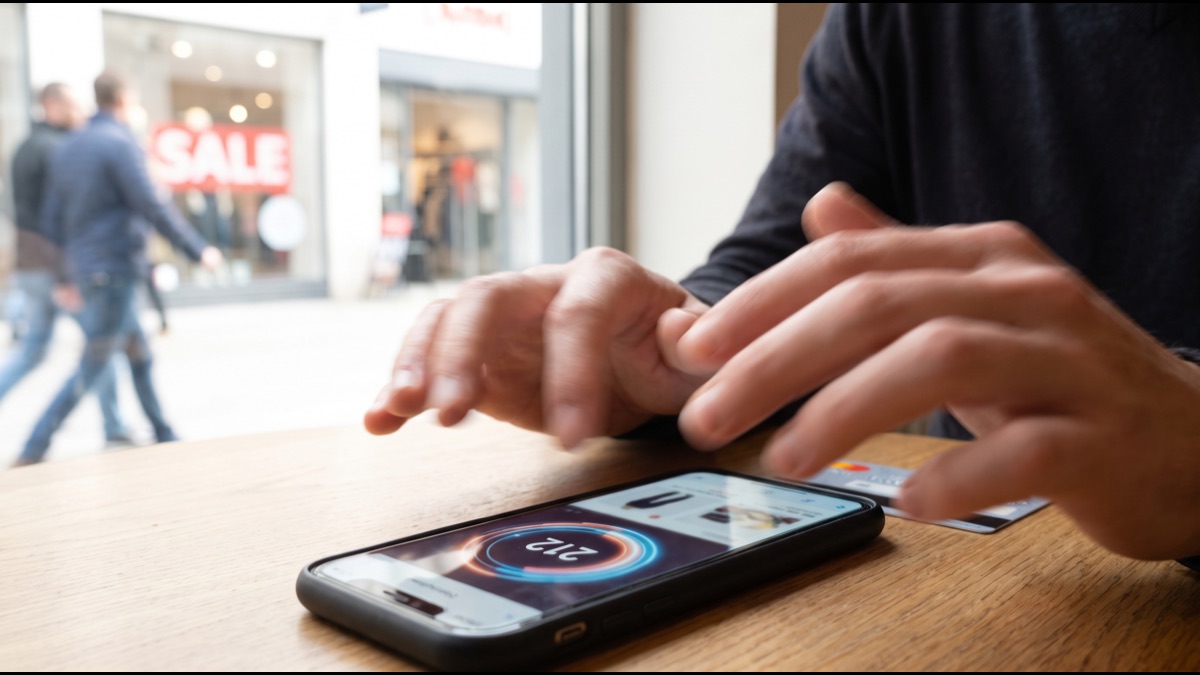
A red banner appears at the top of a shopping app. A clock underneath it is already counting down from four hours. Below the clock, a bar shows that eighty-three percent of the stock is already claimed, and a small line of text says that fourteen other people are looking at the same item right now. None of this happened by accident, and very little of it is a neutral description of inventory. It is a carefully engineered set of psychological cues designed to move a shopper from browsing to buying before the rational, comparison-shopping part of the brain has time to catch up, and understanding how it works is the first step toward deciding whether to go along with it.
The Countdown Clock That Changes Everything
Retail researchers have long observed that the presence of a visible, ticking deadline changes how people evaluate a purchase, shifting the decision away from a calm weighing of price against need and toward a faster, more reactive mode of thinking that prioritizes avoiding a loss over securing the objectively best deal.
A countdown timer does not add any real information about the product itself; the shirt, the flight, or the appliance is identical whether the clock reads four hours or four minutes. What the timer changes is the shopper's internal sense of how much time remains to think, and that compression of decision time is, by design, the entire point of the mechanic.
What Actually Counts as a Flash Sale
A flash sale is generally defined as a short, tightly bounded promotional window, often lasting anywhere from a few hours to a couple of days, in which a retailer offers steep discounts on a limited selection of products, in contrast to a seasonal sale that might run for weeks with broad category-wide markdowns.
The format originated in a mix of clearance retail and early e-commerce, where sites like the now-defunct Woot popularized the idea of offering a single deeply discounted product for twenty-four hours, and it has since been adopted broadly across fashion, electronics, travel, and grocery delivery apps as a standard promotional tool rather than an occasional novelty.
What distinguishes a flash sale from an everyday discount is not primarily the depth of the price cut but the artificial compression of the window in which a shopper can act on it, a structural choice that retailers make deliberately because the time limit itself, not just the lower price, is what drives measurable increases in conversion.
Scarcity as a Psychological Trigger
Robert Cialdini's influential research on persuasion identifies scarcity as one of the most reliable levers for prompting quick decisions, because people generally place higher value on things that appear limited in availability, treating scarcity itself as an implicit signal of desirability even when the actual supply constraint has little to do with genuine demand.
Retailers exploit this by pairing a flash sale with visible scarcity cues, such as a stock counter ticking down or a message noting that an item is almost sold out, signals that are sometimes tied to genuine limited inventory and sometimes generated or exaggerated by the platform's software regardless of how much stock actually remains in a warehouse.
The effect tends to be strongest for products a shopper was already mildly interested in, since scarcity mainly accelerates a decision that was already leaning toward yes rather than manufacturing desire for a product the shopper had no prior interest in at all.
Urgency and the Fear of Missing Out
Urgency and scarcity are closely related but distinct: scarcity concerns how much of a product exists, while urgency concerns how much time remains to act, and flash sales typically layer both together deliberately so that a shopper feels pressure from two directions at once rather than from a single cue.
Consumer psychology researchers describe the resulting emotional state, commonly shortened to FOMO, or fear of missing out, as a blend of anticipated regret and social comparison, in which the discomfort of imagining having missed a good deal becomes a more immediate motivator than a careful assessment of whether the product is actually needed.
This dynamic helps explain why flash sales generate disproportionately high impulse-purchase rates compared to ordinary discounts of a similar size, since the emotional trigger being activated is less about the money saved and more about avoiding the feeling of having lost an opportunity.
Anchoring and Why the Original Price Matters
Behavioral economists Daniel Kahneman and Amos Tversky documented how people judge value relative to a reference point rather than in absolute terms, a phenomenon known as anchoring, and flash sales lean heavily on this by prominently displaying a crossed-out original price next to the discounted one.
The strikethrough price does real psychological work even when a shopper has no independent way to verify it was ever charged at that level, because the brain registers the gap between the two numbers as the size of the deal, and a larger gap generally produces a stronger sense of a bargain regardless of whether the discounted price is actually competitive against other retailers.
This is part of why price-comparison habits, such as checking a second retailer or a price-history tool before buying during a flash sale, tend to meaningfully reduce the emotional pull of the anchor, since they replace a single retailer-supplied reference point with an independently gathered one.
Countdown Timers, Progress Bars, and Stock Counters
User-experience researchers who study e-commerce interfaces have found that countdown timers, stock progress bars, and real-time viewer counts are among the most effective single design elements for increasing conversion rate on a product page, often outperforming price changes of a similar magnitude in controlled testing.
These elements work partly through simple visual salience, since a moving number or shrinking bar draws the eye and signals change more effectively than static text, and partly through the loss-aversion mechanism described earlier, in which watching a resource visibly deplete feels like an active threat rather than a passive fact.
Platforms have refined these tools considerably, testing variations in color, animation speed, and placement to maximize their psychological effect, which is one reason similar-looking countdown widgets now appear across a wide range of unrelated retail and travel booking sites regardless of whether a genuine scarcity condition exists underneath them.
Inflated List Prices and the Discount Illusion
A recurring consumer-protection concern is that some retailers artificially inflate the reference price shown before a flash sale so that the discounted price looks larger than it actually is relative to the item's normal selling price, a practice sometimes called a fake or phantom discount.
Investigations by consumer organizations in several countries have found instances where a product's so-called original price was rarely, if ever, the price customers actually paid before the sale began, meaning the advertised percentage off overstates the real savings a shopper receives.
This practice is distinct from, though related to, ordinary anchoring, since it does not just exploit how people process a real reference price but manufactures a reference price that misrepresents the product's genuine market value, which is why it has drawn specific regulatory attention in a number of jurisdictions.
Flash Sales as an E-commerce Platform Feature
Major e-commerce platforms, particularly those operating in fast-growing markets across the Gulf, Southeast Asia, and Latin America, have built flash sales into core parts of their app experience, sometimes running dedicated daily or hourly sale events rather than treating flash sales as an occasional promotional exception.
This shift reflects data showing that flash sale events reliably drive spikes in app opens and session length even among shoppers who do not ultimately purchase, meaning the format functions as an engagement tool for the platform as a whole, not only as a sales tactic for individual products.
Some platforms have gone further, gamifying the flash sale experience with features like limited-time coupon games or notifications that a sale is about to start, extending the urgency and anticipation cycle beyond the sale window itself and into the moments leading up to it.
Social Proof and Purchase Notifications
Beyond scarcity and urgency, flash sale interfaces frequently display social proof signals, such as a running count of how many people bought an item recently or a small pop-up noting that another shopper in a nearby city just purchased the same product.
Social proof works on a separate but complementary psychological mechanism from scarcity, leaning on people's tendency to treat the observed behavior of others as evidence about the right decision to make, particularly under time pressure when there is little opportunity to research independently.
Marketing researchers note that the combination of scarcity, urgency, and social proof operating simultaneously tends to produce a stronger effect than any one cue alone, which is part of why flash sale interfaces are rarely built around a single tactic and instead stack several reinforcing signals at once.
The Neuroscience Behind Impulsive Buying
Neuroscience research on decision-making under time pressure has found that shortened deliberation windows tend to shift activity toward faster, more automatic evaluation processes and away from the slower, more deliberate reasoning associated with weighing tradeoffs carefully, a distinction popularized in psychology as System 1 versus System 2 thinking.
Flash sales are structurally suited to trigger System 1, automatic-style decision-making precisely because the artificial time constraint discourages the kind of pause a shopper would otherwise take to compare prices, check reviews, or simply ask whether the item is genuinely needed.
Some researchers caution against overstating brain-imaging findings into simple retail advice, noting that most of the evidence for flash sale effectiveness comes from behavioral conversion data and self-reported purchase regret rather than direct neuroimaging, but the behavioral pattern itself, faster decisions under artificial time pressure, is well replicated across many studies.
Regulatory Scrutiny of Fake Discounts
Consumer protection regulators in several countries have introduced rules specifically targeting misleading reference pricing, requiring retailers to have genuinely offered a product at its stated original price for a meaningful period before advertising it as discounted, rather than setting an artificially high price shortly before a sale begins.
The European Union's Omnibus Directive, for example, requires online retailers to disclose the lowest price a product was offered at during a defined period before any price reduction is advertised, a rule introduced explicitly to curb the practice of briefly raising a price just ahead of a flash sale to inflate the apparent discount.
Enforcement varies considerably across jurisdictions, and consumer advocates generally argue that awareness campaigns and independent price-tracking browser tools remain a more immediate practical defense for shoppers than waiting for regulatory enforcement to catch every instance of an inflated reference price.
Flash Sales and Post-Purchase Regret
Surveys conducted by consumer research organizations have found that purchases made during flash sales are more likely to be later described by the buyer as unnecessary or regretted compared to purchases made after more deliberate comparison shopping, a pattern consistent with the idea that urgency compresses evaluation before the purchase rather than eliminating the need for it afterward.
Return rates for flash sale purchases, particularly in fashion and consumer electronics, also tend to run higher than for standard-priced purchases in some retailer data, suggesting that at least a portion of flash sale buying reflects an in-the-moment decision that does not hold up once the artificial urgency has passed and the item arrives at home.
This gap between purchase-moment excitement and post-purchase satisfaction is precisely what makes flash sales commercially effective for retailers even when a meaningful share of buyers are unhappy afterward, since the sale has already achieved its immediate goal of converting a browse into a transaction.
How Retailers Use Data to Time a Sale
Modern flash sale scheduling is rarely arbitrary; retailers increasingly use historical purchase data, browsing patterns, and even device-level signals like time of day and day of week to schedule sales at moments when a given customer segment has historically shown the highest conversion likelihood.
Some platforms personalize flash sale timing and even discount depth at the individual shopper level, showing different urgency cues or slightly different offers to different users based on predicted price sensitivity, a practice that overlaps with the personalized pricing concerns raised in broader discussions of algorithmic retail pricing.
This data-driven targeting means two shoppers browsing the identical product at the identical moment may see meaningfully different urgency signals, timers, or even prices, a level of individualized psychological targeting that goes well beyond the simple, uniform clearance sales of earlier retail eras.
Loyalty Programs and Sale Fatigue
Retailers that run flash sales too frequently risk a phenomenon researchers describe as promotional fatigue, in which repeated exposure to urgency cues gradually dulls their psychological impact, since shoppers who see a countdown clock every day eventually stop treating it as a genuine signal of scarcity.
Some brands have responded by tying flash sale access to loyalty program membership or app notifications, framing early access as an exclusive benefit rather than a routine occurrence, an approach that appears to partially restore the sense of specialness that frequent, unrestricted flash sales tend to erode over time.
This pattern illustrates that the psychological effectiveness of urgency and scarcity cues is not fixed but depends heavily on context and frequency, meaning retailers must continually adjust how often and how they deploy these tactics to keep them working on an increasingly sale-saturated shopper base.
Can Shoppers Outsmart the Tactic
Consumer advocates generally recommend a short set of practical habits for reducing vulnerability to flash sale pressure, including adding an item to a wish list rather than buying immediately, waiting a fixed period such as twenty-four hours before completing a purchase, and independently checking a price-history tool to see whether the discounted price is genuinely lower than recent pricing.
Deliberately avoiding shopping apps during known flash sale windows, muting promotional notifications, and asking a simple question, would I buy this today at full price, before checking out are simple friction-adding steps that research on impulsive buying suggests can meaningfully reduce regretted purchases without requiring any special willpower.
None of these strategies eliminates flash sales as a retail tactic, since the format remains commercially effective for the businesses that use it, but understanding the specific psychological mechanisms at work, scarcity, urgency, anchoring, and social proof, tends to be one of the more reliable ways for an individual shopper to slow down enough to make a decision they will not regret once the countdown clock reaches zero.
Sources
- Federal Trade Commission — U.S. consumer protection guidance on deceptive discount pricing and reference price claims.
- Consumer Reports — Independent research on retail pricing tactics and consumer purchasing behavior.
- Which? — UK investigations into fake discounts and misleading sale pricing.
- National Bureau of Economic Research — Academic research on scarcity, urgency, and consumer decision-making.
FAQ
Why do flash sales make people buy things they did not plan to buy
Flash sales combine scarcity, time pressure, and social proof cues that push shoppers toward faster, more automatic decision-making, which tends to override the slower comparison-shopping process people normally use when there is no artificial deadline.
Are the discounts shown in flash sales always genuine
Not always; consumer investigations have found cases where the original price shown before a discount was artificially inflated shortly before the sale, making the advertised savings appear larger than the product's actual recent selling price.
Do countdown timers and stock counters actually reflect real inventory
Sometimes they reflect genuine limited stock and sometimes they are generated or exaggerated by the platform's software to create a sense of urgency, and there is generally no reliable way for a shopper to verify which is the case from the interface alone.
Why do flash sale purchases get returned more often
Purchases made under time pressure tend to skip the deliberation that normally filters out unnecessary items, so a meaningful share of flash sale buyers later decide the product was not actually needed once the artificial urgency has passed.
What is the simplest way to avoid impulsive flash sale purchases
Adding the item to a wish list and waiting a fixed period, such as twenty-four hours, before completing the purchase is one of the most consistently recommended habits, since it reintroduces the deliberation window that the sale format is designed to remove.
About the Author
We reference the Federal Trade Commission, Consumer Reports, Which?, and the National Bureau of Economic Research to explain the background and current understanding of this topic.
Loved This Article?
Share it on WhatsApp → Share it on WhatsApp
Get more guides in your inbox — Subscribe to our newsletter for weekly surprising stories from Egypt, Saudi Arabia, Dubai, and beyond.