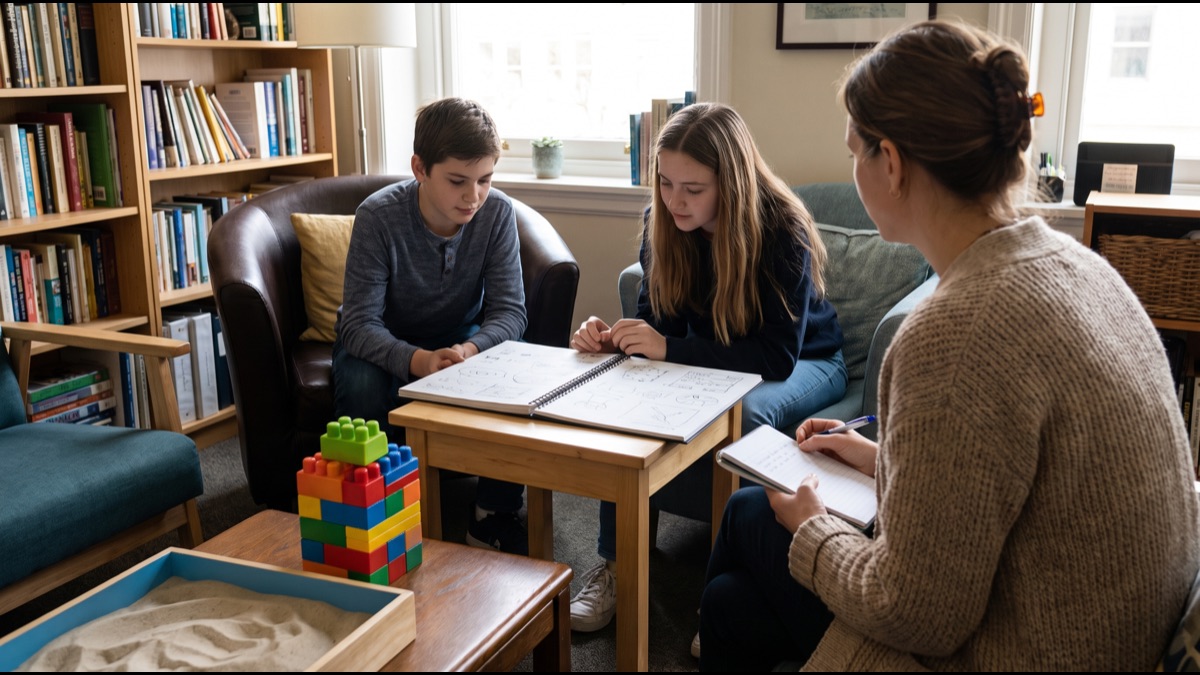
When parents finally bring sibling conflict to a family therapist, they often expect the therapist to fix the children — to diagnose which kid is the problem and correct their behavior. What actually happens in the room looks quite different. A trained clinician typically starts by mapping the whole family system, not just the two children who keep fighting, because decades of family therapy practice and research treat sibling conflict as a symptom of broader patterns rather than an isolated behavioral defect in one child. Understanding the actual frameworks, triggers, and techniques therapists use clarifies why this approach tends to work better than punishing or separating children, and why the popular advice to simply treat kids equally rarely resolves anything on its own.
Why Therapists Treat Sibling Conflict as a Family Pattern, Not a Kid Problem
Family therapists trained in systemic approaches generally start from the premise that no child's behavior exists in isolation; a child's actions are shaped by, and in turn shape, the behavior of every other person in the household, including parents, grandparents, and other siblings.
This means a therapist observing two siblings locked in constant conflict is usually less interested in assigning blame to one child and more interested in identifying the repeating sequence around the fight: what happens immediately before it, who intervenes and how, and what happens afterward, since that sequence is often what actually maintains the conflict over time.
Clinicians describe this as shifting from a linear cause-and-effect view, where one child simply causes the other's reaction, to a circular view, where each child's behavior is both a response to and a trigger for the other's behavior, with parental reactions feeding the loop.
The Family Systems Lens: What Bowen Theory Actually Contributes
Family systems theory, developed largely by psychiatrist Murray Bowen, treats the family as an emotional unit in which members are so interconnected that a change in one person's functioning predictably affects the functioning of others, a framework many family therapists still use as their core diagnostic lens today.
Under this lens, sibling conflict is rarely viewed as a standalone problem between two children; it is more often understood as one visible expression of anxiety circulating through the larger family system, including marital tension, parental stress, or unresolved patterns carried over from the parents' own families of origin.
Therapists working from this framework will often ask about extended family history, past sibling relationships among the parents themselves, and current stressors like work pressure or financial strain, because these factors frequently explain why conflict intensifies at particular times rather than others.
Differentiation of Self and Why It Matters Between Siblings
Differentiation of self, one of Bowen's central concepts, describes a person's capacity to maintain a clear sense of their own thoughts, values, and identity while remaining emotionally connected to family members, rather than being swept along by the family's emotional reactivity.
In practice, siblings with lower differentiation tend to react to each other's moods and provocations almost automatically, escalating quickly because neither can maintain a stable sense of self separate from the immediate emotional charge of the conflict, whereas better-differentiated siblings can disagree without the disagreement threatening their identity or triggering panic.
Therapists often work to help both children, and frequently the parents as well, build differentiation gradually, teaching skills like naming one's own feelings without immediately reacting to a sibling's provocation, which is a slower process than it sounds and typically spans many sessions rather than a single conversation.
Triangulation: How Parents Get Pulled Into Every Fight
Triangulation describes a common pattern where two people in conflict pull in a third person to stabilize the tension between them, and in sibling conflict, that third person is almost always a parent who gets pulled in to judge, referee, or take sides.
Therapists pay close attention to triangulation because it often unintentionally rewards the conflict pattern; when a parent consistently intervenes to determine who started it or who is right, children can learn that conflict is an effective way to secure parental attention and involvement, even negative attention, which paradoxically reinforces the very behavior parents are trying to reduce.
A specific technique therapists use is helping parents recognize the moment they are being triangulated in real time and practicing alternative responses that return responsibility for resolution to the children themselves rather than automatically stepping into the judge role.
Structural Family Therapy and the Sibling Subsystem
Structural family therapy, developed by Salvador Minuchin, conceptualizes families as made up of subsystems, including a parental subsystem and a sibling subsystem, each with its own boundaries, and views healthy family functioning as depending partly on those boundaries being clear but not rigid.
From this perspective, chronic sibling conflict sometimes signals a boundary problem: a sibling subsystem that has been allowed too little autonomy, with a parent constantly inserted into the children's disputes, or conversely a subsystem given too little structure, with older children left to manage conflicts, including power imbalances, that genuinely require adult involvement.
Structural therapists often work directly on strengthening the sibling subsystem's boundary, coaching parents to step back from micromanaging minor disputes while remaining clearly available for genuinely unsafe situations, a distinction that requires real clinical judgment about where that line sits for a given family.
Common Trigger One: Competition for Finite Resources and Attention
Therapists consistently identify competition over genuinely limited resources, parental time, attention, praise, and material items, as one of the most reliable triggers of sibling conflict, particularly during major family transitions like the arrival of a new sibling or a parent returning to demanding work.
This competition is not treated as a character flaw in children; developmental researchers generally describe it as a predictable response to a real scarcity, since parental attention genuinely cannot be divided infinitely, and children, especially younger ones, are still developing the cognitive capacity to reason abstractly about fairness over time rather than needing reassurance in the moment.
A common clinical recommendation is protected one-on-one time with each parent, however brief, specifically because it directly addresses the scarcity driving the competition rather than simply telling children to stop fighting over something that is, from their perspective, genuinely in short supply.
Common Trigger Two: Perceived Parental Favoritism
Perceived favoritism, meaning a child's belief that a parent treats a sibling more favorably, is treated by therapists as clinically significant regardless of whether that perception matches objective reality, since research on differential parental treatment has repeatedly found that a child's subjective sense of unequal treatment predicts sibling conflict and emotional distress independent of how parents actually behave.
Family therapists explain this by pointing out that some differential treatment is developmentally appropriate and often necessary, an eight-year-old and a fourteen-year-old genuinely warrant different bedtimes and responsibilities, but children do not always have the cognitive tools to distinguish appropriate differentiation from favoritism, especially during younger childhood.
A specific intervention here involves coaching parents to explicitly narrate the reasoning behind different treatment out loud, in age-appropriate terms, rather than assuming children will independently understand why rules differ, since making the reasoning visible measurably reduces the likelihood that different treatment is interpreted as unfairness.
Common Trigger Three: Developmental Stage Mismatches
Siblings at different developmental stages are often working with entirely different cognitive and emotional capacities at the same moment, and therapists point to this mismatch as a frequent, underappreciated source of conflict that has nothing to do with personality or parenting failure.
A toddler's inability to reliably share, a school-age child's intense focus on rule-based fairness, and an adolescent's need for autonomy and privacy can all collide within the same household simultaneously, and conflicts that look identical on the surface, two siblings arguing over a shared space, may require completely different responses depending on each child's developmental stage.
Therapists often help parents build a working mental model of what is developmentally typical, not necessarily acceptable but expected, at each child's current stage, which changes how a given conflict gets interpreted and reduces parents' tendency to read normal developmental friction as a character problem in one particular child.
How Attachment Patterns Shape Sibling Relationships
Attachment theory, originally developed to describe the parent-infant bond, has increasingly informed how therapists understand sibling relationships as well, since siblings who each have a secure attachment to at least one consistent caregiver tend to show more cooperative, resilient patterns with each other even amid ordinary conflict.
Conversely, children navigating inconsistent or anxious attachment with a parent sometimes bring that same anxious vigilance into the sibling relationship, becoming hyper-alert to any sign that a sibling is receiving more care or attention, which can intensify rivalry beyond what the situation objectively warrants.
Therapists working with attachment concerns alongside sibling conflict often address the parent-child relationship directly, on the reasoning that stabilizing each child's sense of security with caregivers tends to reduce the intensity of sibling competition as a secondary effect, rather than treating the sibling conflict as the primary target.
Birth Order Dynamics: What Clinicians Actually Use vs. Pop Psychology
Popular psychology often treats birth order as a strong predictor of personality, the responsible firstborn, the rebellious middle child, the charming youngest, but large controlled studies have generally found these effects to be weak, inconsistent, and easily overstated compared to factors like individual temperament and family environment.
Clinicians tend to use birth order much more cautiously, as one contextual factor that shapes role expectations and parental behavior rather than a fixed personality template; a firstborn frequently is given more caregiving responsibility for younger siblings, which shapes relationship dynamics through actual assigned roles rather than an innate trait tied to birth position itself.
What therapists do find clinically useful is examining the specific roles each child has been assigned or has adopted within the family, protector, mediator, scapegoat, entertainer, since these functional roles, however they arose, often explain conflict patterns far better than birth order alone, and roles can shift when family structure changes.
Temperament and Goodness of Fit Between Siblings
Developmental researchers describe temperament, a child's inborn style of reacting to the world including activity level, emotional intensity, and adaptability, as relatively stable from early childhood, and therapists routinely assess how differently siblings' temperaments interact, since two children with very different temperamental styles often generate more friction than two children who happen to be more similar.
The clinical concept of goodness of fit describes how well a parent's or sibling's expectations and responses match a child's actual temperament, and a poor fit, for example a high-energy child paired with a household that strongly values quiet, predictable behavior, can generate chronic low-grade conflict that looks behavioral but is really a mismatch problem.
Rather than trying to change a child's underlying temperament, which developmental research suggests is largely unproductive, therapists more often coach parents and siblings to adjust expectations and communication style to fit each child's actual temperament, which tends to reduce friction more reliably than demanding a child simply behave differently.
How Therapists Assess a Family Before Intervening
Before recommending any specific technique, most family therapists conduct a structured assessment phase, often involving interviews with the whole family together and separately with individual members, direct observation of family interaction patterns, and sometimes standardized questionnaires measuring family functioning, conflict style, or parenting approach.
A key part of this assessment is distinguishing ordinary, developmentally expected sibling friction, which most families experience regularly and does not require clinical intervention, from conflict patterns significant enough to warrant treatment, generally marked by frequency, intensity, physical harm, or clear distress and functional impairment in one or more children.
Therapists also assess the parents' own conflict resolution style and stress levels during this phase, since parental modeling and household stress levels are consistently identified in family therapy literature as significant contributors to how children handle disagreement with each other.
Intervention Technique: Coaching Parents Out of the Referee Role
One of the most consistently used interventions involves coaching parents to deliberately step back from adjudicating every sibling dispute, replacing the instinct to determine who is right with structured questions that hand problem-solving responsibility back to the children themselves whenever the situation is safe enough to allow it.
This does not mean parents disengage entirely; therapists are specific that this technique applies to low-stakes disputes, not situations involving physical aggression, and typically involves parents acknowledging both children's feelings without assigning blame, then asking a guiding question like what each child thinks a fair next step would look like.
Parents are usually coached to practice this in low-stakes moments first, since the instinct to referee is often deeply ingrained and habitual, and therapists frequently report that this single shift, done consistently over weeks, measurably reduces the frequency of parent-triangulated conflict even before other techniques are introduced.
Intervention Technique: Structured Sibling Meetings and Repair Scripts
Many therapists introduce brief, structured sibling meetings, a short, regularly scheduled and calmly facilitated conversation, often weekly, where siblings practice naming a specific grievance, hearing the other's perspective, and agreeing on one concrete next step, run initially with a parent or therapist facilitating and gradually handed over to the children.
A closely related technique is teaching a simple repair script, a short, memorized sequence of phrases children can use after a conflict to acknowledge what happened and reconnect, which matters because research on child conflict consistently shows that the ability to repair after conflict predicts relationship quality more strongly than the frequency of conflict itself.
These structured formats work partly because they lower the emotional stakes of initiating repair; a child who might feel too proud or anxious to spontaneously apologize can use a familiar script within a predictable, low-pressure format, which several therapists describe as removing much of the social risk from making the first move.
Intervention Technique: Working With Each Child's Individual Narrative
Therapists frequently spend individual time with each sibling separately, exploring how that specific child narrates the conflict, what they believe it means about their place in the family, and what they think their sibling and parents believe about them, since these individual narratives often diverge sharply from what an outside observer would describe as objectively happening.
This matters clinically because a child's behavior generally follows their internal narrative more than the objective facts of a situation; a child who has concluded I am the difficult one will often behave in ways that confirm that self-concept regardless of what actually happens in a given dispute, making the narrative itself a meaningful treatment target.
Therapists often work to gently update these narratives over time, helping a child separate a specific incident from a broader identity conclusion, a process that typically requires patience since entrenched self-narratives, especially ones reinforced by a consistent family role over years, do not shift after a single conversation.
When Sibling Conflict Signals Something Else Entirely
Trained therapists are careful to screen for a different and more serious pattern: a shift from mutual, two-directional conflict into a consistently one-directional dynamic where one child is regularly frightened, physically harmed, or coerced by another, which is treated as a bullying or abuse pattern requiring a distinct clinical response rather than standard sibling-conflict coaching.
Warning signs therapists watch for include one child consistently avoiding being alone with a sibling, secrecy around specific interactions, injuries inconsistent with typical rough play, or a marked and lasting change in one child's mood or behavior specifically tied to time spent with a particular sibling, any of which prompts a shift toward individual assessment and safety planning.
This distinction matters because applying standard sibling-conflict techniques, mutual repair scripts, shared responsibility for resolution, to a genuinely one-directional harm pattern can be actively harmful, since it implicitly asks a victimized child to share responsibility for behavior that was never mutual to begin with.
Family therapists approach sibling conflict as a window into the whole family system rather than a discrete behavioral problem confined to two children, drawing on family systems theory, structural concepts like subsystems and boundaries, and a realistic, cautious understanding of factors like birth order and temperament rather than pop psychology shortcuts. The concrete techniques that follow, from stepping back as referee to structured repair scripts to individual narrative work, share a common thread: they treat conflict as something the whole family learns to handle differently together, not something to be eliminated by fixing one child. Recognizing when ordinary friction has crossed into a pattern requiring closer attention is itself part of that clinical skill, and it is precisely why professional guidance, rather than generic advice, remains valuable for families genuinely struggling with this.
Sources
- American Association for Marriage and Family Therapy — Professional standards and research summaries on family systems approaches to treatment.
- American Psychological Association — Research on child development, sibling relationships, and family conflict.
- Child Mind Institute — Clinical guidance on sibling rivalry, favoritism, and family communication.
- American Academy of Pediatrics — Developmental guidance on sibling relationships across childhood stages.
FAQ
Do family therapists focus on the siblings or the whole family?
Most therapists working from a family systems perspective focus on the whole family, since sibling conflict is typically understood as a symptom of broader patterns in how the family communicates, assigns roles, and manages stress, not simply a problem located inside the children.
Is birth order actually used in clinical treatment?
Clinicians generally treat birth order as one loose, low-weight factor among many rather than a reliable predictor of personality or conflict, since controlled research has found only weak and inconsistent birth-order effects; they focus far more on differentiation, temperament, and family roles.
What is differentiation of self in family therapy?
Differentiation of self, a concept from Bowen family systems theory, describes a person's capacity to maintain their own thoughts and identity while staying emotionally connected to family members, and low differentiation between siblings is linked to more reactive, escalating conflict.
How do therapists know if perceived favoritism is really happening?
Therapists generally treat a child's perception of favoritism as clinically significant regardless of whether parents actually treat children differently, since research shows perceived unequal treatment predicts sibling conflict and distress even when objective differences are minor or absent.
When does sibling conflict need more than family coaching?
Therapists screen for a shift from a two-way conflict pattern into a one-directional dynamic marked by fear, secrecy, or physical harm, since that pattern suggests bullying or abuse and requires individual assessment and safety planning rather than standard sibling-conflict coaching.
About the Author
We reference the American Association for Marriage and Family Therapy, the American Psychological Association, the Child Mind Institute, and the American Academy of Pediatrics to explain the clinical frameworks and current understanding of this topic.
Loved This Article?
Share it on WhatsApp → Share it on WhatsApp
Get more guides in your inbox — Subscribe to our newsletter for weekly surprising stories from Egypt, Saudi Arabia, Dubai, and beyond.