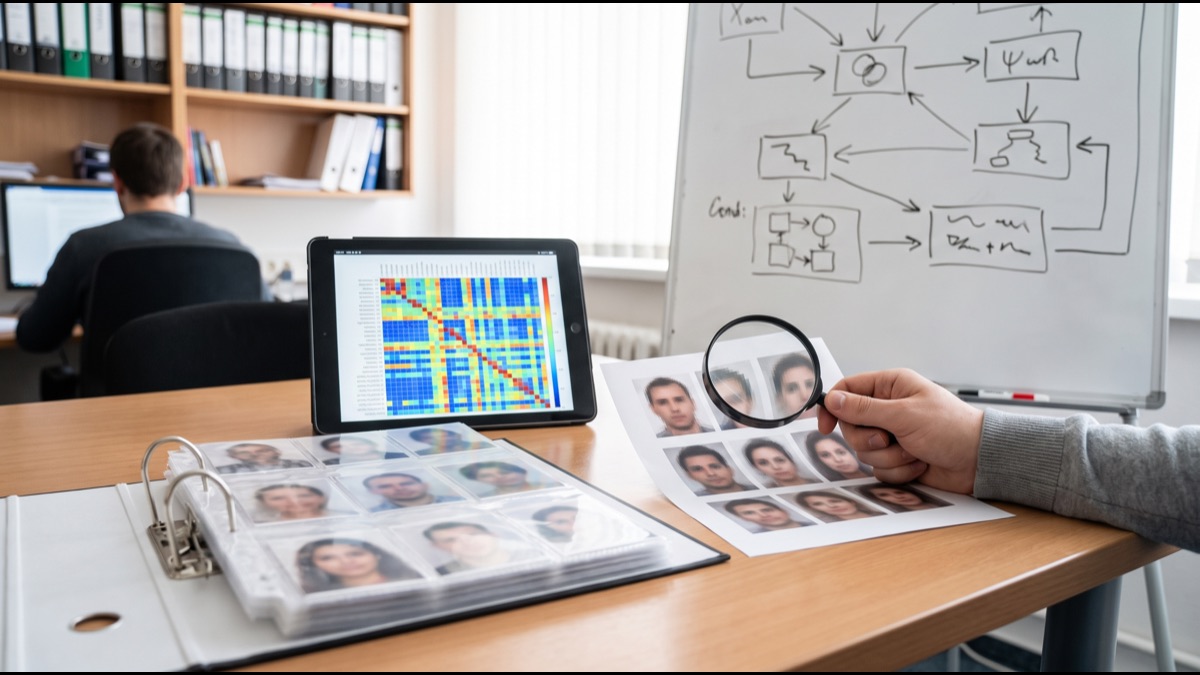
Facial recognition software promises a simple, objective task: compare a face against a database and report a match. Yet a growing body of research, most notably testing by the U.S. National Institute of Standards and Technology (NIST), has repeatedly found that many of these systems perform meaningfully worse on some groups of people than others, particularly people with darker skin, women, and older or younger faces compared to middle-aged men. This is not a single bug that a software patch can quietly fix; it is the predictable output of how these systems are built, trained, and tested, and understanding the actual mechanics behind that gap explains both why it happened and why closing it has proven harder than simply adding more training photos.
What 'Bias' Means in a Facial Recognition System
In a facial recognition context, 'bias' typically refers to a measurable difference in error rates — how often the system incorrectly matches or fails to match a face — across demographic groups defined by factors like skin tone, gender, or age, rather than a difference in the underlying code for different people.
This distinction matters because it shifts the explanation away from the algorithm having explicit rules that treat groups differently, toward a more subtle and, in some ways, harder problem: a single set of mathematical rules that was learned from data which did not represent all groups equally well.
Researchers generally measure this bias using standardized error metrics, comparing false match rates and false non-match rates across demographic categories on large, controlled test sets, which is how differences that might be invisible in casual use become quantifiable and comparable across systems.
How Facial Recognition Models Are Actually Trained
Modern facial recognition systems are built using deep learning, where a neural network is shown millions of labeled face images during training and gradually adjusts internal parameters to get better at distinguishing one face from another based on patterns it identifies in that training data.
The system never receives explicit instructions about race, gender, or age; it only learns statistical patterns from whatever images it is shown, which means the final model's behavior is shaped entirely by the composition of that training dataset, not by any deliberate design choice about how to treat different groups.
This training process is why facial recognition bias is often described as a data problem as much as an algorithm problem — the same neural network architecture can produce very different accuracy patterns across demographics depending entirely on what images it learned from.
Training Data Imbalance: The Root Cause Researchers Keep Finding
Multiple studies, including foundational work by researchers Joy Buolamwini and Timnit Gebru, found that widely used facial recognition training datasets were disproportionately composed of images of lighter-skinned individuals, particularly lighter-skinned men, relative to their share of the general population.
When a dataset contains far more examples of one type of face than another, the resulting model becomes statistically better at recognizing patterns common in the overrepresented group simply because it had more opportunities to learn from those examples during training.
This imbalance was not typically the result of a deliberate choice to exclude certain groups; it more commonly reflected which images were easiest to source at scale, often from existing photo databases, stock imagery, or public figures, which themselves were not demographically representative.
The Gender Shades Study That Made the Issue Impossible to Ignore
The 2018 'Gender Shades' study by Buolamwini and Gebru tested commercial facial analysis systems from major technology companies and found error rates for classifying darker-skinned women were dramatically higher, in some systems exceeding 30%, compared to error rates below 1% for lighter-skinned men.
This study was influential specifically because it used a carefully constructed, balanced test set across skin tone and gender categories, allowing a rigorous, reproducible comparison rather than anecdotal reports, which made the disparity difficult for the companies involved to dismiss.
Following the study's publication, several of the companies tested publicly committed to auditing and retraining their systems, and the research is widely credited with catalyzing much broader industry and academic attention to algorithmic bias in computer vision more generally.
NIST's Large-Scale Testing of Commercial Algorithms
NIST has conducted some of the largest independent evaluations of commercial and research facial recognition algorithms through its Face Recognition Vendor Test (FRVT) program, testing algorithms submitted voluntarily by dozens of developers against massive standardized datasets.
A 2019 NIST report found that the majority of algorithms tested showed higher false positive rates for Asian, African American, and Native American faces compared to Caucasian faces, though the size of that gap varied enormously between different algorithms and vendors.
Importantly, NIST's testing also found that some algorithms showed very little demographic disparity at all, demonstrating that the bias is not an unavoidable property of facial recognition technology broadly, but rather a reflection of specific design and training choices made by individual developers.
Why Darker Skin Tones Have Historically Shown Higher Error Rates
Several technical factors compound to make accurate recognition of darker skin tones harder for some systems: camera sensors and lighting setups historically optimized for lighter skin can capture less facial detail and contrast on darker skin, giving the algorithm a lower-quality input to work with before any processing even begins.
This is a well-documented issue in photography more broadly, not unique to facial recognition, and it means that even a perfectly trained algorithm can underperform on darker-skinned faces if the images it receives during real-world deployment are systematically lower quality due to hardware and lighting limitations.
Combined with training data that underrepresented darker-skinned faces, this created a compounding effect in many early systems: both the input image quality and the learned recognition patterns were weaker for this group, producing the large error-rate gaps documented in studies like Gender Shades.
Camera Hardware and Lighting Compound the Problem
Camera hardware, particularly in lower-cost or older devices, and inconsistent or poor lighting conditions during image capture, introduce additional variability that disproportionately affects certain skin tones, since the physics of light reflection differs meaningfully between lighter and darker skin.
Deployment environments matter enormously here: a facial recognition system tested in controlled laboratory lighting can perform very differently than the same system deployed in a poorly lit retail store, an outdoor security camera at night, or a body camera in variable field conditions.
This is one reason researchers increasingly emphasize testing facial recognition systems under realistic, varied deployment conditions rather than only under the more favorable lighting and camera setups often used during initial development and marketing demonstrations.
False Positives vs. False Negatives: Why the Distinction Matters
A 'false positive' occurs when a system incorrectly matches a person's face to someone else's identity, while a 'false negative' occurs when it fails to recognize a legitimate match, and these two error types carry very different real-world consequences depending on the application.
In law enforcement contexts, a false positive can lead to a wrongful accusation or arrest, making disparities in false positive rates across demographic groups a particularly serious civil rights concern, since it means innocent people from certain groups face a higher risk of being wrongly implicated.
In contrast, a false negative in something like phone unlock security is mostly an inconvenience, illustrating why demographic bias in facial recognition cannot be evaluated with a single overall accuracy number — the type of error and the context it occurs in both matter enormously.
Age and Gender Bias Beyond Skin Tone
NIST and academic research have also documented measurable accuracy differences by age and gender independent of skin tone, generally finding higher error rates for women than men across most tested algorithms, and higher error rates for children and elderly individuals compared to adults in the prime working-age range.
Researchers attribute some of this to similar training data imbalances — datasets historically skewed toward adult faces, often sourced from workplace or government identification photos that underrepresented children and very elderly individuals — as well as genuine physiological differences in how faces change with age.
This means facial recognition bias is better understood as multiple overlapping demographic gaps rather than a single skin-tone-only issue, which is part of why comprehensive testing frameworks like NIST's evaluate performance across many intersecting categories rather than one variable at a time.
Real-World Consequences: Wrongful Arrests Tied to Facial Recognition
Documented cases of wrongful arrests connected to facial recognition misidentification in the United States, reported by organizations including the American Civil Liberties Union (ACLU), have disproportionately involved Black men, consistent with the demographic error-rate patterns identified in NIST and academic testing.
These cases typically involved facial recognition generating an initial investigative lead that was then treated with more confidence by investigators than the underlying technology's accuracy actually warranted, highlighting that bias in the algorithm is only part of the risk — how the output is used by human decision-makers matters just as much.
These real-world incidents have been central to public debate and several city and state-level restrictions on law enforcement use of facial recognition, since they demonstrate that statistical error-rate gaps translate into concrete, unequal harms rather than remaining a purely abstract technical concern.
How Algorithm Accuracy Has Changed Since Early Studies
Overall facial recognition accuracy has improved substantially since the systems tested in the original 2018 Gender Shades study, with NIST's ongoing FRVT testing showing significant reductions in error rates across most demographic groups for algorithms submitted in more recent years.
Much of this improvement is attributed to larger and more demographically diverse training datasets, architectural improvements in the underlying neural network designs, and increased industry attention to bias testing as a standard part of development following the public scrutiny that followed studies like Gender Shades.
NIST's testing methodology has also evolved to more systematically report demographic breakdowns, which itself has created pressure on vendors to address disparities that might previously have gone unmeasured or unreported in a simple overall accuracy figure.
Why Improved Averages Don't Eliminate Demographic Gaps
Even as overall accuracy has improved, relative gaps between demographic groups have not disappeared, and in some cases a system can achieve high average accuracy while still showing a meaningfully higher error rate for a specific subgroup, since averages can mask disparities that only appear when results are broken down by category.
This is a persistent finding across NIST's testing rounds: the best-performing algorithms overall are not automatically the ones with the smallest demographic gaps, meaning developers have to specifically test for and address disparity as its own metric rather than assuming general accuracy improvements will automatically resolve it.
Researchers describe this as an important reason demographic breakdown testing needs to remain a standard, ongoing part of facial recognition evaluation rather than a one-time audit, since new model versions can inadvertently reintroduce or shift where disparities occur even while improving overall numbers.
Efforts to Diversify Training Datasets
In response to documented bias, several major technology companies and research groups have invested in building or sourcing more demographically balanced training datasets, sometimes specifically recruiting volunteers across a wider range of skin tones, ages, and genders to correct historical imbalances.
Projects like IBM's Diversity in Faces dataset and various academic efforts have attempted to create publicly available benchmark datasets specifically designed with demographic balance in mind, giving researchers a shared, more representative resource to train and test against.
This approach has measurably helped close some accuracy gaps, though researchers caution that dataset diversity alone does not automatically eliminate bias, since factors like camera hardware limitations and how a model's internal architecture weighs different features can still introduce disparities even with balanced training data.
Policy and Regulatory Responses to Documented Bias
Documented bias findings have directly influenced policy: several U.S. cities, including San Francisco and Boston, passed bans or significant restrictions on municipal and law enforcement use of facial recognition technology, citing accuracy disparities and civil rights concerns among their stated reasons.
The European Union's AI Act includes specific provisions restricting certain uses of facial recognition, particularly real-time biometric identification in public spaces by law enforcement, reflecting similar concerns about accuracy, bias, and civil liberties raised by researchers and advocacy groups.
These policy responses illustrate how technical research findings about algorithmic bias have moved beyond academic papers into concrete legal and regulatory frameworks, treating documented demographic accuracy gaps as a legitimate basis for restricting how and where the technology can be deployed.
How Independent Testing and Audits Currently Work
NIST's FRVT program remains the most comprehensive ongoing independent testing framework, regularly publishing updated results as vendors submit new algorithm versions, providing a continuously updated public record of demographic performance differences across the industry.
Independent academic researchers, journalists, and civil society organizations also conduct their own audits, sometimes testing deployed systems under real-world conditions rather than the controlled datasets used in formal benchmarks, which can reveal additional disparities not captured by standardized lab testing.
This layered ecosystem of testing — government standards bodies, academic researchers, and independent watchdog organizations — has become an important check on vendor claims, since companies developing facial recognition technology have a commercial incentive to report favorable accuracy figures.
What Responsible Deployment Looks Like Today
Responsible deployment guidance increasingly emphasizes using facial recognition as one input among several rather than the sole basis for consequential decisions like arrests, combined with mandatory human review and disclosure of the specific algorithm's tested demographic accuracy for the relevant use case.
Some jurisdictions now require agencies to use only algorithms that have undergone independent bias testing, such as NIST evaluation, and to publicly report demographic accuracy statistics before deploying facial recognition for law enforcement or public benefit determinations.
Researchers generally agree that facial recognition bias can be substantially reduced through better data, ongoing testing, and careful deployment practices, but caution that it cannot be assumed away, making continued independent measurement, not a one-time technical fix, the realistic path to closing the remaining gaps.
Facial recognition bias happens primarily because these systems learn statistical patterns from training data that, particularly in early systems, underrepresented darker-skinned faces, women, and non-adult age groups, compounded by camera hardware and lighting factors that further disadvantage some skin tones in real-world capture conditions. Landmark research like the Gender Shades study and NIST's ongoing FRVT testing turned what individual users sometimes suspected into rigorously documented, quantifiable disparities, which in turn drove real improvements in training data diversity and algorithm design. Those improvements have narrowed many gaps, but independent testing consistently shows they have not eliminated them, which is why researchers, regulators, and increasingly the companies themselves treat ongoing demographic accuracy testing as a permanent requirement rather than a problem that can be solved once and forgotten.
Sources
- NIST Face Recognition Vendor Test (FRVT) — Ongoing independent federal testing of commercial and research facial recognition algorithm accuracy, including demographic breakdowns.
- Gender Shades Project — Research by Joy Buolamwini and Timnit Gebru documenting demographic accuracy disparities in commercial facial analysis systems.
- American Civil Liberties Union (ACLU) — Civil rights organization tracking facial recognition misidentification cases and related policy.
- Algorithmic Justice League — Research and advocacy organization focused on bias in facial recognition and related AI systems.
FAQ
Is facial recognition bias intentional?
No, it is not typically a deliberate design choice. It results from neural networks learning statistical patterns from training datasets that, particularly in early systems, underrepresented certain demographic groups, producing uneven accuracy without any explicit rule treating groups differently.
Which groups have shown the highest error rates in facial recognition testing?
NIST and academic research, including the Gender Shades study, have found darker-skinned individuals, women, and particularly darker-skinned women showed disproportionately higher error rates in many tested systems, along with children and elderly individuals compared to adults.
Has facial recognition bias gotten better over time?
Yes, overall accuracy and average demographic gaps have improved significantly since 2018, largely due to more diverse training data and algorithm improvements, but NIST testing shows disparities between the best and weakest-performing groups have not been eliminated.
Can better training data alone fix facial recognition bias?
It helps significantly but is not a complete fix on its own. Camera hardware, lighting conditions, and how a model's architecture weighs different facial features can still introduce disparities even with a demographically balanced training dataset.
Why does false positive vs. false negative matter for bias discussions?
A false positive in law enforcement contexts can lead to wrongful accusation or arrest, making disparities in that specific error type a serious civil rights concern, while a false negative, like a failed phone unlock, is typically just an inconvenience.
About the Author
We reference NIST's Face Recognition Vendor Test program, the Gender Shades research project, the American Civil Liberties Union, and the Algorithmic Justice League to explain the background and current understanding of this topic.
Loved This Article?
Share it on WhatsApp → Share it on WhatsApp
Get more guides in your inbox — Subscribe to our newsletter for weekly surprising stories from Egypt, Saudi Arabia, Dubai, and beyond.