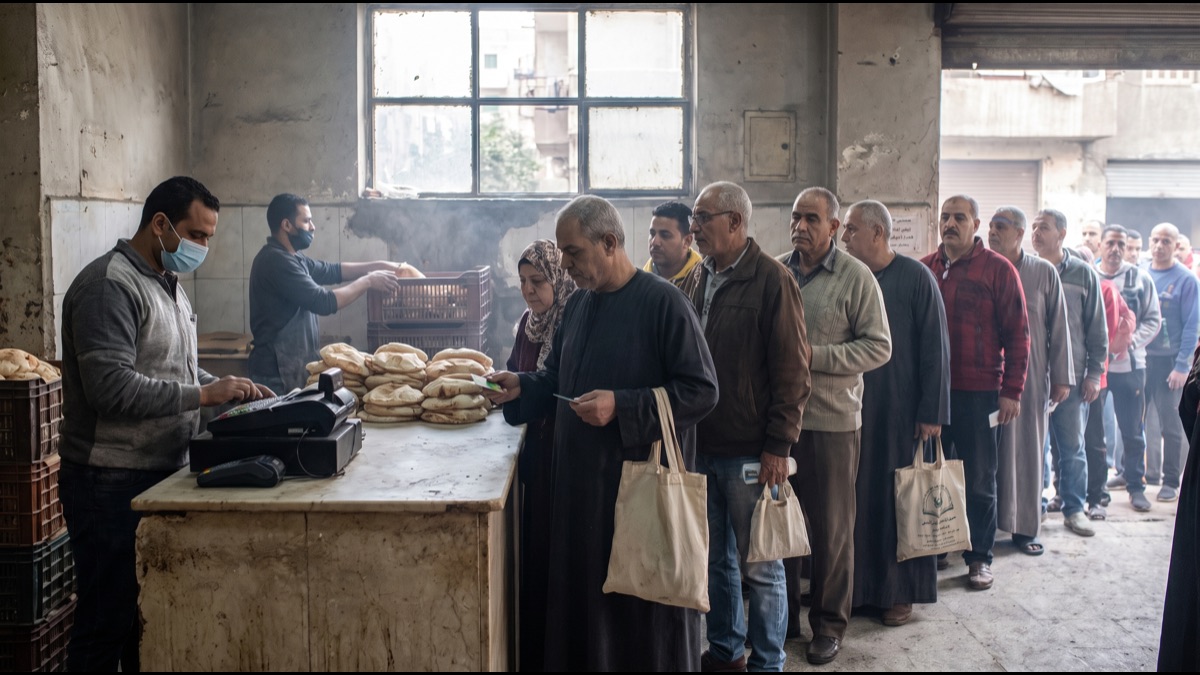
Walk into almost any neighborhood bakery in Cairo and you can still buy a stack of flat baladi bread for a fraction of what it costs to bake it. That single fact — heavily subsidized bread sold for a nominal price to tens of millions of people every single day — sits at the heart of one of the largest and most politically sensitive social protection systems in the Middle East. Egypt's subsidy system extends far beyond bread, into fuel, electricity, and increasingly targeted cash transfers, and understanding how it actually works means understanding a decades-long balancing act between fiscal sustainability and social stability.
A System Woven Into Daily Life
Egypt's subsidy system did not emerge from a single policy decision; it evolved gradually from the mid-20th century onward, as successive governments used price controls and direct subsidies on staple goods as a core tool of social policy. For many Egyptian households, particularly lower- and middle-income families, subsidized bread, cooking gas, and fuel are not abstract line items in a national budget but a daily, tangible part of household expenses.
Because the system touches so many people so directly, any change to it — even a modest one — tends to generate outsized public attention, which helps explain why reform has generally proceeded gradually rather than through abrupt, sweeping changes.
The Bread Subsidy at the Center of It All
Subsidized baladi bread is widely considered the most politically sensitive element of Egypt's entire subsidy structure. The government, through the Ministry of Supply and Internal Trade, procures wheat, supports bakeries producing the subsidized loaf, and sells it to ration-card holders at a price that has remained largely unchanged in nominal terms for years even as production costs have risen substantially.
Egypt is one of the world's largest wheat importers, according to the U.S. Department of Agriculture's foreign agricultural service data, which means the bread subsidy's real cost is directly exposed to global wheat prices and to the value of the Egyptian pound, both of which have moved sharply in recent years.
How the Ration Card (Tamween) System Works
Access to subsidized goods runs through Egypt's ration card system, commonly known as Tamween, which registers eligible households and tracks their monthly allocations of subsidized bread, cooking oil, sugar, rice, and other staples through a smart-card mechanism tied to the Ministry of Supply and Internal Trade's database.
Each registered household is allotted a set number of subsidized loaves per cardholder per day, along with monthly quotas of other goods purchased at reduced prices from designated outlets, and the system has gradually shifted from paper coupons to electronic smart cards to reduce fraud and improve monitoring of who is actually drawing on subsidized supplies.
Who Qualifies for Subsidized Goods
Eligibility for ration cards has historically been broad, covering a large share of the population rather than being narrowly means-tested, though the government has progressively introduced income and asset criteria intended to exclude higher-income households from qualifying for new or renewed cards. Applicants generally need to demonstrate residency, provide national ID details, and, in more recent reforms, disclose information about vehicle ownership, property, or other indicators of wealth that can disqualify a household.
This shift toward at least partial means-testing reflects a broader policy direction: moving Egypt's subsidy system away from broad, universal-style coverage and toward a system that concentrates support more heavily on lower-income households, even though full means-testing across a population of over 100 million remains logistically difficult.
The 1977 Bread Riots and Why They Still Matter
No discussion of Egyptian subsidy policy is complete without reference to the January 1977 bread riots, when an attempt to reduce subsidies on bread and other basic goods under President Anwar Sadat triggered widespread protests across major cities, forcing the government to reverse the price increases within days. The episode has become a foundational reference point in Egyptian policymaking, frequently cited by economists and journalists whenever subsidy reform is discussed.
That history helps explain why, even decades later, Egyptian governments have generally approached subsidy reform through gradual, phased adjustments and compensating measures like cash transfers, rather than abrupt price shocks on the most visible staple goods.
Fuel Subsidies and Their Slow Phase-Out
Alongside food subsidies, Egypt has historically maintained substantial subsidies on petroleum products, including gasoline, diesel, and butane gas cylinders used for household cooking. Beginning around 2014, successive governments implemented a series of scheduled fuel price increases intended to gradually bring domestic fuel prices closer to international market levels, reducing the fiscal burden these subsidies placed on the state budget.
The pace and structure of these fuel price adjustments have often been coordinated with broader macroeconomic reform programs, including commitments made to international lenders, and officials have periodically announced multi-year timelines for further reductions, though actual implementation has sometimes been delayed or adjusted in response to inflation concerns or global energy price swings.
Electricity Subsidy Reform
Electricity subsidies followed a broadly similar trajectory to fuel: the government introduced a tiered pricing structure in which residential electricity consumption is billed at progressively higher rates as usage increases, with lower-consumption households — generally assumed to be lower-income — paying rates that remain more heavily subsidized than higher-consumption tiers.
Egypt's Electricity Regulatory Authority has periodically announced adjustments to these tariff bands as part of a broader push to reduce the state's electricity subsidy bill, a process that officials have said is intended to eventually bring tariffs closer to the actual cost of generation and distribution, though full cost recovery has been repeatedly delayed relative to original announced timelines.
Cash Transfers: Takaful and Karama
As Egypt has gradually reduced broad-based subsidies, it has simultaneously expanded targeted cash transfer programs intended to cushion the impact on the poorest households. The two flagship programs, Takaful and Karama, run by the Ministry of Social Solidarity, provide conditional and unconditional cash payments respectively — Takaful generally targeting poor families with children, conditioned on school attendance and health checkups, and Karama targeting elderly people and people with disabilities who are unable to work.
The World Bank, which has supported the programs' design and expansion, has described Takaful and Karama as central pillars of Egypt's effort to build a more targeted social safety net, replacing some of the role previously played by universal subsidies with transfers directed more precisely at the households considered most vulnerable.
The Fiscal Cost of Subsidizing a Nation
Subsidies of this scale carry a substantial fiscal cost, and Egyptian government budget documents have repeatedly identified subsidies — particularly on fuel and food — as among the largest categories of state spending after debt servicing and public sector wages. Because subsidy costs move with global commodity prices and exchange rates, a period of high global wheat or oil prices, combined with a weaker pound, can sharply increase the subsidy bill even without any change in domestic policy.
This volatility is one of the core reasons successive Egyptian governments and international financial institutions have pushed for subsidy reform: broad, price-linked subsidies make government budgeting less predictable and can crowd out spending on infrastructure, health, and education when global prices spike.
IMF Involvement and Reform Pressure
The International Monetary Fund has been closely involved in Egypt's subsidy reform trajectory through several loan programs, including agreements reached in 2016 and again in subsequent years, which have generally included commitments to reduce energy subsidies and strengthen social safety nets as part of broader fiscal consolidation targets. IMF program reviews routinely reference subsidy reform progress as a condition tied to disbursement of loan tranches.
Critics of IMF-linked reform programs argue that subsidy cuts, even when paired with cash transfer expansion, can strain lower-income households during transition periods, particularly when reforms coincide with currency devaluation and inflation, while the IMF and Egyptian officials have generally argued that maintaining unsustainable universal subsidies poses a greater long-term risk to fiscal stability and, by extension, to the population the subsidies are meant to protect.
Targeting Problems and Leakage
A persistent challenge across Egypt's subsidy system is leakage — subsidized goods reaching households that do not need the support, or being diverted for resale on informal markets rather than reaching intended recipients. Because bread and fuel subsidies have historically been priced rather than means-tested at the point of sale, higher-income households have often been able to access the same subsidized goods as lower-income households simply by shopping at the same outlets.
Egypt's Central Agency for Public Mobilization and Statistics and various World Bank assessments have periodically highlighted this targeting inefficiency as one of the strongest arguments for shifting toward more precisely targeted cash transfers, which can, at least in principle, be conditioned on verified income and asset data rather than relying on universal price subsidies that are difficult to restrict to those who need them most.
The Digital Ration Card and Smart Cards
Digitization has become a central tool in Egypt's effort to make its subsidy system more efficient and harder to defraud. The rollout of electronic smart ration cards, linked to national ID records and biometric data in some cases, has allowed the Ministry of Supply and Internal Trade to track individual purchases in near real time, flag unusual consumption patterns, and gradually close loopholes that previously allowed subsidized goods to be resold on secondary markets.
This digital infrastructure has also made it administratively easier to introduce means-testing criteria and to cross-reference ration card eligibility against other government databases, a capability that would have been far harder to implement under the older, largely paper-based coupon system.
Currency Devaluation and Subsidy Pressure
Egypt's several rounds of currency devaluation, including major moves in 2016 and again in 2022 and 2024, have repeatedly complicated subsidy management, because a weaker pound immediately raises the local-currency cost of imported wheat, fuel, and other subsidized inputs even when global dollar prices remain stable. Each devaluation has generally been followed by a period of accelerated inflation, disproportionately affecting lower-income households that spend a larger share of their income on food and fuel.
These currency shocks have repeatedly forced Egyptian authorities to expand cash transfer programs or introduce temporary compensation measures alongside devaluation, illustrating how tightly subsidy policy and exchange rate policy are linked in practice, even though they are formally separate areas of economic management.
Why Cutting Subsidies Is Politically Risky
Beyond the 1977 precedent, subsidy reform in Egypt carries ongoing political risk because bread, fuel, and electricity prices are among the most visible, immediately felt indicators of economic conditions for ordinary households. Even relatively modest, well-telegraphed price adjustments can generate significant public frustration, particularly when they coincide with broader inflationary pressure from currency devaluation or global commodity price increases.
Egyptian officials have generally sought to manage this risk by pairing subsidy adjustments with public communication campaigns, phased timelines, and expanded cash transfer coverage, an approach that reflects lessons drawn from earlier periods when reforms were perceived as sudden or poorly explained.
How Egypt's System Compares Internationally
Egypt's reliance on subsidies is significant even by regional standards; the IMF and World Bank have both noted that food and energy subsidies have historically represented a larger share of Egyptian government spending than in many comparable middle-income economies. Other countries in the region, including several Gulf states, have also maintained substantial energy subsidies, though their fiscal capacity to absorb the cost differs considerably given oil and gas export revenues that Egypt, as a net energy importer for much of this period, does not have at the same scale.
Countries that have pursued similar subsidy-to-cash-transfer transitions, such as Indonesia's long-running fuel subsidy reforms, are sometimes cited by economists as partial models, though most analysts caution that Egypt's scale, population size, and political history make direct comparisons imperfect.
Where the System Is Headed
Egypt's subsidy system is likely to keep evolving rather than disappearing outright; officials have repeatedly signaled continued gradual adjustment of fuel and electricity prices toward cost-recovery levels, alongside continued expansion and refinement of Takaful and Karama as the primary vehicle for protecting the most vulnerable households. The bread subsidy, given its outsized political symbolism, has generally been treated more cautiously than other subsidy categories.
For ordinary Egyptian households, the practical reality is that the system will likely keep shifting from broad, price-based support toward more targeted, means-tested assistance over the coming years, a transition that international lenders continue to encourage and that domestic politics continues to shape in its pace and sequencing.
The Practical Impact on Everyday Household Budgets
For an average lower-income Egyptian household, the practical effect of this decades-long reform process has been a gradual but noticeable shift in how much of the family budget goes toward food and energy even with subsidies still in place, since subsidized prices have risen periodically even as they remain well below market levels. Economists studying household consumption patterns in Egypt have generally found that food and fuel still represent a disproportionately large share of spending for the poorest households, which is part of why cash transfer expansion has been treated as a necessary complement to subsidy reform rather than an optional add-on.
At the same time, many Egyptian families have adapted their consumption habits around the rhythms of the subsidy system itself — timing purchases around ration card cycles, relying on subsidized bread as a dietary staple, and budgeting fuel costs around scheduled price adjustment announcements — a pattern of behavior that illustrates just how deeply embedded these subsidies remain in ordinary economic life, regardless of the reforms unfolding around them.
Sources
- International Monetary Fund — Publishes program reviews and analysis of Egypt's subsidy and fiscal reform trajectory.
- World Bank — Assesses Egypt's social protection programs, including Takaful and Karama, and subsidy targeting efficiency.
- Central Agency for Public Mobilization and Statistics (CAPMAS) — Egypt's official statistics body, publishing household expenditure and poverty data.
- World Food Programme — Analyzes food security and subsidy-linked nutrition outcomes in Egypt.
FAQ
What is Egypt's ration card (Tamween) system?
Tamween is Egypt's ration card system, administered by the Ministry of Supply and Internal Trade, which registers eligible households and allocates subsidized bread, cooking oil, sugar, rice, and other staples through electronic smart cards.
Who is eligible for subsidized bread and goods in Egypt?
Eligibility has historically been broad, but Egypt has progressively introduced income and asset criteria, such as vehicle or property ownership, to exclude higher-income households from qualifying for or renewing ration cards.
What are Takaful and Karama?
Takaful and Karama are Egypt's flagship cash transfer programs run by the Ministry of Social Solidarity, with Takaful providing conditional payments to poor families with children and Karama providing unconditional payments to elderly and disabled people.
Why has Egypt been reducing fuel and electricity subsidies?
Egypt has gradually reduced fuel and electricity subsidies since around 2014 to lower the fiscal burden on the state budget, often as part of reform commitments made alongside International Monetary Fund loan programs.
Why is subsidy reform politically sensitive in Egypt?
Subsidy reform is politically sensitive largely because of the legacy of the 1977 bread riots, when subsidy cuts triggered nationwide unrest, which is why governments since have generally favored gradual, phased adjustments over sudden price shocks.
About the Author
We reference the International Monetary Fund, the World Bank, Egypt's Central Agency for Public Mobilization and Statistics, and the World Food Programme to explain the background and current understanding of this topic.
Loved This Article?
Share it on WhatsApp → Share it on WhatsApp
Get more guides in your inbox — Subscribe to our newsletter for weekly surprising stories from Egypt, Saudi Arabia, Dubai, and beyond.