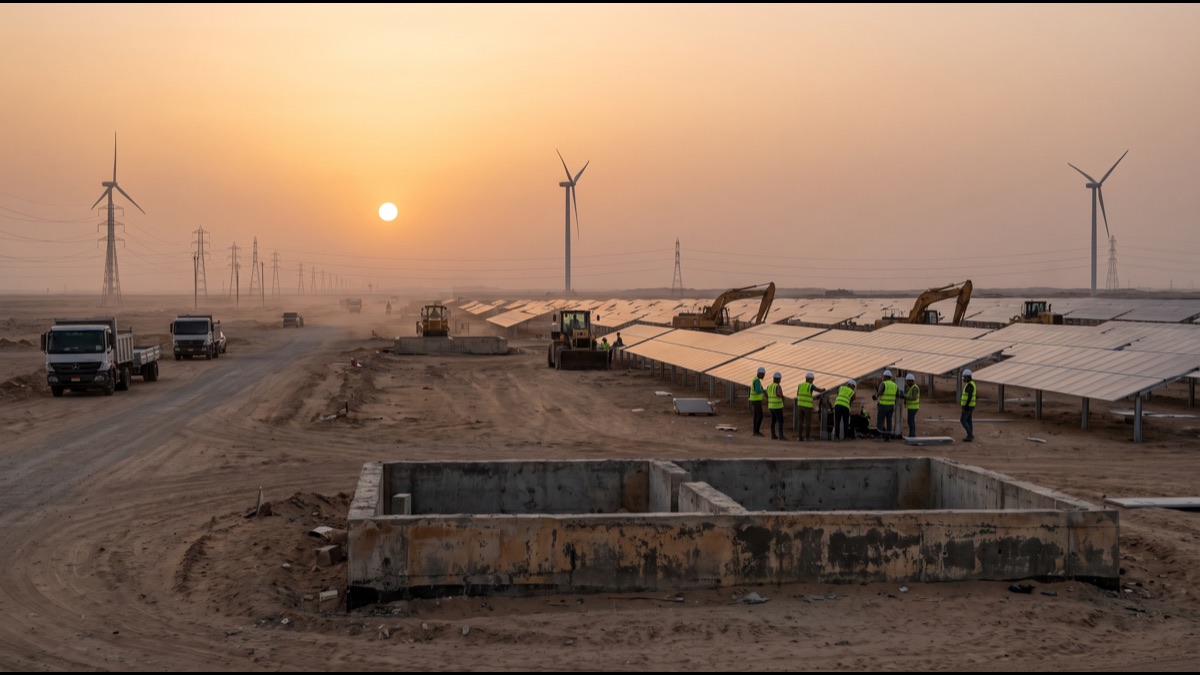
Egypt has spent the past decade trying to convert one of its most abundant natural resources, sun and wind, into a real share of its electricity mix, and the results are a genuinely mixed picture of large completed projects, ambitious signed deals that have yet to produce power, and official targets the country is still working to catch up to. Understanding how that push is actually progressing means separating what is physically built and generating electricity today, like the Benban solar complex and the Gulf of Suez wind farms, from what remains a memorandum of understanding or an early construction site, particularly across Egypt's much-publicized green hydrogen ambitions. The gap between announcement and operation is where most of the real story sits.
Why Egypt Bet on Renewable Energy in the First Place
Egypt entered the 2010s facing a domestic energy squeeze, with a growing population, rising electricity demand, and a natural gas sector that was, for a period, struggling to keep pace, contributing to rolling blackouts that became a visible political liability for the government.
Renewable energy offered a way to diversify the generation mix using resources Egypt has in genuine abundance, since the country's southern and western desert regions receive some of the most consistent, intense solar irradiation anywhere on Earth, and its Gulf of Suez corridor sits among the world's strongest sustained wind zones.
Beyond domestic supply security, officials have consistently framed renewables as an export and foreign investment opportunity as well, positioning Egypt as a potential regional electricity and green fuel exporter to Europe given its geographic position and existing interconnection infrastructure.
Inside the Benban Solar Park, One of the World's Largest
Located in Aswan governorate in Upper Egypt, the Benban solar complex is a roughly 1.6 gigawatt cluster of more than 30 individual solar photovoltaic plants built by different private developers on a shared government-allocated site, making it one of the largest single solar installations anywhere in the world by combined capacity.
Rather than a single utility building one plant, Benban's structure allowed dozens of separate international and domestic developers to build and operate individual facilities under standardized power purchase agreements with the Egyptian government, a model designed to attract private capital quickly by spreading risk across many smaller projects rather than one giant one.
Construction proceeded rapidly through the mid-to-late 2010s, with the bulk of Benban's capacity connected to the grid by 2019, making it one of the fastest large-scale solar build-outs completed on the African continent at the time.
How Benban Was Actually Financed and Built
Benban's financing model relied heavily on international development finance institutions, including the World Bank Group's International Finance Corporation and the European Bank for Reconstruction and Development, which provided both direct lending and risk guarantees that made the project bankable for private developers operating in what many considered, at the time, an unproven Egyptian solar market.
Egypt's Feed-in Tariff program, later supplemented by competitive auction rounds, set the pricing framework that gave developers the revenue certainty needed to secure financing, an approach widely credited with accelerating Benban's construction timeline compared to a purely government-procurement model.
The project also became something of a proving ground for Egypt's broader renewable energy regulatory framework, with lessons from Benban's land allocation, grid connection, and currency-risk arrangements informing how subsequent Egyptian renewable projects were structured.
The Gulf of Suez Wind Corridor and Egypt's Growing Wind Fleet
The Gulf of Suez region has long been recognized by wind resource assessors as one of the most consistently windy corridors on the planet, a natural funnel effect between the Sinai mountains and the Eastern Desert that produces wind speeds and consistency rare even among strong global wind sites.
Egypt has built a growing cluster of wind farms along this corridor over more than two decades, with government-owned projects developed alongside international private developers, and total installed wind capacity expanding steadily even as newer projects have moved further along the Red Sea coast to capture additional sites.
Wind's high and consistent capacity factor in this corridor, meaning turbines here generate closer to their theoretical maximum output more of the time than in many other wind regions worldwide, has made the Gulf of Suez one of the more commercially attractive renewable investment locations in Egypt's broader energy strategy.
Official Targets Versus Egypt's Actual Renewable Share
Egypt's official Integrated Sustainable Energy Strategy has set ambitious targets for renewables to reach a substantial share of total electricity generation over the coming years, a target repeatedly reaffirmed by government officials even as the country's actual generation mix has lagged behind the pace originally envisioned.
In recent years, renewables including longstanding hydropower from the Aswan High Dam plus newer wind and solar capacity have supplied roughly one-fifth of Egypt's electricity generation, a meaningful and growing contribution but still well short of the government's own medium-term targets for the sector.
Officials have periodically revised target timelines rather than target percentages, a pattern common across countries pursuing ambitious energy transition goals but one that has drawn some domestic and international commentary questioning how quickly the remaining gap can realistically close.
Why Egypt's Grid Has Struggled to Absorb New Capacity
Egypt's national electricity grid, built primarily around large, centralized gas and hydro generation, has required substantial upgrades to handle the variable, distributed nature of solar and wind output, particularly transmission capacity between generation-rich regions like Aswan and Egypt's population and demand centers around Cairo and the Delta.
Grid connection delays have been cited by multiple renewable project developers as a bottleneck slowing the pace at which signed and even partially built projects actually begin delivering power, a common challenge in fast-growing renewable markets worldwide but one that has specifically affected several Egyptian project timelines.
Egypt has pursued grid modernization investment, including smart grid pilot programs and transmission expansion projects, explicitly framed by the Ministry of Electricity as necessary infrastructure to support the renewable capacity already built and still planned.
The Green Hydrogen Rush: What's Actually Signed Versus Built
Following the 2022 COP27 climate summit held in Sharm El-Sheikh, Egypt signed a wave of memoranda of understanding and framework agreements with international energy companies proposing large-scale green hydrogen and green ammonia production facilities, several with headline capacity figures in the multiple gigawatts.
The overwhelming majority of these announcements remain at the framework, feasibility study, or early construction stage rather than commercial production, a pattern consistent with the global green hydrogen sector broadly, where announced project capacity worldwide has vastly outpaced projects that have reached final investment decision and actual construction.
A smaller number of Egyptian green hydrogen and ammonia projects have progressed further, including facilities that reached financial close or began construction work in the Suez Canal Economic Zone, though even these remain earlier-stage relative to the scale of the original headline announcements.
Inside the Suez Canal Economic Zone Hydrogen Hub Plans
Egyptian officials have positioned the Suez Canal Economic Zone as the country's primary hub for green hydrogen and derivative fuel production, leveraging existing port infrastructure, proximity to the Suez Canal shipping route, and adjacent renewable energy resources in one geographic cluster.
The zone's pitch to international developers combines available industrial land, streamlined regulatory and customs arrangements under Egypt's economic zone framework, and direct access to export shipping lanes serving European and Asian energy markets, a combination intended to make Egypt cost-competitive against other emerging green hydrogen exporting regions.
Water availability for hydrogen electrolysis, which requires large volumes of purified water, has been addressed in project planning through dedicated desalination facilities built alongside the hydrogen production plants themselves, an additional infrastructure requirement not present in most conventional power generation projects.
Financing Challenges: Currency Risk and Power Purchase Agreements
Egypt's currency volatility over the past several years, including multiple significant devaluations of the Egyptian pound, has complicated financing for renewable projects that typically require long-term power purchase agreements denominated partly or fully in foreign currency to satisfy international lenders.
Developers and financiers have had to negotiate currency risk-sharing arrangements more extensively than in more currency-stable markets, and several announced projects have seen financing timelines extend as parties worked through these terms, an additional layer of complexity beyond the technical and grid-connection challenges renewable projects face everywhere.
Egypt's government has periodically introduced incentive packages, including land allocation terms and tax arrangements, specifically aimed at offsetting currency and macroeconomic risk perceptions among prospective renewable and hydrogen investors.
Egypt's Continued Reliance on Natural Gas
Despite the renewable push, natural gas remains Egypt's dominant electricity generation source by a wide margin, supported by the country's own offshore gas production, including the large Zohr field discovery, which transformed Egypt from a gas importer back into a net exporter for a period.
Government energy planning has generally framed gas and renewables as complementary rather than directly competing in the near term, with gas providing reliable baseload and peaking capacity while renewable capacity is built out and grid flexibility improves enough to handle a larger variable-generation share.
This gas-heavy baseline is one reason independent energy analysts have cautioned that Egypt's renewable transition, while real and accelerating, will likely unfold over a longer timeframe than the most optimistic project announcements alone might suggest.
Nuclear Power and Egypt's Broader Energy Diversification Strategy
Alongside renewables, Egypt has pursued the El Dabaa nuclear power plant on the Mediterranean coast, developed with Russian state nuclear company Rosatom, as a separate but parallel pillar of its energy diversification strategy intended to provide substantial reliable baseload capacity once operational.
Egyptian officials have generally presented nuclear and renewable capacity as complementary rather than competing priorities within the national energy strategy, arguing that a diversified generation mix reduces overall system risk compared to depending heavily on any single technology or fuel source.
El Dabaa's construction timeline, like many of Egypt's major energy infrastructure projects, has also faced delays relative to original targets, a pattern that mirrors some of the same financing and execution challenges affecting the renewable sector.
International Partnerships Driving the Renewable Push
Beyond development finance institutions, Egypt has attracted renewable and green hydrogen investment interest and signed agreements with companies and state entities from the Gulf, Europe, and Asia, reflecting both Egypt's resource advantages and its strategic geographic position between African, Middle Eastern, and European energy markets.
Gulf sovereign wealth funds and state utilities have been particularly active in Egyptian renewable and green fuel announcements in recent years, part of a broader pattern of Gulf capital diversifying into regional energy infrastructure beyond hydrocarbons.
These partnerships have brought not just capital but technical expertise and, in some cases, offtake commitments for green hydrogen derivatives, an important factor given that project financing for export-oriented green fuel facilities typically requires credible long-term buyers secured well before construction begins.
Jobs, Local Industry, and Manufacturing Ambitions
Egyptian officials have repeatedly emphasized job creation and local manufacturing development as goals attached to the renewable buildout, including efforts to attract solar panel and wind turbine component manufacturing investment rather than relying entirely on imported equipment.
Some local content requirements have been incorporated into renewable project tenders and incentive frameworks, intended to encourage developers to source a growing share of components and labor domestically as the sector matures, though the pace of building genuine domestic manufacturing capacity has, like project construction itself, generally moved more slowly than initial ambitions suggested.
Vocational and technical training programs tied to the renewable sector have expanded alongside project development, particularly around Aswan and the Suez Canal Economic Zone, aiming to build a domestic workforce pipeline for both construction and long-term operations roles.
Common Misconceptions About Egypt's Renewable Energy Progress
A common misconception is that Egypt's green hydrogen sector is already producing hydrogen at the scale of its announced multi-gigawatt deals; in reality, the large majority of those announcements remain in early planning, feasibility, or initial construction stages rather than commercial operation.
Another misconception assumes Benban represents the totality of Egypt's solar buildout; while it is the largest single complex, additional solar capacity has been developed and continues to be developed elsewhere in Egypt outside the Benban site.
A third misconception treats renewable energy and natural gas as an either-or competition in Egypt's current strategy; in practice, Egyptian energy planning has treated gas as the reliable backbone supporting a growing renewable share, rather than something renewables are expected to fully displace in the near term.
Egypt's renewable energy story is genuinely one of real, substantial progress, a working 1.6 gigawatt solar complex, an expanding wind corridor along the Gulf of Suez, and international financing relationships that have proven durable across a difficult macroeconomic period, sitting alongside a green hydrogen pipeline that remains far earlier in its lifecycle than the headline announcements suggest. Understanding the difference between what is built, what is under construction, and what is still a signed framework agreement is the clearest way to judge how far Egypt's energy transition has actually come, and how much distance still remains between its stated targets and its current generation mix.
Sources
- Egyptian Ministry of Electricity and Renewable Energy — Official generation data, strategy documents, and project updates.
- International Finance Corporation — Financing details for Benban and related Egyptian renewable projects.
- International Energy Agency — Egypt — Independent energy sector analysis and generation mix data.
- European Bank for Reconstruction and Development — Development finance and project details for Egyptian renewable investments.
- Suez Canal Economic Zone Authority — Green hydrogen hub planning and investment framework information.
FAQ
What is the Benban solar park?
Benban is a roughly 1.6 gigawatt solar photovoltaic complex in Aswan governorate, built as a cluster of dozens of separate privately developed plants on shared government-allocated land, and it is one of the largest solar installations in the world.
How much of Egypt's electricity currently comes from renewables?
Renewables, dominated by longstanding hydropower from the Aswan High Dam plus newer wind and solar capacity, have supplied roughly one-fifth of Egypt's electricity generation in recent years, still below the government's own stated targets for the sector.
Is Egypt's green hydrogen industry actually producing hydrogen yet?
As of the most recent public project updates, most of Egypt's announced green hydrogen and green ammonia megaprojects remain in memorandum-of-understanding or early construction stages rather than commercial production, with a handful of projects further along than others.
Why has Egypt struggled to meet its renewable energy targets?
Grid capacity constraints, currency and financing volatility that complicate long-term power purchase agreements, and competing near-term priorities around gas-fired capacity and subsidy reform have all slowed the pace at which announced renewable projects reach completion.
What role does wind power play in Egypt's energy mix?
The Gulf of Suez corridor has some of the strongest, most consistent wind resources in the world, and it hosts a growing cluster of wind farms that make wind the fastest-growing segment of Egypt's renewable capacity alongside solar.
About the Author
We reference the Egyptian Ministry of Electricity and Renewable Energy, the International Finance Corporation, the International Energy Agency, the European Bank for Reconstruction and Development, and the Suez Canal Economic Zone Authority to explain the background and current understanding of this topic.
Loved This Article?
Share it on WhatsApp → Share it on WhatsApp
Get more guides in your inbox — Subscribe to our newsletter for weekly surprising stories from Egypt, Saudi Arabia, Dubai, and beyond.