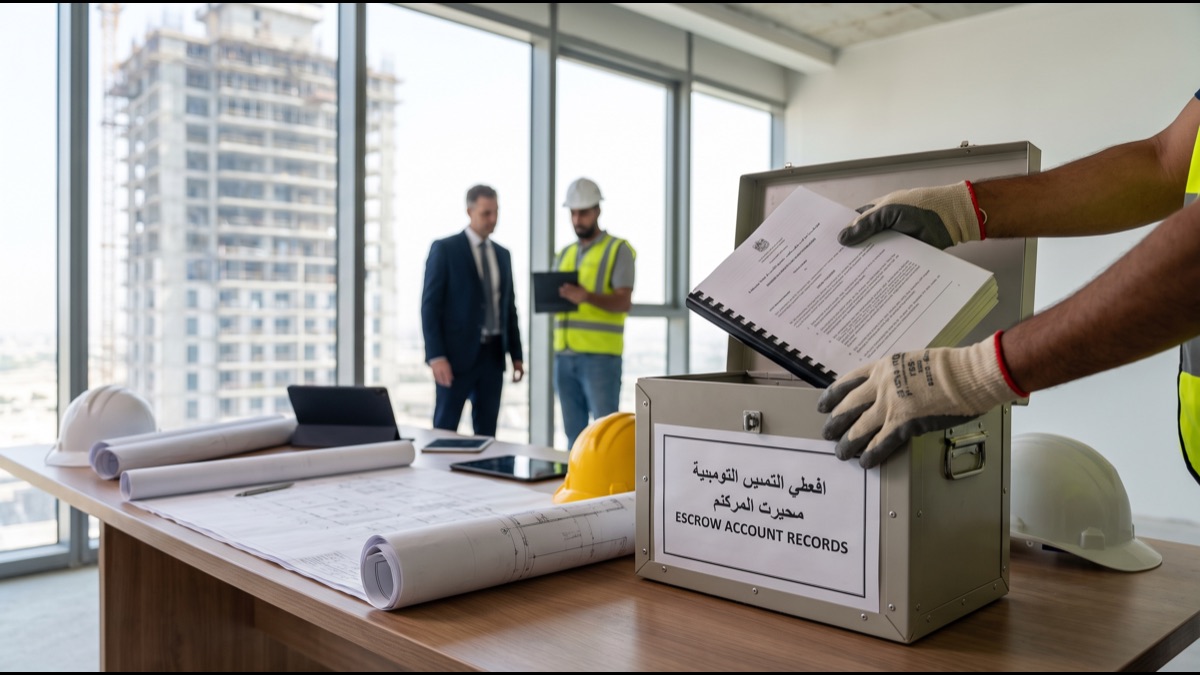
A buyer who pays a Dubai developer a deposit for an apartment that is still a hole in the ground is trusting that the money will still be there when the building is finished. That trust is not left to goodwill; it is enforced through a specific legal mechanism most buyers never look at closely until something goes wrong on a project.
Understanding how that mechanism works explains why some off-plan projects in Dubai proceed smoothly to handover while others stall for years, and why buyers who lose money on a stalled project are rarer here than the sheer number of paused developments elsewhere might suggest.
Why Off-Plan Buying Needed a Trust Mechanism
Selling a property that does not yet exist creates an obvious asymmetry: the buyer hands over real money on a defined schedule, while the developer delivers a physical asset only years later, if at all. Without a mechanism forcing that money to be used specifically for building the thing it was paid for, off-plan buying is an act of pure trust in the developer's solvency and intentions.
Dubai's real estate market went through a period, particularly following the 2008 global financial crisis, where a number of off-plan projects stalled after buyers had paid substantial sums, with funds not clearly ring-fenced for the specific project buyers had actually purchased into.
The regulatory response was to require that buyer payments for a specific off-plan project be deposited into a dedicated escrow account tied to that project alone, rather than pooled into a developer's general operating funds where they could be used for unrelated purposes, including other struggling projects.
This was not a minor procedural tweak but a fundamental restructuring of how off-plan sales legally function in the emirate, shifting the entire model from one where a developer's word and reputation were the buyer's main protection to one backed by an enforceable, independently monitored financial structure.
What an Escrow Account Actually Is Here
An escrow account in this context is a bank account registered with Dubai's Real Estate Regulatory Agency (RERA), opened specifically for one development project, into which every buyer payment for units in that project must be deposited directly rather than paid to the developer's own account.
The account is not controlled solely by the developer. It sits with a bank acting as an independent trustee, and releases from the account require verification against the project's actual construction progress rather than simply following the developer's instruction to transfer funds.
This structure converts a buyer's payment from an unsecured advance to a developer into money that is legally earmarked for construction of the specific building the buyer purchased into, monitored by a party with no financial incentive to release funds prematurely.
Why a Trustee Bank Holds the Money, Not the Developer
The trustee bank's role is deliberately narrow: it holds the funds and releases them only against documentation showing verified construction progress, rather than exercising any independent judgment about whether the project is a good idea or likely to succeed commercially.
This narrow mandate matters because it removes discretion from the party with the strongest incentive to access the funds quickly. A developer under financial pressure elsewhere in its business has no legal route to redirect escrowed funds toward that pressure, however urgent it may feel internally.
Banks that act as escrow trustees for Dubai real estate projects must themselves be registered for this specific role with the regulator, which places a layer of institutional accountability between buyer money and any single developer's internal financial decisions.
This trustee arrangement also creates a paper trail that regulators and, in disputed cases, courts can review independently of the developer's own accounting, since the bank's records of deposits and releases exist entirely outside the developer's internal books and cannot be altered unilaterally by the party under scrutiny.
How Milestone-Based Withdrawals Actually Work
Rather than releasing funds on a simple time schedule, the trustee structure ties withdrawals to certified construction completion percentages, verified by an engineering consultant appointed to assess progress against the approved project plan.
A developer seeking to withdraw funds for the next phase of construction must submit evidence that a defined percentage of the physical building work has actually been completed, and the trustee bank checks this against the consultant's certification before releasing the corresponding portion of escrowed funds.
This milestone linkage is what prevents a scenario where a developer collects most of the sale price early, using buyer money as general working capital, while construction lags dramatically behind the payment schedule buyers were sold on.
Independent engineering consultants performing these verifications typically visit the site directly rather than relying on developer-supplied photographs or progress reports, and their certifications become part of the formal record the trustee bank relies on before authorizing any release, adding a further check against inflated progress claims.
Why RERA Registration Comes Before Any Sale
Before a developer can legally market and sell units in an off-plan project, the project itself must be registered with RERA, and that registration is tied to the specific escrow account opened for it, connecting the sales process directly to the fund-protection mechanism from day one.
A developer attempting to sell units in an unregistered project, or to collect payments outside the designated escrow account, is operating outside the legal framework entirely, which is a materially different and more serious problem than a registered project simply running behind schedule.
This registration requirement is also what allows individual buyers, brokers, and due-diligence services to verify a specific project's legal status before a buyer commits any money, rather than relying purely on a developer's own marketing claims about its standing.
Registration also fixes the specific units, floor plans, and unit numbers being sold as part of the public record, which closes off a category of fraud where a developer might otherwise market and collect deposits for units that do not correspond precisely to what is actually being built.
What Happens to Escrow Funds If a Project Stalls
If a project stalls or is formally cancelled, funds remaining in the project's escrow account are generally protected for the benefit of buyers under regulatory oversight, rather than becoming available to satisfy the developer's other creditors in the way an ordinary company bank account might be.
The specific resolution process for a stalled project — whether that means appointing an alternative developer to complete construction using remaining escrow funds, or refunding buyers proportionally — depends on the circumstances and is handled through the regulator's dedicated processes for troubled projects.
This protection is precisely why the escrow requirement exists: it does not guarantee that every project will complete on schedule, but it substantially reduces the risk that a buyer's money simply disappears into an insolvent developer's broader financial difficulties.
In practice, resolution timelines for stalled projects can still stretch over months or years while the regulator works through valuation, alternative-developer arrangements, or refund logistics, so buyers caught in this process should expect a genuine administrative process rather than an instant payout, even though the underlying funds remain protected throughout.
How Oqood Registration Fits Into the Picture
Alongside the escrow requirement, off-plan buyers register their specific unit purchase through Dubai Land Department's Oqood system, which creates an official record of the buyer's interest in that unit ahead of the final title deed being issued at handover.
This registration gives the buyer a documented, provable claim to the specific unit, which matters both for the buyer's own protection and because it prevents a developer from selling the same unit to multiple buyers, a fraud pattern that project-level and unit-level registration together are designed to close off.
Oqood and escrow work together rather than substituting for one another — Oqood protects the buyer's claim to the physical unit, while escrow protects the money paid toward it, addressing two distinct risks in the off-plan transaction.
Why Not All Developer Money Sits in Escrow
The escrow requirement applies specifically to buyer payments for off-plan units; it does not mean every dirham a developer earns sits in a project-tied trustee account, since developers also generate revenue from completed, already-handed-over projects that is not subject to the same construction-linked release mechanism.
This distinction matters for understanding developer cash flow more broadly: a developer with several completed projects generating rental or resale income has financial flexibility that a purely off-plan-focused developer relying entirely on escrow-restricted buyer payments does not.
Buyers evaluating a developer's overall financial health should understand that escrow protects their specific payment for their specific project, but says relatively little on its own about the developer's broader balance sheet or its performance across other developments.
How Buyers Verify a Project Is Actually Registered
Dubai Land Department provides public tools allowing a prospective buyer to check whether a specific project is registered, whether it has an active escrow account, and basic details about its regulatory status before any payment is made.
Serious buyers and the brokers advising them treat this verification as a standard first step rather than an optional extra, precisely because the entire protective value of the escrow system depends on the project actually being properly registered in the first place.
A project marketed aggressively with attractive payment plans but unable to produce clear evidence of escrow registration when asked is a meaningful warning sign that should prompt considerably more scrutiny before any funds change hands.
What Escrow Does Not Protect Against
Escrow protection addresses the specific risk of buyer funds being misused or diverted; it does not eliminate the ordinary commercial risks inherent in any construction project, including genuine delays caused by permitting, supply chains, or contractor performance issues.
It also does not protect against market risk — a buyer who pays for a unit that completes exactly on schedule but that has fallen in resale value by handover has experienced a real financial loss that the escrow system was never designed to address.
Buyers sometimes mistake escrow protection for a broader guarantee of investment outcome, when its actual function is narrower and more specific: ensuring that money paid toward construction is genuinely spent on that construction rather than diverted elsewhere.
How Dubai's System Compares to Other Markets
Escrow-style protection for off-plan buyers exists in various forms in other real estate markets, but the strength of enforcement, the specificity of project-level ring-fencing, and the clarity of the milestone-verification process vary considerably between jurisdictions.
Markets with weaker or less consistently enforced protections have seen larger-scale off-plan buyer losses during downturns, which is part of why Dubai's post-2008 regulatory tightening is frequently cited as a comparatively robust model within the region.
The trade-off for buyers is not that Dubai's system eliminates all off-plan risk, but that the specific risk of funds being misappropriated outright is substantially better controlled here than in markets without an equivalent trustee-bank, milestone-verified structure.
International buyers who have purchased off-plan in markets with weaker safeguards sometimes underestimate how much of their comfort in those markets rested on reputation and personal relationships rather than enforceable structure, and are often surprised by how procedural and document-driven the equivalent Dubai process feels by comparison.
Why the Rules Tightened After Earlier Downturns
The current escrow and registration framework did not exist in its present form from the earliest years of Dubai's off-plan market; it developed specifically in response to the real losses and stalled projects that followed the 2008 downturn, when weaker protections were clearly shown to be insufficient.
Subsequent adjustments have generally moved toward tighter verification and clearer accountability rather than looser rules, reflecting a regulator responding to lessons learned from specific project failures rather than treating the framework as permanently finished.
This history matters for buyers today because it explains why the current system is comparatively strict: it was built directly in response to identifiable historical harm, not as a theoretical best-practice exercise disconnected from real market experience.
Market participants who were active in Dubai real estate during that earlier period often describe the pre-reform and post-reform environments as functionally different markets, which is a useful reminder that today's relatively buyer-protective framework is a comparatively recent, deliberately engineered outcome rather than a long-standing regional norm.
What a Careful Off-Plan Buyer Actually Checks
A careful buyer verifies the project's RERA registration and active escrow account status directly through Dubai Land Department's public tools before signing any reservation agreement, rather than relying solely on a broker's or developer's assurance.
They also review the payment plan against the construction schedule critically, since a payment plan that front-loads an unusually large share of the price very early, relative to typical milestone-based structures, deserves closer questioning even within an escrow-protected framework.
The escrow system substantially reduces, but does not eliminate, the diligence a buyer should apply to an off-plan purchase; understanding precisely what it protects — and what it leaves to ordinary construction and market risk — is what allows a buyer to use that protection wisely rather than treating it as a blanket guarantee.
Experienced buyers also track the master developer's broader delivery history across previous projects rather than evaluating a single development in isolation, since a company with a consistent record of on-time handovers across multiple prior escrow-protected projects offers a meaningfully different risk profile than a newer entrant with no comparable track record, even where both are fully compliant with the same registration and escrow requirements.
Sources
- Dubai Land Department — official project registration, Oqood, and escrow verification tools
- Real Estate Regulatory Agency (RERA) — regulatory framework for off-plan sales and escrow accounts
- The Official Portal of the UAE Government — federal legal context for real estate regulation
- Wikipedia — general overview of escrow account mechanisms
FAQ
What is an escrow account in Dubai real estate?
It is a dedicated bank account, registered with Dubai's real estate regulator, into which all buyer payments for a specific off-plan project must be deposited rather than paid directly to the developer.
Can a developer withdraw escrow funds whenever it wants?
No — withdrawals are tied to verified construction progress on that specific project and released by the trustee bank against certified completion percentages, not on demand.
What happens to escrow funds if a project is cancelled?
Buyer funds remaining in escrow are generally protected for refund to buyers under the regulator's oversight, rather than being available to the developer's general creditors.
Is every Dubai property sale required to use escrow?
Escrow requirements apply specifically to off-plan sales, where a buyer is paying before construction is complete; a resale of a finished, titled property does not use a project escrow account.
Does escrow eliminate all risk for off-plan buyers?
No — it substantially reduces the risk of funds being misused or disappearing, but does not remove the ordinary risks of construction delay or market value changes.
About the Author
We reference Dubai Land Department, the Real Estate Regulatory Agency, the UAE Government Portal, and Wikipedia to explain the background and current understanding of this topic.
Loved This Article?
Share it on WhatsApp → Share it on WhatsApp
Get more guides in your inbox — Subscribe to our newsletter for weekly surprising stories from Egypt, Saudi Arabia, Dubai, and beyond.