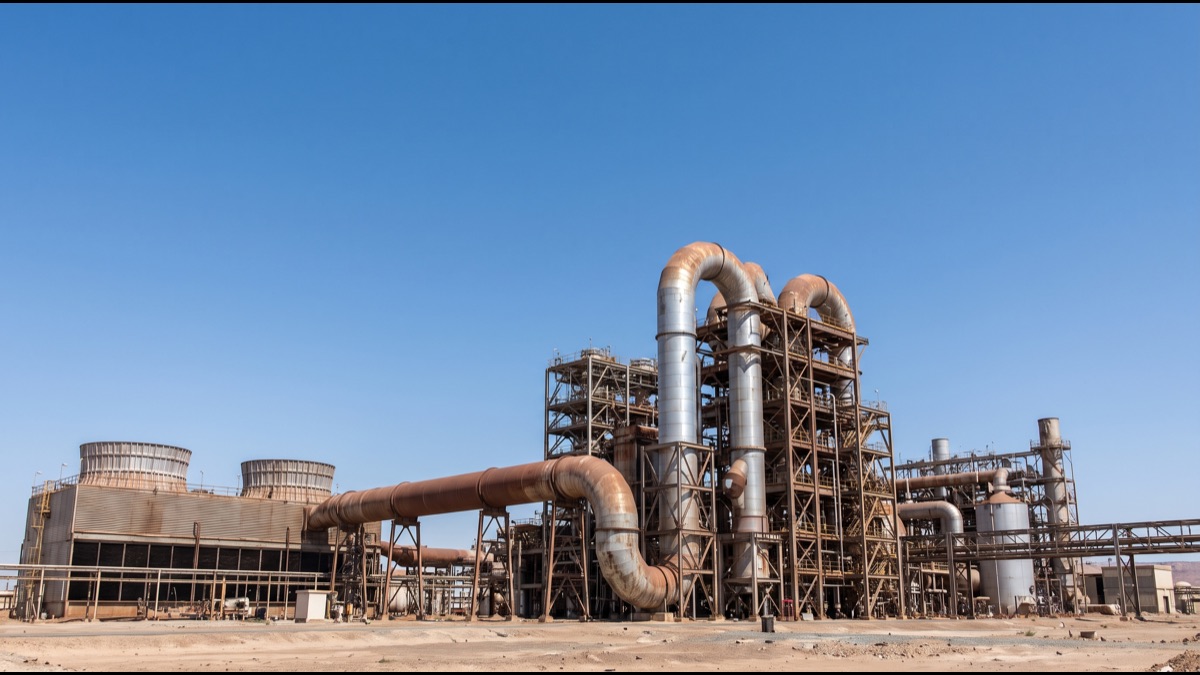
Carbon capture starts from a straightforward premise, that carbon dioxide already released into a flue gas stream or diffused through the open atmosphere can in principle be physically separated back out again, but the practical chemistry, energy cost, and infrastructure required to do this at meaningful scale are considerably more demanding than the premise suggests.
Why Capturing Carbon Is Chemically Harder Than It Sounds
Carbon dioxide is chemically stable and, outside a concentrated industrial flue stream, extremely dilute, making up a small fraction of a percent of ordinary air, which means separating it from everything else it is mixed with requires overcoming a genuine thermodynamic penalty rather than simply filtering it out mechanically.
The more dilute the CO2 source, the more energy the separation process generally requires per tonne captured, which is the underlying reason capturing CO2 from a concentrated industrial flue gas is considerably more energy-efficient than pulling the same amount directly from the open atmosphere.
How Post-Combustion Capture Actually Separates CO2
The most widely deployed approach, post-combustion capture, passes flue gas from a power plant or industrial facility through a liquid chemical solvent, typically an amine compound, that selectively binds to CO2 molecules while allowing other gases in the stream to pass through largely unaffected.
The CO2-rich solvent is then moved to a separate vessel and heated, which breaks the chemical bond and releases a concentrated stream of CO2 gas while regenerating the solvent for reuse, a cycle that repeats continuously as flue gas keeps flowing through the system.
This approach has the practical advantage of being retrofittable onto existing power plants and industrial facilities without redesigning the core combustion process itself, which is part of why it remains the dominant commercial technology despite the solvent regeneration step being genuinely energy-intensive.
How Pre-Combustion and Oxyfuel Approaches Differ
Pre-combustion capture takes a different route, converting fuel into a mixture of hydrogen and CO2 before combustion actually happens, then separating the CO2 out of that mixture while burning the resulting hydrogen-rich gas for energy, an approach generally requiring a facility designed around it from the start rather than a simple retrofit.
Oxyfuel combustion burns fuel in nearly pure oxygen rather than ordinary air, producing a flue gas that is mostly CO2 and water vapour rather than being diluted by the nitrogen that makes up most of ordinary air, which considerably simplifies the subsequent separation step at the cost of the energy needed to produce that pure oxygen beforehand.
Each of these three broad approaches trades a different combination of retrofit cost, energy penalty, and plant redesign requirement, which is why the specific approach a given industrial facility adopts depends heavily on whether it is a new build or an existing plant being modified.
How Direct Air Capture Pulls CO2 From Open Air
Direct air capture uses large fans to draw ambient air across a chemical sorbent, either a liquid solvent or a solid material, that binds CO2 despite its extremely low concentration in open air, then applies heat or a pressure change to release the captured CO2 as a concentrated stream, much like post-combustion capture but starting from far more dilute source air.
Because atmospheric CO2 concentration is so much lower than in a concentrated flue gas stream, direct air capture requires processing a considerably larger volume of air per tonne of CO2 captured, which is the fundamental reason it remains meaningfully more expensive per tonne than capturing CO2 directly at an industrial source.
The genuine appeal of direct air capture is that it can in principle be sited anywhere near suitable storage rather than needing to be located at a specific emissions source, and it can address emissions that have already dispersed into the atmosphere rather than only preventing new emissions from a specific facility.
Why Capture Consumes So Much Energy
Every capture pathway shares a common thermodynamic burden, that separating one gas from a mixture and concentrating it always requires energy input, a physical constraint rather than merely an engineering limitation that better technology can eventually eliminate entirely.
Regenerating the chemical solvents used in post-combustion and direct air capture specifically requires substantial heat, and this energy demand, sometimes called the energy penalty, can meaningfully reduce the net output of a power plant retrofitted with capture equipment if that heat is drawn from the plant's own generation.
Researchers continue developing solvents and solid sorbents that require less energy to regenerate, alongside process designs that recover and reuse waste heat within the capture system itself, both of which incrementally reduce this energy penalty without eliminating it outright.
A useful way to think about the energy penalty is as a genuine trade-off rather than a fixable engineering bug: a power plant fitted with capture equipment burns somewhat more fuel to produce the same amount of usable electricity, because part of its output is effectively diverted to running the capture and compression process, and that trade-off shows up directly in the plant's overall efficiency figures.
How Captured CO2 Gets Compressed and Transported
Once separated, CO2 gas is compressed to a dense, liquid-like supercritical state, which dramatically reduces its volume and makes it practical to move through pipelines in a manner broadly similar to how natural gas is transported, though at different pressure and temperature conditions specific to CO2's own physical properties.
Existing CO2 pipeline networks, built up over decades primarily to supply enhanced oil recovery operations, already move meaningful volumes of compressed CO2 across long distances in several regions, providing a template for the considerably larger pipeline infrastructure that broader carbon capture deployment would require.
Where pipeline infrastructure does not yet exist, captured CO2 can also be transported by ship in a manner similar to liquefied natural gas, an option receiving growing attention specifically for connecting industrial emission sources to suitable offshore storage sites that lack direct pipeline access.
How Geological Storage Actually Keeps CO2 Underground
Permanent storage typically involves injecting compressed CO2 deep underground into porous rock formations, commonly depleted oil and gas reservoirs or saline aquifers, capped by an impermeable layer of rock that prevents the injected CO2 from migrating back upward toward the surface over geological time.
Suitable storage sites are identified through extensive geological surveying to confirm both adequate porous rock capacity to hold the injected volume and a genuinely impermeable cap rock layer above it, since a site lacking either characteristic risks the CO2 either failing to stay contained in sufficient volume or slowly escaping back toward the surface.
Over time, injected CO2 also undergoes gradual chemical and physical trapping mechanisms within the rock formation itself, including dissolving into surrounding groundwater and, over much longer timescales, reacting with minerals in the rock to form stable solid carbonate compounds, both of which further reduce the practical likelihood of the stored CO2 migrating.
Why Monitoring Storage Sites Matters So Much
Regulatory frameworks in jurisdictions that permit geological CO2 storage generally require extended monitoring of injection sites, using techniques including seismic surveying and pressure measurement, specifically to confirm the stored CO2 is behaving as predicted and has not begun migrating outside the intended storage formation.
This monitoring obligation typically continues for decades after injection has finished, reflecting the genuinely long timescale over which storage permanence needs to be demonstrated before liability for the stored CO2 can reasonably be considered to have been fully discharged.
Documented storage failures have been rare relative to the number of active injection projects, but the monitoring requirement itself reflects an appropriately cautious regulatory approach to a technology where the consequence of an undetected leak, while not acutely dangerous at typical concentrations, would meaningfully undermine the climate purpose the storage was meant to serve.
How Enhanced Oil Recovery Complicates the Climate Story
A substantial share of historically captured CO2 has been used for enhanced oil recovery, injecting CO2 into a partially depleted oil reservoir to help push additional oil toward extraction wells, a technique that has long been commercially profitable independent of any climate motivation.
This creates a genuinely complicated climate accounting question, since the injected CO2 does end up stored underground, but the additional oil the injection helps extract will itself eventually be burned and release further CO2 emissions, meaning the net climate benefit of enhanced-oil-recovery-linked storage is considerably more contested than storage with no associated fossil fuel extraction.
Newer storage projects increasingly emphasise dedicated geological storage with no enhanced oil recovery component specifically to avoid this accounting complication, though enhanced oil recovery remains the historically dominant commercial use case that helped fund early CO2 pipeline and injection infrastructure.
What Carbon Utilisation Actually Does With Captured CO2
Beyond underground storage, captured CO2 can be used as a feedstock for various commercial products, including carbonation for beverages, certain plastics and chemical processes, and emerging construction materials that chemically incorporate CO2 into cured concrete during manufacturing.
Most current utilisation pathways consume a genuinely small fraction of captured CO2 relative to permanent storage, and some utilisation applications, such as beverage carbonation, ultimately release the CO2 back to the atmosphere relatively quickly rather than sequestering it long-term.
Utilisation in durable materials like cured concrete offers a longer-lasting form of carbon storage than short-cycle applications, and continues attracting research and early commercial investment specifically because it can generate revenue from captured CO2 rather than treating storage purely as a cost.
Why Cement and Steel Are Especially Hard to Decarbonise
Cement and steel production both release substantial CO2 through the core chemistry of the manufacturing process itself, not merely from the energy used to power the factory, meaning switching to renewable electricity alone cannot eliminate their emissions the way it can for many other industrial processes.
Cement manufacturing releases CO2 when limestone is chemically broken down at high temperature to produce clinker, an unavoidable chemical reaction independent of the fuel used to generate that heat, which is why carbon capture is considered a genuinely necessary component of deep cement industry decarbonisation rather than merely one option among several.
Steel production using traditional blast furnaces likewise releases CO2 through the chemical reduction of iron ore, though newer approaches using hydrogen instead of carbon as the reducing agent are emerging as an alternative pathway that avoids the CO2-generating reaction rather than needing to capture it after the fact.
Gulf economies with large cement and steel sectors, alongside significant existing oil and gas pipeline expertise, have specifically identified carbon capture as a strategically relevant technology precisely because the region already has geological formations and engineering capacity suited to large-scale CO2 injection, even where the broader climate debate about capture's overall role remains unsettled.
What Determines Whether a Capture Project Is Economically Viable
The economics of a specific capture project depend heavily on the concentration of CO2 in the source stream, since more concentrated sources such as ethanol fermentation or natural gas processing require considerably less energy and cost to capture than a coal power plant's more dilute flue gas.
Government incentives, including tax credits calculated per tonne of CO2 permanently stored, have become a genuinely significant factor in project viability in several jurisdictions, meaningfully shifting the economics of projects that would not otherwise be commercially competitive against simply emitting the CO2 without capture.
Proximity to suitable geological storage or an existing CO2 pipeline network also substantially affects project cost, since transporting captured CO2 long distances to reach suitable storage adds meaningful expense that can determine whether a specific project proceeds at a specific industrial site.
Why Critics Question Carbon Capture's Climate Role
Critics of carbon capture generally raise two related concerns, that the technology can be used to justify continued operation of fossil fuel infrastructure that might otherwise be retired, and that capture rates in practice have sometimes fallen short of the levels projects were designed and marketed to achieve.
Proponents respond that for genuinely hard-to-decarbonise sectors like cement and steel, and for managing existing atmospheric CO2 through direct air capture, some form of carbon capture is difficult to substitute entirely with alternative approaches, making the debate less about whether the technology has any role and more about how large a role it should play relative to reducing emissions in the first place. A smaller but recurring criticism concerns measurement rigour: because capture rate is usually reported as a percentage of a facility's own CO2 stream rather than independently verified against total plant emissions including any upstream leakage, comparing claimed performance across different projects and operators is genuinely harder than the headline percentage figures suggest.
Carbon capture works by chemically separating CO2 from a gas stream, whether concentrated industrial flue gas or dilute open air, then compressing, transporting, and either permanently storing or commercially using that concentrated CO2, with the entire pathway constrained throughout by the genuine thermodynamic energy cost of separating and concentrating a gas.
That underlying energy cost, more than any single engineering hurdle, is what continues to shape where capture technology gets deployed first, favouring concentrated industrial sources and hard-to-decarbonise sectors over broad atmospheric cleanup, while ongoing research into cheaper solvents, sorbents, and storage monitoring gradually narrows the gap between what the technology can achieve today and the scale climate targets ultimately call for.
Sources
- Wikipedia — overview of carbon capture and storage technology
- International Energy Agency — global data and analysis on carbon capture deployment
- Intergovernmental Panel on Climate Change — scientific assessment of carbon capture's role in climate mitigation
- U.S. Department of Energy — research and project data on carbon capture and storage
- Global CCS Institute — industry tracking of carbon capture and storage projects worldwide
FAQ
Does carbon capture actually remove CO2 from the atmosphere?
Most current large-scale capture targets concentrated CO2 in flue gas before it reaches the atmosphere; direct air capture removes it from ambient air but remains far more energy-intensive and smaller in scale.
Is captured carbon stored permanently?
When injected into suitable deep geological formations and properly monitored, storage is generally considered effectively permanent on human timescales, though long-term monitoring obligations typically continue for decades.
Why does carbon capture use so much energy?
Separating a dilute gas from a mixture and then compressing it for transport and injection is thermodynamically demanding, and regenerating the chemical solvents used to bind the CO2 requires substantial heat.
Is captured CO2 always injected underground?
No — some captured CO2 is used commercially, including in enhanced oil recovery, beverage carbonation, and emerging construction materials, though the largest climate benefit comes from permanent geological storage.
Can carbon capture make fossil fuel plants climate-neutral?
Even well-run capture systems typically remove roughly 85 to 95 percent of a plant's CO2 rather than all of it, and upstream emissions from fuel extraction are generally not addressed by the capture system itself.
About the Author
We reference Wikipedia, International Energy Agency, Intergovernmental Panel on Climate Change, U.S. Department of Energy, Global CCS Institute to explain the background and current understanding of this topic.
Loved This Article?
Share it on WhatsApp → Share it on WhatsApp
Get more guides in your inbox — Subscribe to our newsletter for weekly surprising stories from Egypt, Saudi Arabia, Dubai, and beyond.