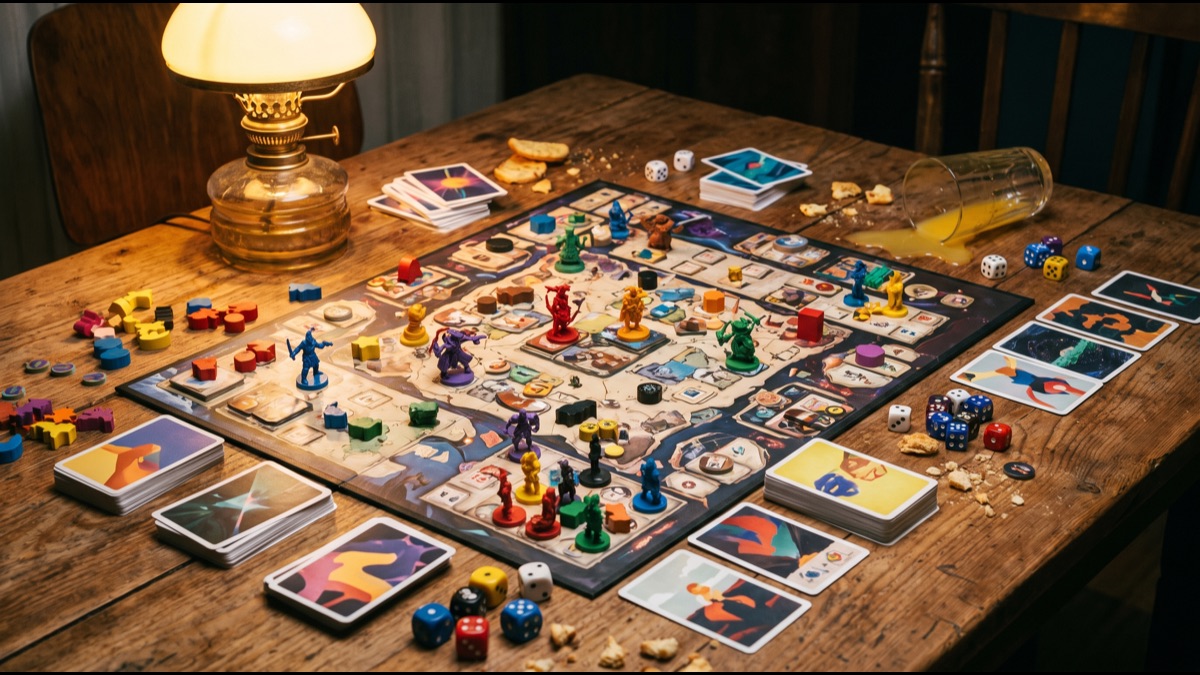
Almost every board game that reaches a shelf began as an idea that did not work. A designer's first prototype, however clever the central concept, is usually unbalanced, confusing, or simply not fun once real players sit down with it, and the gap between that first version and a released game is filled almost entirely by a long, unglamorous process of testing, breaking, and rebuilding the mechanics.
That process is largely invisible to the eventual buyer, who sees only a finished box with clean rules and balanced components. Understanding what actually happens between the first prototype and the final print run explains why some games take years to reach a table, why a design can change dramatically after its first showing, and why even well-funded projects sometimes fail late in development despite strong initial reception.
Why a Fun Idea and a Working Game Are Not the Same Thing
A game concept can sound compelling in a pitch document and still fail completely once it is played, because a rulebook description cannot capture how a mechanic actually feels under real decision pressure, with real turn order, and with players who bring strategies the designer never anticipated.
Designers commonly discover that a mechanic they considered central to the experience turns out to be tedious, that a supposedly balanced resource system rewards one strategy so heavily that alternatives become pointless, or that a clever rule interacts badly with another rule in a way that only becomes visible once both are tested together rather than considered in isolation.
This is why professional designers treat the first prototype as a question rather than an answer. Its purpose is not to demonstrate a finished idea but to generate the specific failures that reveal what actually needs fixing, and experienced designers generally distrust any prototype that plays smoothly on its very first outing.
What Blind Playtesting Actually Reveals
Blind playtesting means handing a prototype and its rulebook to a group with no designer present to explain, clarify, or nudge play in the intended direction, and it is considered the single most revealing stage of the entire process because it is the only test that replicates how a real customer will actually encounter the game.
When the designer is in the room, players unconsciously defer to explanations and corrections that will not exist once the game ships, which means a session that seems to go smoothly with the designer present can collapse entirely when the same group tries to learn it from the printed rules alone.
Blind tests routinely surface problems that in-person sessions never do: rules that seem clear to the person who wrote them but are genuinely ambiguous to a new reader, turn sequences that get misremembered without correction, and entire mechanics that quietly get skipped because no one realized they were missing a step.
How Designers Separate Fun From Balance
A mechanically balanced game, in which no single strategy dominates and outcomes are reasonably close across skilled play, is not automatically an enjoyable one, and designers have to evaluate these two qualities somewhat separately even though they interact throughout development.
A perfectly balanced game can still be tedious if it forces repetitive decisions or drags on well past the point where the outcome feels meaningfully undecided, while a genuinely fun interaction can survive in a design even if it is not perfectly balanced, provided the imbalance does not consistently determine the winner before the game is over.
Experienced designers typically track both dimensions across sessions using separate notes, asking testers not only who won but which moments produced visible engagement, tension, or laughter, since those emotional signals are considered at least as important as the numerical spread of final scores.
Why Iteration Cycles Stay Deliberately Short
Rather than testing a prototype extensively and then making one large set of revisions, most designers deliberately keep each iteration cycle short, changing only a handful of variables between sessions so that any resulting shift in play can be attributed to a specific, identifiable cause.
Changing too many rules at once between tests makes it nearly impossible to know which adjustment actually fixed a problem, or worse, whether a new adjustment introduced a different problem that happens to be masked by an unrelated change, which is why disciplined designers resist the temptation to fix everything they noticed in a single pass.
This incremental approach means a single mechanic can go through dozens of small revisions over the course of development, each tested independently, with the designer keeping a running log of what was changed and why so that a fix that seems to work can later be traced back if problems resurface.
How Publishers Recruit Outside Playtest Groups
Once a design has stabilized enough to survive contact with strangers, publishers typically expand testing well beyond the designer's personal circle, recruiting dedicated playtest groups, gaming clubs, convention demo tables, and increasingly online communities willing to try unreleased prototypes in exchange for early access and feedback credit.
These groups are deliberately chosen for variety rather than familiarity, since a design that only ever gets tested by experienced strategy gamers can end up calibrated for a much narrower audience than the one the publisher actually intends to sell to, missing problems that would be obvious to a more casual or family-oriented group.
Publishers commonly run parallel test tracks with different player profiles, comparing how a mechanic that delights experienced gamers lands with newcomers, and treating a significant gap between those two reactions as a signal that the design needs simplifying, additional guidance, or a genuinely different onboarding structure.
What Data Gets Tracked During a Session
Beyond simply asking testers whether they enjoyed a session, structured playtesting captures specific, comparable information across sessions: total playtime against the target, the point in the game where a winner became statistically likely, how often each available strategy was chosen, and where in the rules confusion or rereading occurred.
This quantitative layer matters because subjective enjoyment is notoriously unreliable as a sole signal, since a group can report having a great time while a game is nonetheless running twice as long as intended or being effectively decided in the opening moves, both of which are real design problems that pure enjoyment ratings can mask.
Many designers also track a simple metric sometimes called the groan test, the frequency of audible frustration, confusion, or rules disputes during a session, treating a rise in that count between otherwise similar sessions as an early warning sign worth investigating even before players articulate what specifically bothered them.
Why a Strong First Impression Can Still Mislead
A prototype that produces genuine excitement in its first few sessions can still fail later testing, because novelty itself generates enjoyment independent of whether the underlying mechanics hold up, and experienced designers treat early enthusiasm with some caution precisely for this reason.
The real test of a mechanic is not the first play but the fifth or tenth, once the initial novelty has worn off and players start to see the underlying structure clearly enough to notice repetitive patterns, dominant strategies, or decision points that turn out to have only one sensible answer once thought through.
This is why serious playtesting programs deliberately schedule repeat sessions with the same testers over weeks or months rather than relying on one-off reactions, since a design that still produces genuine tension and interesting decisions on a tenth playthrough has cleared a bar that a merely novel first impression cannot substitute for.
How Rules Ambiguity Gets Caught Before Print
A rulebook that seems perfectly clear to its author is frequently ambiguous to a reader encountering the game for the first time, since the author already knows the intended interpretation and cannot fully read the text as someone without that context would, which is exactly the blind spot blind playtesting is designed to expose.
Publishers commonly employ a separate rules-editing pass distinct from design testing, in which an editor unfamiliar with the game attempts to teach it purely from the written rules, flagging every point where they had to guess, reread, or invent an interpretation that the designer had not explicitly specified.
Genuine rules disputes discovered during testing get resolved by rewriting the offending passage, adding an explicit example, or in some cases changing the underlying mechanic itself if the ambiguity turns out to stem from a rule that was always going to be difficult to state clearly regardless of the wording chosen.
Why Component Count and Manufacturing Cost Shape Design
Every physical component in a board game, from cards and tokens to dice and custom-molded pieces, carries a real manufacturing and shipping cost that constrains what a design can ultimately include, meaning mechanics that work beautifully in an unlimited prototype sometimes have to be simplified or cut once production budgets are considered.
This economic pressure is not simply an obstacle to good design; it also frequently forces genuinely useful simplification, since a designer asked to achieve the same strategic depth with fewer component types is sometimes pushed toward a more elegant mechanic than the original, more component-heavy version would have produced.
Late-stage playtesting therefore often runs in parallel with cost analysis, testing whether a proposed component reduction preserves the experience the designer intends, and publishers will frequently reject a design change that saves money if testing shows it noticeably damages the core gameplay loop that made the title appealing in the first place.
How Digital Prototypes Changed the Testing Process
Physical prototyping traditionally limited how many sessions a design could realistically go through, since assembling and reassembling paper components by hand is slow, but digital prototyping tools built for tabletop game development have substantially widened how much testing a design can absorb before a single physical copy is printed.
Digital versions also make it practical to recruit remote testers scattered across different time zones and player backgrounds, widening the diversity of the test pool well beyond what any single local playtest group could offer, while automatically logging turn times, move sequences, and rule lookups that would otherwise require a human observer taking notes.
This shift has not eliminated physical prototyping, since some tactile and spatial elements of tabletop play genuinely do not translate to a screen, but most serious modern development pipelines now combine both, using digital testing for rapid early iteration and reserving physical sessions for the stages where the tactile experience itself is being evaluated.
Why Some Games Go Through Hundreds of Iterations
Designers of well-regarded strategy games have publicly described development processes running into hundreds of distinct playtested versions over periods of several years, a scale that surprises many players who assume a finished game reflects a single strong original concept rather than an extended process of incremental correction.
This is particularly common for games built around a small number of tightly interacting systems, since changing any one system to fix a problem can shift the balance of every other system it touches, requiring another full round of testing to confirm the fix did not simply relocate the imbalance somewhere less obvious.
Publishers generally accept this extended timeline as the cost of releasing a design that holds up under scrutiny, since a game rushed to market with unresolved balance problems tends to generate visible criticism quickly once a wider audience plays it far more times than any internal test group realistically could.
How Designers Test for Player Skill Variance
A mechanic that produces close, engaging games among evenly matched players can behave very differently when a highly experienced player faces a first-time one, and testing specifically for this skill variance matters because most games are sold to be played across exactly that kind of mismatch in ordinary social settings.
Designers deliberately construct mismatched test groups to check whether the game remains reasonably engaging for the less experienced player throughout, or whether the outcome effectively becomes predictable early once one player identifies an optimal strategy the other has not yet recognized, since the latter tends to produce a frustrating rather than a competitive experience.
Catch-up mechanics, randomization elements, and information-hiding rules are often adjusted specifically in response to this testing, aiming to preserve genuine strategic depth for experienced players while keeping the game from feeling effectively decided the moment a skill gap becomes apparent to everyone at the table.
Why Publisher Notes Differ From Player Reactions
Publisher-side development staff and ordinary playtesters frequently flag different problems in the same session, because publishers evaluate a prototype against commercial concerns including shelf appeal, box size, target audience fit, and how the game compares to competing titles already on the market, alongside the pure gameplay experience.
A mechanic that testers genuinely enjoy can still be cut or altered at the publisher's request if it requires a component type the publisher considers too expensive to include at the intended price point, or if it makes the rules explanation too long for the audience the game is being positioned toward.
Reconciling these two sources of feedback is a routine part of late-stage development, and designers who have worked with multiple publishers often describe this negotiation, rather than the underlying mechanical testing, as the part of the process most likely to visibly change a design between its playtested form and its final released version.
How Crowdfunding Reshaped Pre-Release Testing
The rise of crowdfunding as a route to market for tabletop games introduced a new testing pressure, since a campaign typically needs to demonstrate a compelling, largely finished experience to potential backers well before the traditional testing timeline would have concluded under a conventional publishing deal.
This has pushed many independent designers toward heavier public playtesting earlier in development, including open beta-style prototype releases and convention demo circuits specifically intended to generate visible enthusiasm and testimonial feedback that can be used in the eventual campaign, rather than testing conducted purely in private.
The tradeoff is that crowdfunded games sometimes lock in a design earlier than a traditionally published title would, under pressure to hit a stated campaign delivery date, which several notable crowdfunded releases have cited afterward as the reason a mechanic that later drew criticism was not caught or fixed before the printed edition shipped.
What Happens When a Game Fails Late-Stage Testing
Not every prototype survives the process. A design that reaches advanced testing and is found to have a fundamental, unfixable problem, such as a dominant strategy that cannot be balanced away without unraveling the rest of the system, is sometimes shelved entirely even after substantial investment of time and, in commercial contexts, real money.
More often, a late-stage failure results in a significant structural revision rather than outright cancellation, with a core mechanic being replaced while surrounding elements such as theme, components, and overall scope are preserved, effectively restarting the iteration cycle for the affected system while treating the rest of the design as validated.
The willingness to make this kind of late, painful revision, rather than shipping a design known to have unresolved problems simply because a release date is approaching, is widely regarded within the industry as one of the clearest practical differences between playtesting that genuinely improves a game and playtesting conducted mainly to generate marketing testimonials.
Across every stage of this process, from a designer's first rough prototype to a publisher's final production sign-off, the through-line is the same: a mechanic that sounds good on paper is treated as a hypothesis, not a conclusion, until it has survived repeated contact with players who were never told how it was supposed to work.
That discipline, more than any single clever rule, is what separates games that hold up to dozens of plays from ones that feel exciting once and forgettable afterward, and it is the reason the gap between a designer's first prototype and a game sitting on a shelf is measured, for serious titles, in years rather than weeks.
Sources
- Wikipedia — overview of game testing and playtesting methodology
- BoardGameGeek — community database and design discussion for tabletop games
- International Game Developers Association — professional body covering game design and development practice
- The Strong National Museum of Play — research and archival resource on game design history
FAQ
How many playtests does a typical board game go through before release?
It varies widely, but well-regarded strategy games have been reported to go through anywhere from dozens to several hundred distinct tested versions over periods of one to several years.
What is blind playtesting and why does it matter so much?
Blind playtesting means a group learns and plays the game from the rulebook alone, with no designer present to clarify — it is considered the most reliable way to catch confusing rules and mechanics that only work when the designer is there to explain them.
Does a fun first play mean a game design is finished?
Not reliably — novelty itself can generate enjoyment independent of whether the mechanics hold up, so designers generally treat repeat sessions with the same testers as a more meaningful test than a strong first impression.
Why do some games change significantly after crowdfunding campaigns start?
Crowdfunding often requires showing a largely finished design earlier than traditional publishing timelines allow, which can lock in mechanics before the full testing cycle a conventional deal would have included is complete.
What happens if a game fails testing late in development?
Outcomes range from a major mechanic being replaced while the rest of the design is kept, to the project being shelved entirely if the core problem cannot be fixed without unraveling the rest of the system.
About the Author
We reference Wikipedia, BoardGameGeek, the International Game Developers Association, and The Strong National Museum of Play to explain the background and current understanding of this topic.
Loved This Article?
Share it on WhatsApp → Share it on WhatsApp
Get more guides in your inbox — Subscribe to our newsletter for weekly surprising stories from Egypt, Saudi Arabia, Dubai, and beyond.