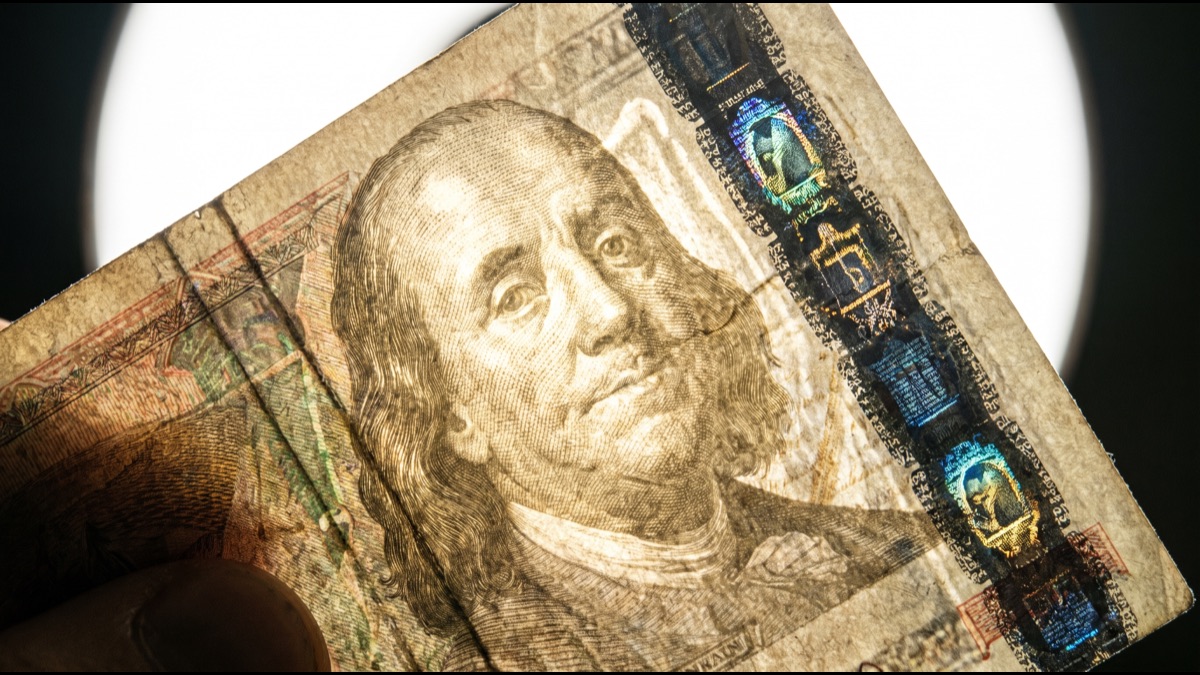
Hold a genuine banknote up to a decent color photocopy under normal room light, and at a glance the two can look almost indistinguishable. That resemblance is exactly the problem currency designers have spent centuries solving, and the solution is never a single trick but a deliberately layered stack of physical and optical features, each one chosen because it is expensive, slow, or technically difficult to reproduce outside a licensed mint.
Understanding how that stack actually works explains why a cashier tilts a note under a light, why some countries switched to plastic-feeling currency, and why the design of the money in your wallet quietly changes every decade or so even when the denomination stays the same.
Why Banknotes Need Layered Security at All
A single security feature, however clever, eventually gets reverse-engineered once enough counterfeit examples circulate and criminals study them closely, so central banks and mints deliberately combine features that fail in different ways for a forger: some require expensive specialized printing equipment, some require materials that are not sold to the public, and some are simply impossible to replicate through ordinary photocopying or home printing regardless of cost.
This layering also protects against different threat levels. A convenience-store cashier checking cash quickly needs an obvious, fast visual or tactile cue, while a bank's currency-processing machine can check far more subtle features like magnetic ink patterns or infrared responses that no untrained eye would ever notice.
The result is that a single genuine banknote typically carries somewhere between six and twenty distinct security features simultaneously, most of which the average person has never consciously registered even though they interact with them every time they hand over cash.
The Paper or Polymer Substrate Itself
Genuine currency paper is not ordinary paper at all. Most traditional banknote paper is made from cotton and linen fibers rather than wood pulp, giving it a distinctive crisp snap and texture that feels noticeably different from standard printer paper within a few seconds of handling, even before any printed design is examined.
This specialized substrate is manufactured by a very small number of licensed paper mills worldwide, several of which supply multiple countries' central banks under strict security protocols, and the raw material itself is simply not available for purchase by the general public or ordinary commercial printers.
An increasing number of countries have shifted to polymer substrate instead, a thin flexible plastic film that is significantly harder to tear, resistant to water and washing-machine cycles, and capable of holding an entirely different category of security feature that paper cannot support at all.
Watermarks and See-Through Registration
A traditional paper watermark is created during the papermaking process itself, not printed on afterward, by varying the thickness of the paper fibers so that a faint image becomes visible only when the note is held up to a light source, appearing as subtle shading rather than a printed line.
Because the watermark is embedded in the fiber structure rather than sitting on the surface, it cannot be reproduced by any printing or copying process, including high-resolution scanning, which is why it remains one of the most reliable checks available to an ordinary person without any special equipment.
A related feature called see-through registration prints a partial design on the front of the note and a complementary partial design on the back, engineered so precisely that the two halves align into a single complete image only when held up to light, a level of print registration accuracy that consumer printers cannot achieve.
Security Threads Woven Into the Note
A genuine security thread is a thin strip of plastic or metallic film embedded within the paper fibers during manufacturing rather than printed on top, and it typically appears as a continuous dark line running through the note when viewed against light, distinct from anything visible under ordinary room lighting.
Modern security threads have grown considerably more sophisticated than a simple embedded strip, with many now carrying microprinted text, color-shifting properties, or even tiny holographic elements built directly into the thread itself, layering multiple defenses into what looks like one modest visual feature.
Because the thread is physically woven into the paper structure rather than sitting on its surface, any attempt to simulate it by printing a dark line or gluing a strip onto counterfeit paper produces a visibly different texture and appearance under close inspection or light transmission.
Color-Shifting Ink and Optically Variable Devices
Certain ink formulations contain microscopic flakes of specialized pigment that reflect light differently depending on the viewing angle, causing a printed number or symbol to visibly shift from one color to another, commonly green to blue or gold to green, as the note is tilted back and forth.
This optically variable ink is manufactured by a handful of specialized chemical companies under tightly controlled distribution agreements with government mints, making the raw pigment itself essentially unobtainable for counterfeiting purposes regardless of how much money or equipment a forger has access to.
Standard color printers, including expensive professional models, print flat pigment colors that do not shift with viewing angle at all, meaning any convincing photocopy or scan of a color-shifting element will simply display a static, non-shifting version that fails the tilt test immediately.
Holograms and Foil Elements
Holographic strips and foil patches use microscopic diffraction gratings, precisely etched surface patterns far too fine to see individually, that bend and scatter light in specific controlled ways to produce an image that appears three-dimensional or that changes as the viewing angle shifts.
Producing an authentic-looking hologram requires access to specialized diffraction-grating manufacturing equipment that is not commercially available outside a small number of licensed security-printing suppliers, and even skilled counterfeiters attempting crude imitations typically produce visibly flatter, less precise optical effects under close inspection.
Many modern banknotes combine the hologram with other features in the same physical location, such as embedding microprinted text or a color-shifting element directly within the holographic foil itself, forcing a counterfeiter to defeat several distinct technical challenges simultaneously rather than just one.
Raised Intaglio Printing You Can Feel
Genuine banknotes are printed using an intaglio press, a technique that forces ink under extremely high pressure into engraved plates so deeply that the dried ink actually sits raised above the surface of the paper, producing a texture you can feel with your fingertips by running them lightly across the printed portrait or lettering.
This raised texture is a defining characteristic of legitimate currency printing that ordinary offset or digital printing, the methods available to virtually any counterfeiter, simply cannot replicate, since those processes deposit flat ink onto the paper surface rather than pressing it into raised ridges.
Central banks frequently design specific tactile elements, such as raised dots or distinctive patterns near a note's edge, specifically to help visually impaired users distinguish denominations by touch alone, a feature that doubles as an additional counterfeiting deterrent since it depends entirely on the intaglio process.
Microprinting Too Small to Photocopy
Microprinting embeds extremely small text, sometimes repeating a currency's name, a denomination, or a security phrase, into fine lines or decorative borders at a size far below what the unaided human eye can read directly, typically requiring a magnifying glass to confirm the text is legible rather than a blurred pattern.
The defining test of genuine microprinting is that it stays crisp and legible under magnification precisely because it was produced by specialized high-resolution security printing equipment, whereas any attempt to reproduce it through standard printing or photocopying collapses into an unreadable smudge once viewed at the same scale.
Because microprinting can be embedded almost anywhere on a note's design without disrupting the visual layout, mints frequently scatter it across multiple locations on a single banknote, multiplying the number of distinct verification points a counterfeiter would need to successfully replicate.
Ultraviolet and Infrared Features
Many banknotes incorporate ink or fibers that remain invisible under normal lighting but glow in specific colors when exposed to ultraviolet light, a property achieved through fluorescent compounds mixed into the ink or embedded as tiny colored fibers scattered through the paper itself during manufacturing.
Separately, some notes carry infrared-responsive elements that are entirely invisible to the human eye under any lighting condition but appear or disappear when scanned by specialized infrared-sensitive equipment, a feature primarily used by banks and cash-handling machines rather than everyday consumers.
These invisible-spectrum features are particularly valuable precisely because an ordinary counterfeiter has no straightforward way to even know whether their fake note passes such a check, since the relevant equipment and reference standards are restricted to financial institutions and law enforcement rather than being publicly documented.
Serial Numbers and Their Hidden Logic
Every genuine banknote carries a unique serial number printed using a distinct process from the rest of the note's design, often in a special ink that may itself be color-shifting or fluorescent, and following an internal numbering logic specific to the issuing central bank that helps distinguish authentic sequences from randomly generated fakes.
Financial institutions maintain records connecting serial number ranges to specific print runs, paper batches, and printing facilities, allowing investigators to trace a suspicious note back to information about when and where it was supposedly produced, and to flag inconsistencies that a counterfeiter attempting to fabricate a plausible-looking number would be unlikely to know about.
Duplicate serial numbers appearing on multiple notes in circulation is itself a red flag banks specifically screen for, since legitimate printing processes are tightly controlled to guarantee that no two genuine notes ever share an identical serial number within the same currency.
Why Polymer Notes Are Spreading Worldwide
Beyond durability, polymer substrate enables an entirely distinct security feature category unavailable to paper currency: a genuinely transparent window built directly into the note itself, through which the background is visible, often incorporating additional printed or embossed elements that would be effectively impossible to fake using an opaque paper substitute.
Several countries that pioneered polymer banknotes reported measurable drops in counterfeiting rates within a few years of transitioning, driven partly by the transparent window feature and partly by the general unfamiliarity of casual counterfeiters with polymer printing techniques compared to the far more widely understood paper printing process.
The transition is not universal or without tradeoffs, since polymer notes can behave differently in extreme heat, tend to stick together in certain climates without specialized coatings, and require central banks to invest in entirely new printing infrastructure rather than adapting existing paper-based production lines.
How Retailers and Banks Actually Check Notes
Ordinary retail cashiers are typically trained to perform a quick combination check often summarized as feel, tilt, and look: feeling for the raised intaglio texture, tilting the note to observe color-shifting ink or holographic movement, and looking for the watermark against available light, a process that takes only a few seconds once practiced.
Many retail environments supplement this manual check with an ultraviolet counterfeit-detection pen or lamp, which reacts differently to the chemical composition of genuine currency paper compared to ordinary printer or photocopy paper, though this method catches only certain categories of low-effort counterfeits rather than sophisticated forgeries.
Banks and cash-processing centers use far more rigorous automated equipment capable of simultaneously checking magnetic ink patterns, infrared responses, precise physical dimensions, and paper density, screening large volumes of currency at speeds no human inspection could match while flagging suspicious notes for manual investigation.
Why Designs Get Refreshed Every Few Years
Security features that were genuinely difficult to reproduce a decade ago can become achievable with consumer-grade equipment as printing, scanning, and materials technology generally improves over time, meaning a currency design's effective security naturally degrades even without any specific new counterfeiting technique being developed against it.
Central banks typically monitor global counterfeiting trends and technological capability continuously, planning design refreshes on a rolling schedule of roughly seven to fifteen years depending on the currency, incorporating newly developed security features that were not commercially feasible when the previous design was issued.
A design refresh also allows central banks to phase out any specific vulnerability discovered in the field, since publicized instances of a particular counterfeiting method succeeding against a specific feature create strong pressure to address that weakness in the next printing cycle rather than waiting for a scheduled full redesign.
The Arms Race Between Mints and Counterfeiters
Currency security exists as a continuous technological competition rather than a solved problem, with mints developing new features specifically in response to demonstrated counterfeiting capability, and sophisticated criminal operations in turn investing significant resources into defeating whichever features currently protect the highest-value denominations in wide circulation.
Most successful large-scale counterfeiting operations historically required either state-level resources, access to specialized printing equipment through illicit channels, or insider knowledge from someone previously employed within legitimate currency production, since the layered feature combinations described above are genuinely difficult for an independent small-scale operation to replicate convincingly.
International cooperation between central banks, law enforcement agencies, and currency-printing security consortiums has become increasingly important precisely because counterfeiting operations and the criminal networks distributing fake currency frequently operate across national borders rather than remaining confined to a single country's jurisdiction.
What This Means for Everyday Cash Users
For most people handling cash in ordinary daily transactions, the practical takeaway is straightforward: the feel-tilt-look check genuinely works for the overwhelming majority of counterfeit attempts, since low-effort fakes generally fail at least one of those checks within seconds, and taking the few extra seconds to check higher-denomination notes received from unfamiliar sources is a reasonable habit rather than excessive caution.
Businesses handling significant cash volumes benefit from investing in basic detection tools like ultraviolet lamps and staff training, since the cost of occasionally accepting a sophisticated counterfeit is generally far lower than the operational cost of aggressively rejecting genuine currency due to unfamiliarity with legitimate security features.
Ultimately, the layered security stack built into modern currency reflects a deliberate design philosophy: no single feature needs to be unbreakable, because a forger attempting to convincingly replicate paper composition, watermarks, security threads, color-shifting ink, holograms, raised printing, microprinting, and invisible-spectrum elements simultaneously faces a combined technical and financial barrier that remains, for now, largely prohibitive outside state-level counterfeiting operations.
Sources
- Wikipedia — overview of banknote design and security feature terminology
- Bank for International Settlements — cross-country central bank reference on currency issuance
- European Central Bank — public documentation on euro banknote security features
- U.S. Federal Reserve — public currency education and counterfeit-detection resources
- Reserve Bank of Australia — reference on polymer banknote technology and adoption
FAQ
What is the single most reliable way to check if a banknote is genuine?
Tilting the note to see the color-shifting ink and holographic strip move is generally the fastest reliable check, since these are the hardest features for counterfeiters to reproduce cheaply.
Why do some countries use polymer notes instead of paper?
Polymer substrate is harder to tear, survives washing machines and humidity far better, and allows a transparent window security feature that is extremely difficult to fake on paper.
Do banknote scanners at retail stores actually catch counterfeits?
UV and infrared scanners catch many common fakes by checking specific ink and fiber responses, but sophisticated counterfeits can sometimes pass basic retail scanners, which is why cashiers are also trained on tactile and visual checks.
Why do banknote designs change every few years?
Central banks periodically upgrade security features because counterfeiting technology improves over time, and an older design that was secure a decade ago may now be reproducible with consumer-grade printers and scanners.
Can microprinting be read without a magnifying glass?
No — genuine microprinting is deliberately too small to read with the naked eye but stays crisp under magnification, while photocopied or low-quality counterfeit versions typically blur into an unreadable smudge at the same scale.
About the Author
We reference Wikipedia, the Bank for International Settlements, the European Central Bank, the U.S. Federal Reserve, and the Reserve Bank of Australia to explain the background and current understanding of this topic.
Loved This Article?
Share it on WhatsApp → Share it on WhatsApp
Get more guides in your inbox — Subscribe to our newsletter for weekly surprising stories from Egypt, Saudi Arabia, Dubai, and beyond.